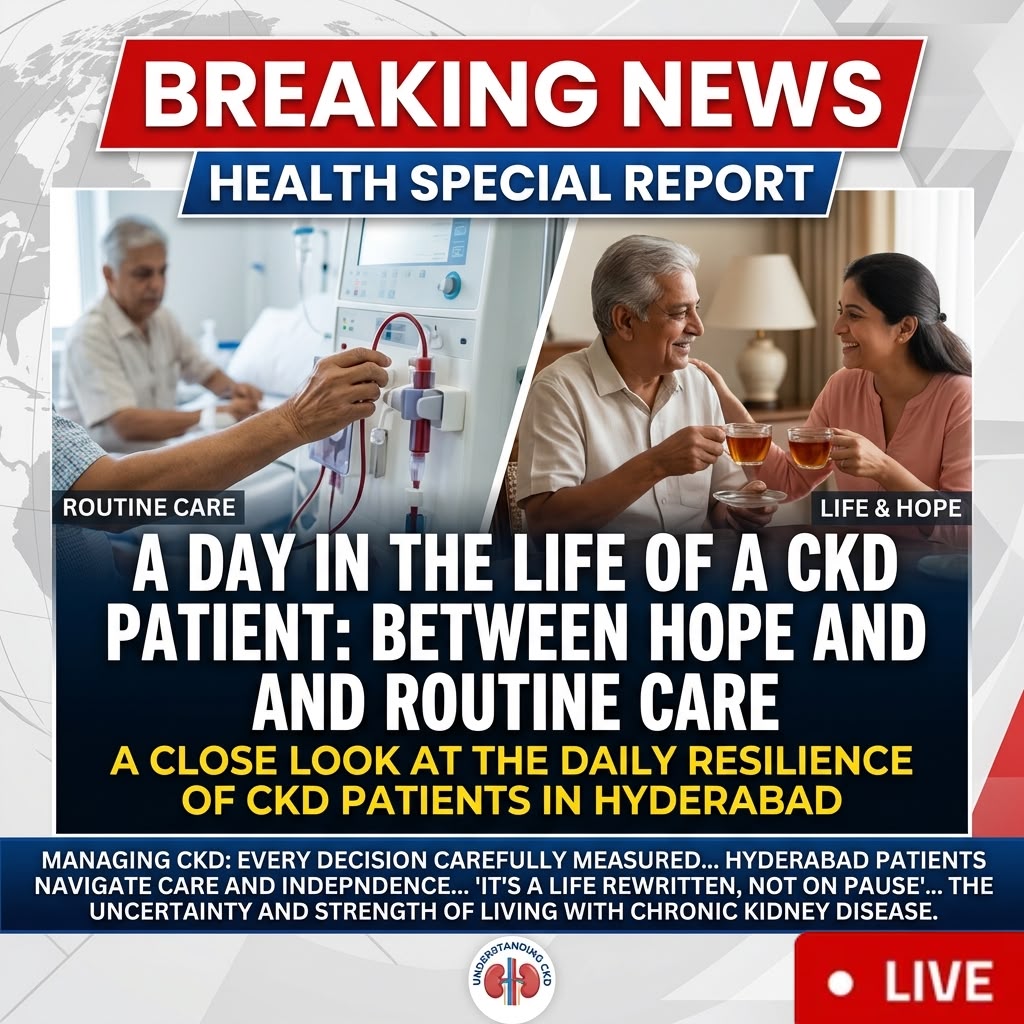
A Day in the Life of a CKD Patient: Between Hope and Routine Care
For most people, a day moves with little thought—meals are eaten when hungry, water is sipped freely, plans are made and changed without hesitation. But for someone living with Chronic Kidney Disease (CKD), even ordinary moments carry quiet decisions. Every glass of water, every bite of food, every hour of energy is measured more carefully than time itself.
In a fast-growing city like Hyderabad, where hospitals are advanced and life outside moves quickly, CKD patients live in a parallel rhythm—one shaped not by speed, but by discipline, monitoring, and endurance.
It is not a life on pause. It is a life carefully rewritten.
Morning: Listening to the Body Before the World Wakes
The day often begins early, sometimes before sunrise. Not because of work or habit, but because the body demands attention.
CKD patients wake up by quietly scanning themselves—swelling in the feet, dryness in the mouth, fatigue that lingers from the previous day, or changes in blood pressure readings. These small signals matter more than alarms or calendars.
Morning medicine comes first. Tablets for blood pressure control, phosphate management, vitamin balance, and other supporting treatments become part of daily identity. There is no skipping, no forgetting—only routine.
Breakfast is not spontaneous. It is planned, measured, and repeated with caution. Salt is restricted. Protein is calculated. Fluids are carefully limited.
“I don’t eat without thinking first,” shares a 52-year-old patient from Hyderabad undergoing long-term treatment. “It’s not about craving anymore. It’s about balance.”
Even food, something once effortless, becomes a quiet responsibility.
Midday: The World of Machines and Maintenance
For many patients, midday is defined by dialysis schedules.
Inside treatment rooms, machines take over what the kidneys can no longer do—filtering waste, balancing electrolytes, and maintaining internal stability. The process is routine, but never fully easy.
Dialysis sessions often stretch for hours. Patients sit still, connected to machines that hum steadily in the background. Time feels different here—measured in cycles of filtration rather than minutes.
Fatigue often follows. Some feel drained immediately after, others need hours of rest before they feel steady again.
Yet within this clinical space, something unexpected often develops: familiarity. Nurses, technicians, and fellow patients become part of an unspoken support system.
“There’s comfort in routine,” one patient says softly. “We all understand what the other person is going through. No need to explain.”
It is a quiet community built not by choice, but by shared experience.
Afternoon: The Weight of Stillness
Afternoons are often the most difficult—not because of activity, but because of its absence.
After dialysis or medical appointments, the body slows down. Energy dips sharply. Even small movements can feel heavier than usual. Walking to another room, preparing a light snack, or focusing on a conversation may require effort.
CKD affects the entire system, not just the kidneys. Muscle weakness, reduced stamina, and persistent tiredness become part of daily life.
But there is also emotional stillness here. Once the medical tasks are done for the day, thoughts often settle into quieter spaces—concerns about tomorrow’s energy, upcoming reports, or the long-term nature of the illness.
Doctors often remind patients that this phase of stability is also progress. “CKD management is about control, not cure in the short term,” says a nephrology specialist. “Maintaining function is a success in itself.”
It is a different definition of improvement—one measured in stability rather than change.
Evening: Small Returns to Normal Life
Evenings bring a soft shift. The intensity of the day eases slightly, and life outside medical routines begins to reappear.
Families gather for dinner. Conversations move away from test results and hospital visits. If energy allows, short walks or sitting outdoors becomes part of the evening rhythm.
But discipline remains constant. Fluid intake is still limited. Medications are taken on time. Diet restrictions continue quietly in the background.
For those who still work, evenings may be the only window for professional life. Many adjust to reduced hours or flexible roles, balancing health with financial needs.
Caregivers play an essential role here—often unnoticed but deeply involved. They prepare meals suited to restrictions, manage appointments, and offer emotional grounding when fatigue or worry becomes heavy.
In many households, CKD becomes a shared responsibility rather than an individual burden.
The Emotional Landscape: Quiet but Constant
Beyond the physical routines lies something harder to measure—emotional weight.
CKD brings uncertainty. It changes how people plan years, months, and even days. It introduces dependence on treatment and regular monitoring. Anxiety can surface quietly, even on stable days.
But alongside this, many patients describe something unexpected: a deeper awareness of small, steady moments.
A permitted cup of tea. A stable report. A smooth dialysis session. A day without complications.
“These things feel small to others,” a patient says, “but for us, they feel like victories.”
Life becomes less about what is lost and more about what remains steady.
Hope Within Structure
Medical advancements have significantly changed the outlook for CKD patients. Improved dialysis technology, early detection methods, and better disease management have allowed many to live longer and more stable lives.
Doctors emphasize that CKD is not a sudden collapse—it is a condition that responds to consistent care. With proper monitoring, diet control, medication, and lifestyle adjustments, patients can maintain quality of life for years.
Hope, in this context, is not dramatic. It is routine. It is consistency. It is showing up for treatment, again and again.
A Life Rewritten, Not Reduced
A day in the life of a CKD patient is not defined only by restriction. It is defined by adaptation.
Schedules are rebuilt around treatment. Diets are redesigned with precision. Energy is respected instead of assumed. Life becomes more deliberate, but not less meaningful.
There is hardship, yes—but also resilience that grows quietly over time.
One patient captures it simply: “I don’t live the life I used to. But I still live my life.”
And in that quiet sentence lies the reality of CKD—not as an ending, but as a different way of continuing forward, one careful day at a time.