There was a time when human beings looked upward—toward the stars, temple spires, and symbols of meaning that connected them to something greater than themselves.
Today, many people spend much of their time looking downward, into screens held only inches from their faces. Technological progress has transformed communication, learning, and access to information, yet many observers argue that modern society is also experiencing increasing levels of stress, distraction, and emotional fatigue.
As a physician who has spent decades studying the human heart, I have witnessed remarkable advances in modern medicine. Procedures that were once unimaginable now save lives every day. However, I have also encountered patients whose physical health improved while emotional and psychological challenges remained unresolved.
Over time, this observation led me toward another area of interest: sacred art, particularly the intricate tradition of Nepalese Thangka painting. Through this experience, I began reflecting on the relationship between beauty, meaning, and human well-being.
The Idea of “Broken DNA”
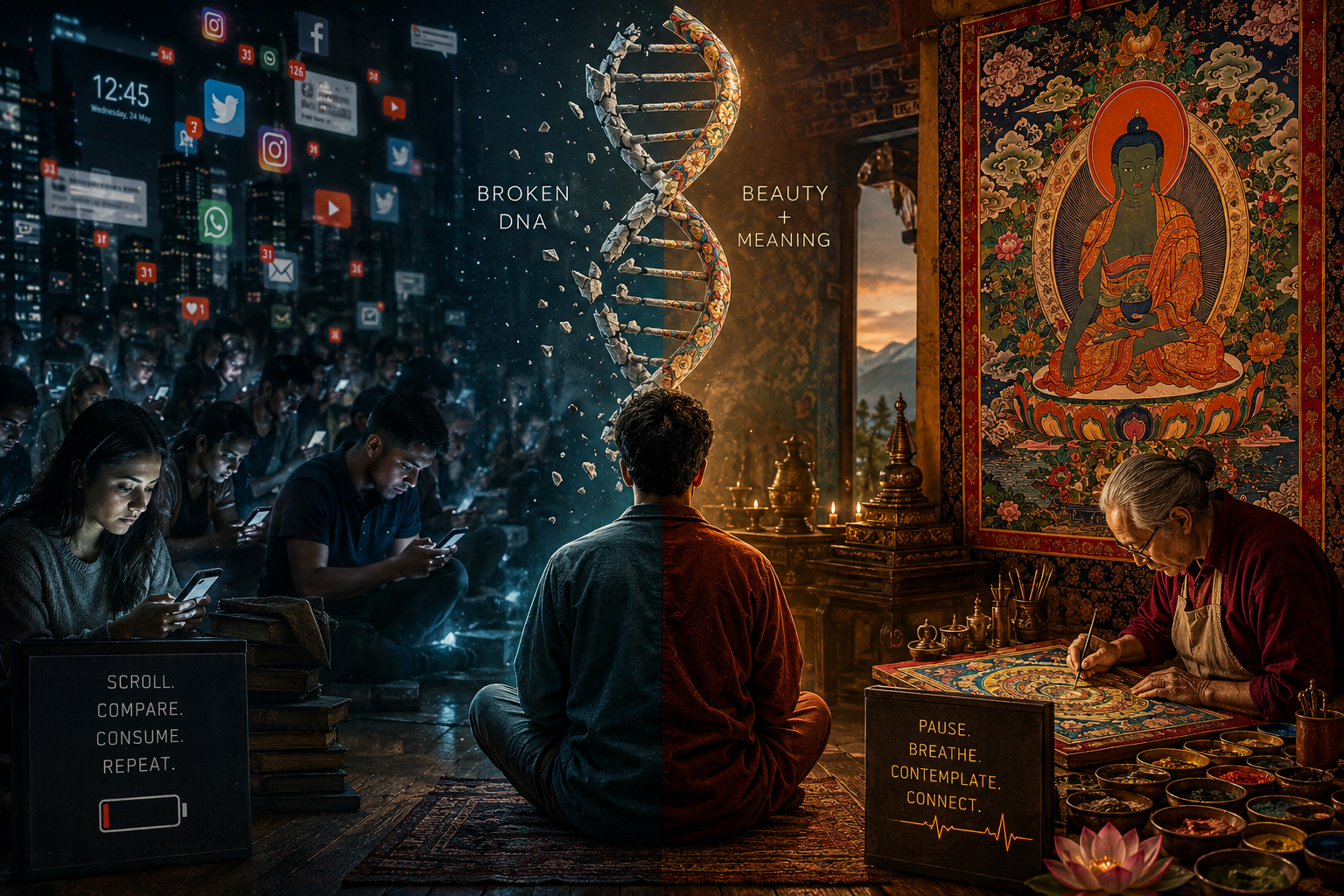
The phrase “broken DNA” in this essay is not used in a biological sense. Instead, it serves as a metaphor for what may be a growing disconnect between beauty and meaning in modern life.
Throughout history, art, architecture, rituals, and sacred spaces often combined aesthetic beauty with deeper cultural, philosophical, or spiritual significance. Temples, churches, mosques, monasteries, and other places of reflection were designed not only as physical structures but also as environments intended to inspire contemplation and emotional balance.
Many traditional societies viewed art as more than decoration. It was a means of storytelling, education, cultural preservation, and personal reflection.
Sacred Art and Human Experience
Traditional Thangka paintings are created according to detailed artistic and symbolic principles developed over centuries. Their geometric patterns, colors, and imagery often reflect religious teachings and philosophical ideas.
For many practitioners and observers, viewing such artwork can encourage focus, contemplation, and mindfulness. While sacred art should not be viewed as a substitute for medical treatment, some researchers have explored how exposure to aesthetically pleasing environments may influence emotional well-being and stress levels.
Studies in environmental psychology and healthcare design have suggested that access to nature, harmonious visual surroundings, and calming artistic imagery can contribute positively to a person’s overall sense of well-being.
A Crisis of Attention
Modern life presents a constant stream of information. Notifications, advertisements, short-form videos, and endless scrolling compete for attention every minute of the day.
Many educators, psychologists, and social commentators have raised concerns about declining attention spans, increasing digital dependence, and reduced opportunities for quiet reflection.
In this environment, traditional forms of art and cultural expression may offer a valuable opportunity to slow down and engage more deeply with ideas, emotions, and experiences.
Preserving Beauty and Meaning
Technology has undoubtedly improved countless aspects of life. The challenge is not technology itself but maintaining balance.
Art, culture, literature, music, and spiritual traditions continue to provide opportunities for reflection and connection. Whether through a Thangka painting, a temple mural, a classical sculpture, or a piece of literature, such works remind us that human beings seek more than efficiency and convenience. They also seek meaning, purpose, and emotional connection.
The preservation of cultural and artistic heritage therefore remains important not only for historical reasons but also because it contributes to the richness of human experience.
Conclusion
Modern civilization has achieved extraordinary scientific and technological progress. Yet alongside these advances, many people continue searching for deeper forms of connection and understanding.
Sacred art may not provide all the answers, but it can serve as a reminder of humanity’s enduring relationship with beauty, contemplation, and meaning.
Perhaps the challenge facing modern society is not merely technological adaptation, but learning how to preserve the human values that have guided civilizations for centuries.