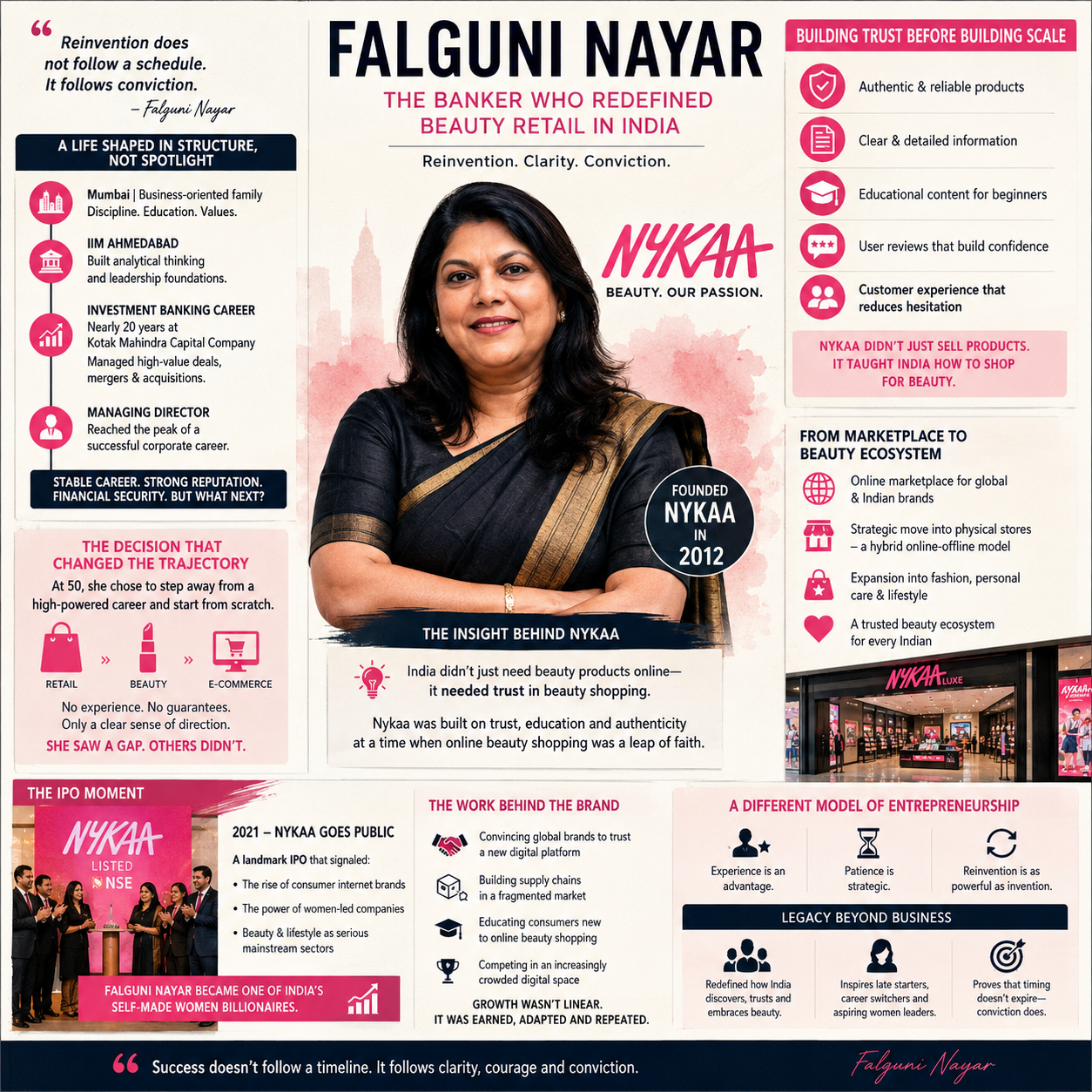
In the story of India’s modern startup revolution, most founders are often portrayed as young, fast-moving individuals—freshly out of college or corporate exits. But the journey of Falguni Nayar quietly disrupts that narrative and replaces it with something far more grounded: reinvention does not need an early start, only a clear sense of direction.
She did not begin in a garage in her twenties. She did not chase hype cycles or sudden trends. Instead, she spent decades building credibility in the financial world, walked away at the peak of her career, and then started over at 50—with no guaranteed outcome and no prior experience in retail or technology.
What followed was the creation of Nykaa, a brand that would go on to reshape how India discovers, trusts, and purchases beauty products.
But the real story is not just about what she built. It is about how she thought before she built anything at all.
A Life Shaped in Structure, Not Spotlight
Falguni Nayar grew up in Mumbai in a Gujarati, business-oriented family where discipline and education were treated as non-negotiables rather than choices. That early grounding shaped her worldview—less about shortcuts, more about systems.
She later studied at IIM Ahmedabad, one of India’s most competitive management institutions. The environment there was not about glamour; it was about analytical thinking, long hours, and learning how large-scale decisions are made.
Her early career unfolded in investment banking, where she eventually joined Kotak Mahindra Capital Company. Over nearly two decades, she worked on mergers, acquisitions, and high-value corporate deals—often forming the invisible backbone of India’s financial ecosystem.
By the time she became Managing Director, she had already reached a position many would consider the end goal.
Stable career. Strong reputation. Financial security.
Yet the question she could not ignore was simple: what next?
The Decision That Changed the Trajectory
Most career transitions happen under pressure—job loss, burnout, or necessity. Her shift came from something quieter: reflection.
At 50, when many professionals consolidate what they have built, she chose to dismantle her comfort zone entirely.
Leaving a senior leadership position in banking was not just a job change—it was a complete identity shift. She was stepping away from a world where she was an expert into a space where she was, by every definition, a beginner.
Retail. Beauty. E-commerce.
Three industries she had not formally operated in.
There was no guarantee that India even needed what she was about to build.
But she saw a gap others were underestimating.
The Insight Behind Nykaa
In 2012, India’s beauty market was still largely unorganized. Buying cosmetics often meant visiting local stores with inconsistent product availability, limited brand authenticity, and minimal product education. For many consumers—especially first-time buyers—the experience was confusing rather than empowering.
Nayar identified a simple but powerful idea:
India did not just need beauty products online—it needed trust in beauty shopping itself.
That insight became the foundation of Nykaa.
But the timing was risky. Indian e-commerce was still in its early expansion phase, and most online shopping was limited to electronics or books. Asking customers to buy skincare or makeup without physically touching or testing them seemed like a behavioral leap.
Still, she moved forward—not aggressively, but carefully.
Building Trust Before Building Scale
Nykaa’s early growth strategy was not driven by discounts or rapid expansion. It was built on something less visible but more difficult: credibility.
Instead of pushing volume, the platform focused on:
- Reliable and authentic products
- Clear and detailed product information
- Educational content for beginners
- User reviews that guided decision-making
- A customer experience designed to reduce uncertainty
This approach addressed a core emotional barrier: hesitation.
For many Indian consumers, buying beauty products online was not a transaction problem—it was a trust problem. Nykaa slowly converted that hesitation into habit.
It did not just sell lipstick or skincare. It taught a new way of shopping.
From Marketplace to Beauty Ecosystem
As adoption grew, Nykaa evolved beyond its original identity.
What started as an online marketplace gradually transformed into a multi-layered beauty ecosystem that included international luxury brands, affordable Indian labels, and curated lifestyle offerings.
Then came a strategic move that surprised many in the industry: physical retail stores.
At a time when most digital-first companies were moving away from offline presence, Nykaa did the opposite. It created a hybrid model—blending online convenience with offline experience.
This allowed customers to discover products in stores and continue purchasing online, or vice versa. The ecosystem reinforced itself.
Over time, the brand also expanded into fashion and personal care verticals, strengthening its position in India’s lifestyle market.
The IPO Moment and What It Represented
In 2021, Nykaa went public in one of India’s most closely watched IPOs.
The listing was more than a financial event. It symbolized a broader shift in how Indian startups were being perceived:
- Consumer internet businesses were no longer experimental
- Women-led companies could dominate mainstream markets
- Beauty and lifestyle retail had become serious economic sectors
For Falguni Nayar, the IPO also marked a personal milestone. She became one of India’s most prominent self-made entrepreneurs to reach billionaire status through a company she built from scratch after 50.
But the numbers, while headline-grabbing, were only part of the story.
The Work Behind the Brand Image
Behind Nykaa’s polished branding was a long list of operational challenges:
- Convincing global beauty brands to trust a new digital platform
- Building supply chains for a fragmented market
- Educating consumers unfamiliar with online beauty purchases
- Competing in an increasingly crowded e-commerce landscape
As competition intensified—especially from new-age quick commerce and lifestyle platforms—Nykaa had to constantly adapt its strategy. Growth was never linear; it required repeated recalibration.
The brand’s stability today is less about early success and more about sustained adjustment.
A Different Model of Entrepreneurship
The dominant image of entrepreneurship often celebrates speed: fast exits, rapid scaling, aggressive disruption.
Falguni Nayar’s journey suggests an alternative model.
Experience can be an advantage, not a delay.
Patience can be strategic, not passive.
Reinvention can be as powerful as invention.
Her background in finance did not limit her—it helped her understand structure, capital efficiency, and long-term thinking. Those skills became central in building a company that could survive beyond early hype.
Legacy Beyond Business
Today, Nykaa is not just a retail platform—it is part of India’s cultural shift in how beauty is perceived, accessed, and discussed.
But Falguni Nayar’s deeper impact lies elsewhere.
She represents a category of founders who often go unnoticed in startup storytelling:
- People who start late but build steadily
- Professionals who leave stable careers for uncertain paths
- Women who redefine leadership in industries dominated by fast-scaling narratives
Her story also challenges a quiet assumption embedded in modern work culture—that timing has an expiration date.
The Closing Insight
If there is a consistent thread in her journey, it is not speed or disruption. It is clarity followed by execution.
She did not rush into entrepreneurship. She prepared for it through years of observation, experience, and patience.
And when she finally acted, she did so without waiting for perfect conditions.
The lesson is not that everyone should leave their job at 50 to start a company.
It is simpler than that:
Reinvention does not follow a schedule. It follows conviction.