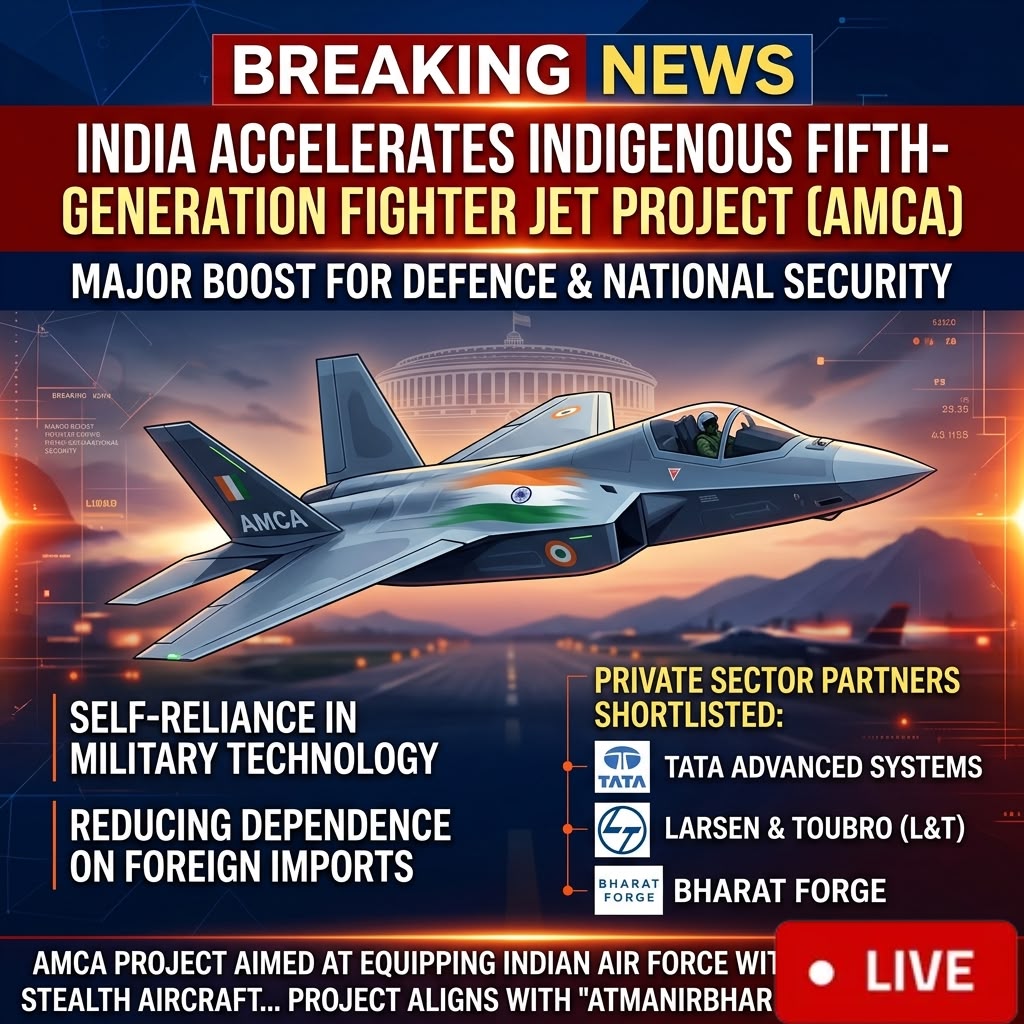
India has taken a major step toward strengthening its indigenous defence capabilities by accelerating the development of its fifth-generation stealth fighter aircraft project, the Advanced Medium Combat Aircraft (AMCA). The initiative reflects India’s broader focus on self-reliance in defence technology and reducing dependence on foreign military imports.
According to recent reports, major Indian private sector companies including Tata Advanced Systems, Larsen & Toubro (L&T), and Bharat Forge have reportedly been shortlisted to participate in the AMCA fighter jet program. Their participation is being viewed as an important development under India’s “Atmanirbhar Bharat” (Self-Reliant India) defence manufacturing initiative.
The AMCA project is expected to become one of India’s most advanced aerospace and defence programs. It aims to equip the Indian Air Force with next-generation fighter aircraft featuring stealth capabilities, advanced avionics, artificial intelligence-assisted systems, supercruise technology, and modern warfare capabilities.
Defence analysts believe the indigenous fighter aircraft program has gained strategic importance amid evolving regional security challenges and changing geopolitical dynamics. The AMCA project is expected to contribute to the modernization of the Indian Air Force over the coming decades.
The involvement of private defence manufacturers such as Tata Advanced Systems, L&T, and Bharat Forge highlights the increasing role of private industry in India’s defence ecosystem. Over recent years, the Indian government has encouraged greater participation from private companies in aerospace engineering, military manufacturing, and advanced defence technologies.
Tata Advanced Systems has expanded its presence in aerospace manufacturing and defence partnerships, while Larsen & Toubro is known for its engineering and defence production capabilities. Bharat Forge has also increased its focus on aerospace and military technology sectors in recent years.
The AMCA fighter jet is expected to feature stealth design technology aimed at reducing radar visibility and improving operational effectiveness in high-threat combat environments. Reports suggest the aircraft may also include advanced electronic warfare systems, network-centric combat capabilities, internal weapon bays, and high-performance engines suited for modern aerial warfare.
Defence experts consider the AMCA program important for India’s long-term strategic and technological independence. Indigenous defence manufacturing is also expected to support employment generation, technological innovation, and growth within India’s defence sector.
The project aligns with India’s broader objective of strengthening domestic defence manufacturing capabilities. In recent years, India has increased investments in indigenous missile systems, drones, naval platforms, cyber security infrastructure, and aerospace technologies.
If successfully developed, the AMCA program could place India among a limited group of countries capable of developing advanced stealth fighter aircraft domestically.
As the project progresses, collaboration between government agencies, defence research organizations, and private industry is expected to play a key role in shaping the future of India’s aerospace and defence capabilities.
The AMCA program continues to attract attention both domestically and internationally as India advances its long-term defence modernization efforts.