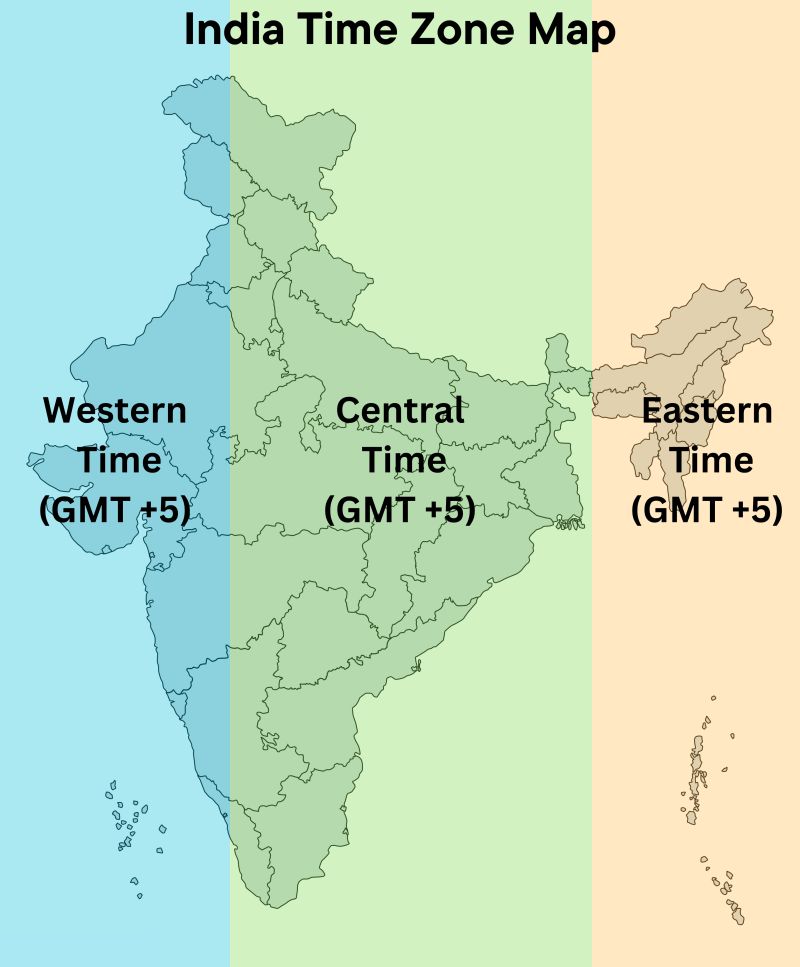
India follows a single official time zone — Indian Standard Time (IST, UTC+5:30) — despite spanning a wide geographical area from Gujarat in the west to Arunachal Pradesh in the east. While this system has long been viewed as a symbol of national unity and administrative simplicity, experts and policymakers continue to debate whether multiple time zones could improve productivity, energy efficiency, and quality of life.
India’s IST is based on the 82.5°E longitude near Mirzapur in Uttar Pradesh. However, the country stretches across nearly 30 degrees of longitude, creating a noticeable difference in sunrise and sunset timings between eastern and western regions.
Challenges Associated with a Single Time Zone
Daylight Imbalance
In several northeastern states, sunrise occurs significantly earlier than in western India, especially during summer months. Residents in parts of Assam and Arunachal Pradesh often begin their day much earlier according to natural daylight, while official work and school schedules continue to follow standard IST timings.
Experts argue that this leads to underutilization of morning daylight and increased electricity consumption during evening hours.
Impact on Daily Routines
Some studies have suggested that the mismatch between solar time and official time may influence sleep cycles, work efficiency, and school routines in certain regions. Concerns have also been raised about lifestyle disruptions in areas where sunrise and sunset timings differ substantially from the official clock.
Economic and Energy Concerns
Supporters of multiple time zones believe that better alignment with natural daylight could improve workplace productivity and reduce energy usage. Certain industries in the Northeast, such as tea plantations, already follow adjusted local schedules informally to maximize daylight hours.
International Comparisons
Several large countries operate with multiple time zones to accommodate their geographical spread:
- The United States uses multiple continental time zones.
- Russia spans 11 time zones.
- Australia, Canada, and Brazil also follow multi-zone systems.
At the same time, some countries, including China, continue to follow a single national time zone despite large geographical variation.
Proposals Discussed in India
Over the years, experts and institutions have proposed various alternatives for India:
Two Time Zones
One frequently discussed proposal suggests:
- Retaining IST for western and central India.
- Introducing a separate time zone for eastern and northeastern states.
Flexible Regional Timings
Some experts recommend adjusting office and school timings regionally instead of creating separate official time zones.
Pilot Projects
There have also been suggestions to introduce limited pilot programs in northeastern states before implementing wider reforms.
Concerns About Multiple Time Zones
Opponents of the idea argue that introducing additional time zones could create administrative and logistical complications, particularly for railways, aviation, broadcasting, and national coordination.
Questions related to interstate synchronization, public communication, and implementation complexity continue to remain part of the debate.
A Continuing National Discussion
India’s time zone debate reflects the broader challenge of balancing national uniformity with regional practicality. As technology and digital systems become more advanced, some experts believe that managing multiple time zones would be easier today than in earlier decades.
However, no final policy decision has been taken so far, and the discussion remains open among policymakers, researchers, and economists.
Conclusion
The debate over India’s time zone system highlights important questions related to energy efficiency, productivity, governance, and regional diversity. Whether India ultimately adopts multiple time zones or continues with a single standard time, the issue is likely to remain part of the country’s long-term policy discussions as urbanization and economic activity continue to grow.