NEET Controversy, Market Volatility and Public Expectations: Examining Trust in Institutions
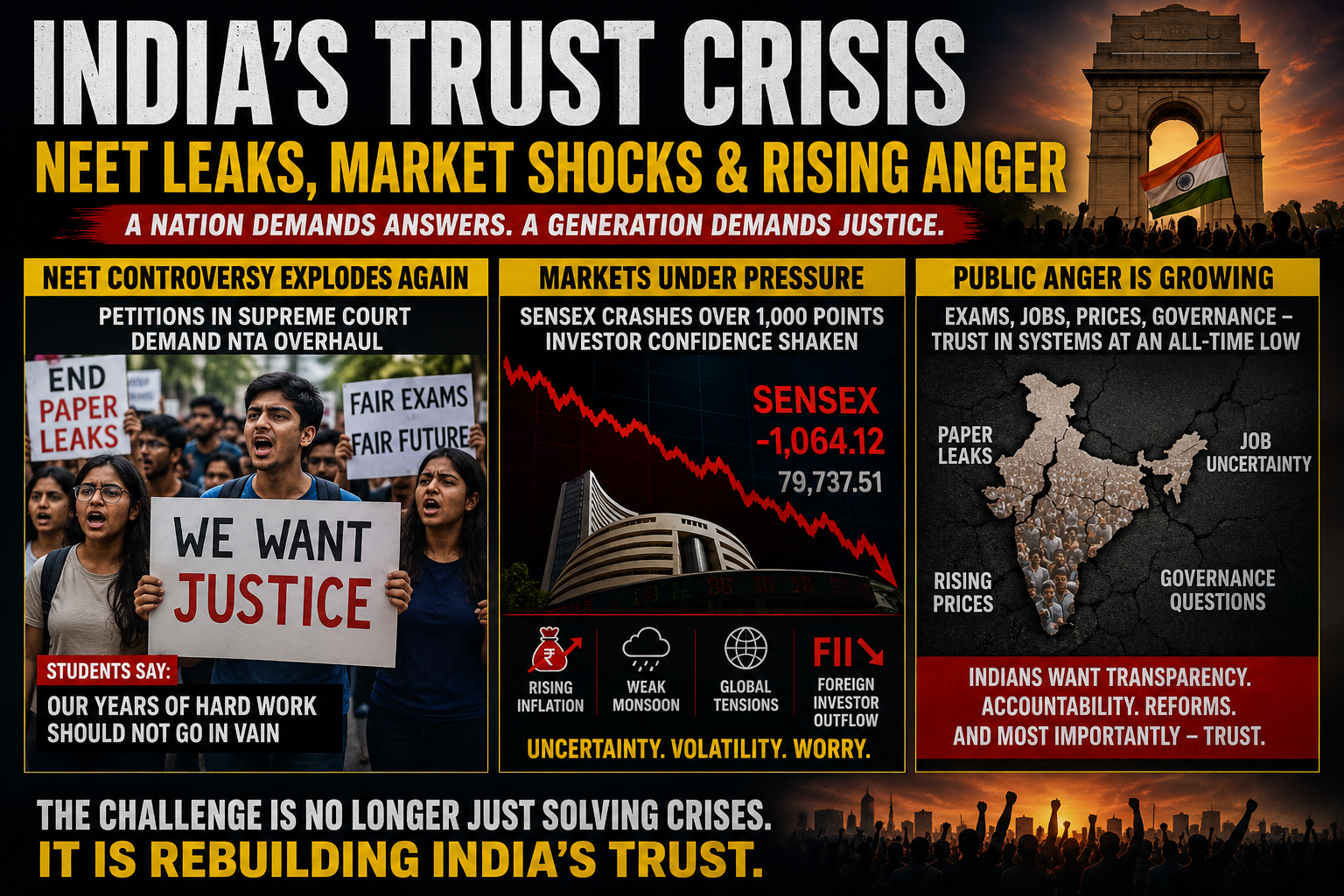
Recent developments involving examination administration, economic uncertainty, and public accountability have renewed discussions about institutional trust and governance in India.
NEET and the Debate on Examination Reforms
The National Eligibility-cum-Entrance Test (NEET) continues to remain a subject of public discussion following allegations of examination irregularities and concerns over security measures in competitive examinations.
Fresh petitions have reportedly been filed before the Supreme Court seeking reforms in examination processes and improvements in the functioning of agencies responsible for conducting large-scale national tests.
The issue has highlighted the importance of maintaining transparency, security, and fairness in competitive examinations that affect the academic future of millions of students.
Education experts have emphasized that examination credibility is essential for preserving confidence in merit-based selection systems.
Student Concerns and Competitive Pressure
India’s competitive examination system serves a large number of students seeking admission to professional courses.
Students often face intense competition, significant preparation costs, and academic pressure. Any controversy related to examination integrity can therefore generate widespread concern among candidates and their families.
Several student groups and educational stakeholders have called for stronger safeguards, technological improvements, and transparent grievance redressal mechanisms.
Economic Developments and Market Sentiment
Alongside educational concerns, recent fluctuations in financial markets have attracted attention from investors and policymakers.
Market movements are often influenced by multiple domestic and global factors, including inflation trends, weather-related concerns affecting agriculture, geopolitical developments, and investment flows.
Economists note that market volatility is a normal feature of financial systems, although sustained uncertainty can affect investor sentiment and economic planning.
Growing Demand for Transparency
Across different sectors, public discourse increasingly focuses on transparency, accountability, and institutional efficiency.
Whether related to examinations, recruitment processes, economic policies, or public administration, citizens are seeking clear communication and effective governance mechanisms.
Experts suggest that strengthening institutional processes, improving oversight, and ensuring timely responses to public concerns can help build confidence among stakeholders.
Institutional Credibility and Public Confidence
Strong institutions play a critical role in supporting democratic governance, economic development, and social stability.
Public confidence is often strengthened when institutions demonstrate transparency, fairness, and accountability in decision-making and crisis management.
Policy analysts argue that addressing concerns promptly and implementing reforms where necessary can contribute to long-term institutional resilience.
Conclusion
Recent debates surrounding examination administration, economic developments, and governance highlight the importance of public trust in institutions.
As India continues its development journey, discussions on transparency, accountability, and institutional effectiveness are likely to remain central to public policy conversations. The manner in which institutions respond to challenges and implement reforms will continue to influence public confidence in the years ahead.