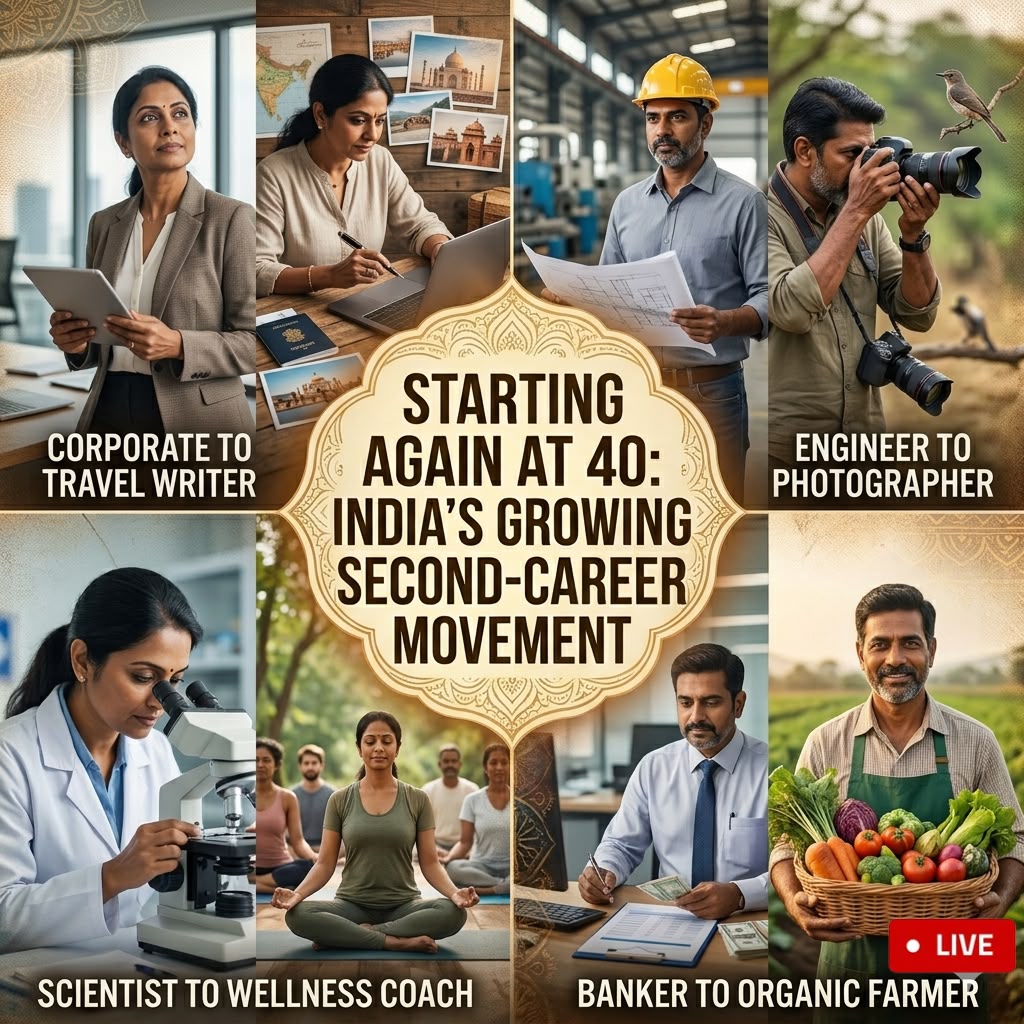
Starting Again at 40: India’s Growing Second-Career Movement
For decades, the roadmap to professional success in India appeared straightforward and predictable. Study hard, secure a stable job, climb the corporate ladder, support the family, and eventually retire after years of dedicated service. Stability was prized, risk was often avoided, and changing careers midway through life was considered unusual, if not impractical.
Today, however, that narrative is undergoing a remarkable transformation.
Across India, thousands of professionals in their forties, fifties, and even sixties are making bold decisions to leave established careers and pursue entirely new professional journeys. From senior corporate executives becoming entrepreneurs to engineers turning organic farmers and bankers becoming educators, a growing number of Indians are embracing what experts describe as the country’s emerging “Second-Career Movement.”
What was once considered a risky leap is increasingly viewed as an opportunity for reinvention, personal fulfillment, and renewed purpose.
A Generation Redefining Midlife
Turning 40 was traditionally associated with reaching professional stability. By that age, most individuals were expected to have established careers, financial responsibilities, and clearly defined life paths.
Yet many professionals now view midlife differently.
Rather than seeing 40 as a destination, they see it as a fresh beginning.
The shift reflects changing attitudes toward work, success, and personal happiness. While earlier generations often prioritized job security above all else, today’s professionals are increasingly seeking careers that align with their passions, values, and lifestyles.
Many have spent years achieving financial goals only to realize that professional fulfillment remains elusive. Others have experienced burnout, workplace stress, or a growing desire to pursue long-held dreams that were once postponed due to practical concerns.
As a result, career reinvention is becoming less about necessity and more about choice.
The Rise of Purpose-Driven Careers
One of the strongest drivers behind the second-career movement is the search for purpose.
After spending decades in corporate environments, many professionals begin questioning whether their work truly reflects their interests and aspirations. Promotions, salary hikes, and prestigious titles often provide temporary satisfaction, but they do not always create a sense of deeper meaning.
Career counselors across India report that mid-career professionals increasingly express a desire to make a more direct impact through their work.
Some transition into education, coaching, counseling, social entrepreneurship, healthcare, or community development. Others choose careers that allow them to work more closely with people, creativity, or causes they care about.
The question is no longer simply, “How much can I earn?”
Increasingly, professionals are asking, “How do I want to spend the next twenty years of my life?”
From Corporate Offices to Entrepreneurial Ventures
Entrepreneurship has emerged as one of the most popular second-career choices.
Professionals who have spent years building expertise within large organizations often discover they possess valuable knowledge, networks, and leadership skills that can be applied independently.
Many are launching ventures in sectors such as:
* Education and training
* Healthcare services
* Food and hospitality
* Digital marketing
* Consulting
* Wellness and fitness
* E-commerce
* Sustainable agriculture
Unlike younger entrepreneurs who may still be learning industry dynamics, second-career entrepreneurs often enter the market with years of practical experience and established professional relationships.
Their maturity, business understanding, and problem-solving abilities frequently become significant advantages.
The success of entrepreneurs such as Falguni Nayar, who launched Nykaa at the age of 50, has further challenged conventional assumptions about the ideal age to start a business.
Her story has inspired countless professionals to believe that entrepreneurship is not reserved exclusively for the young.
Turning Passions into Professions
For many Indians, the second-career journey begins with a passion that remained dormant for years.
Responsibilities such as mortgages, family commitments, and financial security often forced personal interests into the background. Midlife, however, presents an opportunity to revisit those dreams.
Former bankers are becoming travel bloggers and writers.
Engineers are building photography businesses.
Corporate managers are opening bakeries, wellness centers, cafés, and art studios.
Retired executives are becoming mentors, trainers, and public speakers.
These transitions are not necessarily driven by financial necessity. In many cases, they are motivated by the desire to spend more time doing work that feels personally rewarding.
The growing acceptance of passion-based careers reflects a broader shift in societal attitudes toward success and professional identity.
Technology Is Making Reinvention Easier
A decade ago, switching careers often required significant financial investment and access to specialized training.
Today, technology has dramatically lowered those barriers.
Online learning platforms allow professionals to acquire new skills from anywhere. Whether someone wants to learn digital marketing, artificial intelligence, graphic design, financial planning, coding, or content creation, resources are available at affordable costs.
Social media platforms have also democratized entrepreneurship.
A fitness coach can attract clients through Instagram.
A consultant can build authority on LinkedIn.
A teacher can launch online courses.
A writer can reach global audiences through digital publishing.
Technology has effectively expanded the number of viable career options available to midlife professionals.
The Impact of Remote Work
The rise of remote work has further accelerated the second-career movement.
Many professionals no longer need to relocate or completely resign from their existing roles before exploring new opportunities.
Remote work allows individuals to:
* Freelance while maintaining full-time employment.
* Build side businesses gradually.
* Offer consulting services globally.
* Experiment with new career paths without immediate financial risk.
This flexibility has reduced the pressure traditionally associated with major career changes.
For many professionals, the transition into a second career now occurs gradually rather than abruptly.
The Emotional Challenge of Starting Over
Despite the opportunities, starting again at 40 is rarely easy.
One of the most difficult aspects is emotional adjustment.
Professionals who once managed large teams or held senior positions may find themselves becoming beginners again. They must learn new technologies, adapt to unfamiliar industries, and sometimes compete with younger professionals who possess different skill sets.
Many describe the experience as humbling.
The confidence built over decades can temporarily give way to uncertainty. Self-doubt, fear of failure, and concerns about public perception are common challenges.
Yet those who successfully navigate the transition often report significant personal growth.
Learning again, adapting again, and building something new often reignites enthusiasm that may have faded during years of routine work.
Managing Financial Realities
Financial planning remains one of the most critical aspects of any second-career transition.
Unlike younger professionals, individuals in their forties and fifties often carry significant responsibilities, including:
* Children’s education
* Home loans
* Family expenses
* Healthcare costs
* Retirement planning
Experts generally recommend preparing financially before making major career changes.
Many successful second-career professionals spend years building savings, reducing debt, developing side income streams, and testing business ideas before leaving established employment.
Careful planning can significantly reduce risk and improve long-term success.
Why the Movement Is Growing
Several powerful trends are contributing to the rise of second careers in India.
Longer life expectancy means people can remain productive for decades beyond traditional retirement ages.
Increased workplace stress has prompted professionals to seek healthier and more balanced lifestyles.
The growth of the digital economy has created entirely new categories of work.
Entrepreneurship has become more accessible.
Society has become more accepting of unconventional career paths.
Most importantly, people are increasingly rejecting the idea that a single profession must define an entire lifetime.
Instead, careers are being viewed as evolving journeys that can change and adapt as individuals grow.
A New Definition of Success
Perhaps the most significant aspect of India’s second-career movement is the way it is reshaping the meaning of success.
For previous generations, success was often measured by stability, seniority, and financial achievement.
Today’s professionals are adding new dimensions to that definition.
Success now includes:
* Personal fulfillment
* Flexibility
* Meaningful work
* Better work-life balance
* Creative expression
* Continuous learning
Many second-career professionals report feeling more energized, motivated, and satisfied than they did during the peak years of their traditional careers.
Their experiences challenge the assumption that professional growth has an expiration date.
The Future of Career Reinvention
As India’s economy continues to evolve, second careers are likely to become increasingly common.
Organizations are beginning to recognize the value of experienced professionals who bring maturity, leadership, and industry knowledge. Educational institutions are expanding programs designed specifically for adult learners. Digital platforms continue to create new opportunities for entrepreneurship and independent work.
The result is a workforce that is becoming more dynamic, adaptable, and resilient.
The growing second-career movement sends a powerful message to professionals across the country: age does not limit opportunity.
For a generation raised to believe that career choices were permanent, the ability to reinvent oneself later in life represents a profound cultural shift.
Because sometimes the most successful chapter of a career is not the first one.
Sometimes, it begins when a person decides to start again.
And for a growing number of Indians, that new beginning is arriving at 40.