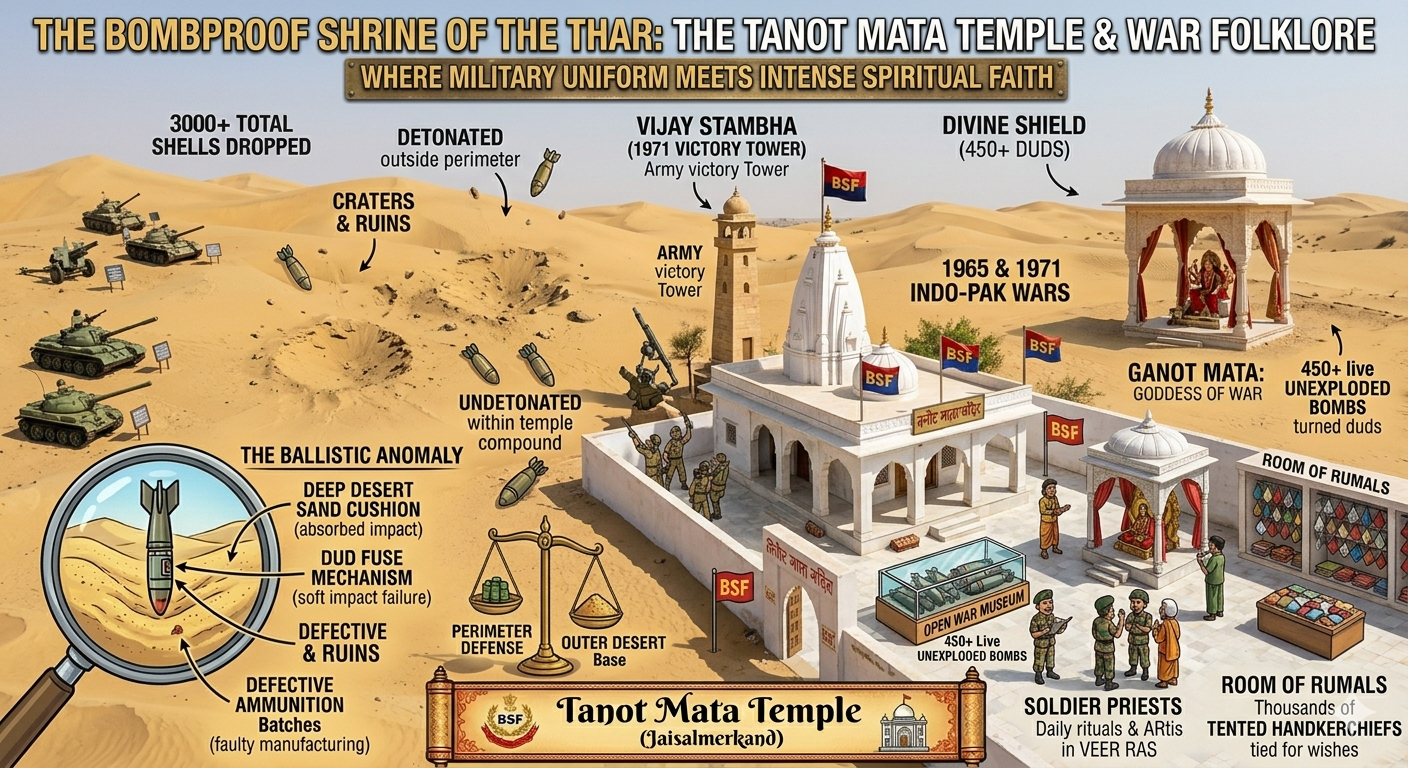
Located deep within the Thar Desert near the India–Pakistan border, the Tanot Mata Temple is one of Rajasthan’s most well-known places of worship and a site closely associated with stories from the 1965 and 1971 Indo-Pakistani conflicts.
Over the years, the temple has become a symbol of faith, resilience, and military heritage, attracting both pilgrims and visitors interested in the region’s history.
Ancient Origins
According to local traditions, the temple was established in 828 AD by Bhati Rajput ruler Tanu Rao and dedicated to Tanot Mata, who is regarded by devotees as an incarnation of Hinglaj Mata, a revered form of Goddess Shakti.
For centuries, the shrine served as a place of worship for local communities living in the desert region. Its location near present-day international borders later brought it into the spotlight during periods of military conflict.
The 1965 War and Local Accounts
One of the most widely known stories associated with Tanot Mata Temple relates to the Indo-Pakistani War of 1965.
According to accounts maintained by temple authorities and local narratives, a large number of artillery shells were fired into the Tanot sector during the conflict. While the surrounding area sustained damage, devotees and local residents believe that the temple itself remained largely unharmed.
Several unexploded shells recovered from the area are displayed today within the temple complex and are often cited as part of the temple’s wartime history.
Military historians note that unexploded artillery shells can result from various factors, including fuse malfunctions, storage conditions, impact angles, or terrain-related effects. However, many devotees regard the survival of the temple as evidence of divine protection.
Association with the Battle of Longewala
The temple also gained prominence following the Battle of Longewala during the 1971 Indo-Pakistani War.
The nearby battle became one of the most famous engagements of the conflict, with Indian forces successfully defending their position against a larger attacking force.
Over time, stories linking the temple to the events of the war became part of local military folklore, strengthening its significance among soldiers stationed in the border region.
Faith and Interpretation
The events associated with Tanot Mata Temple are viewed differently depending on perspective.
For devotees, the temple’s survival during wartime represents the blessings and protection of the goddess. Many pilgrims visit the shrine to offer prayers for safety, success, and well-being.
From a historical and scientific standpoint, researchers point to environmental and technical explanations that may have influenced the behavior of artillery shells in desert terrain.
Rather than viewing these perspectives as mutually exclusive, many visitors see Tanot as a place where faith, history, and human experience intersect.
The Temple Today
Today, the Border Security Force (BSF) plays an important role in maintaining the temple complex.
The site attracts thousands of visitors every year, including pilgrims, military personnel, and tourists exploring Rajasthan’s border regions.
Within the temple premises, visitors can view wartime memorabilia, unexploded shells that were later rendered safe, and exhibits documenting the area’s military history.
The temple has also become a symbol of the close relationship between local faith traditions and the armed forces stationed along India’s western frontier.
A Symbol Beyond the Battlefield
Whether viewed through the lens of spirituality, history, or military heritage, Tanot Mata Temple occupies a unique place in India’s cultural landscape.
For believers, it remains a sacred site associated with divine protection. For historians, it represents an important chapter in the story of India’s border regions. For soldiers serving in challenging desert conditions, it continues to symbolize courage, hope, and resilience.
More than half a century after the wars that brought it national attention, Tanot Mata Temple remains one of Rajasthan’s most remarkable landmarks—where history and faith continue to coexist.