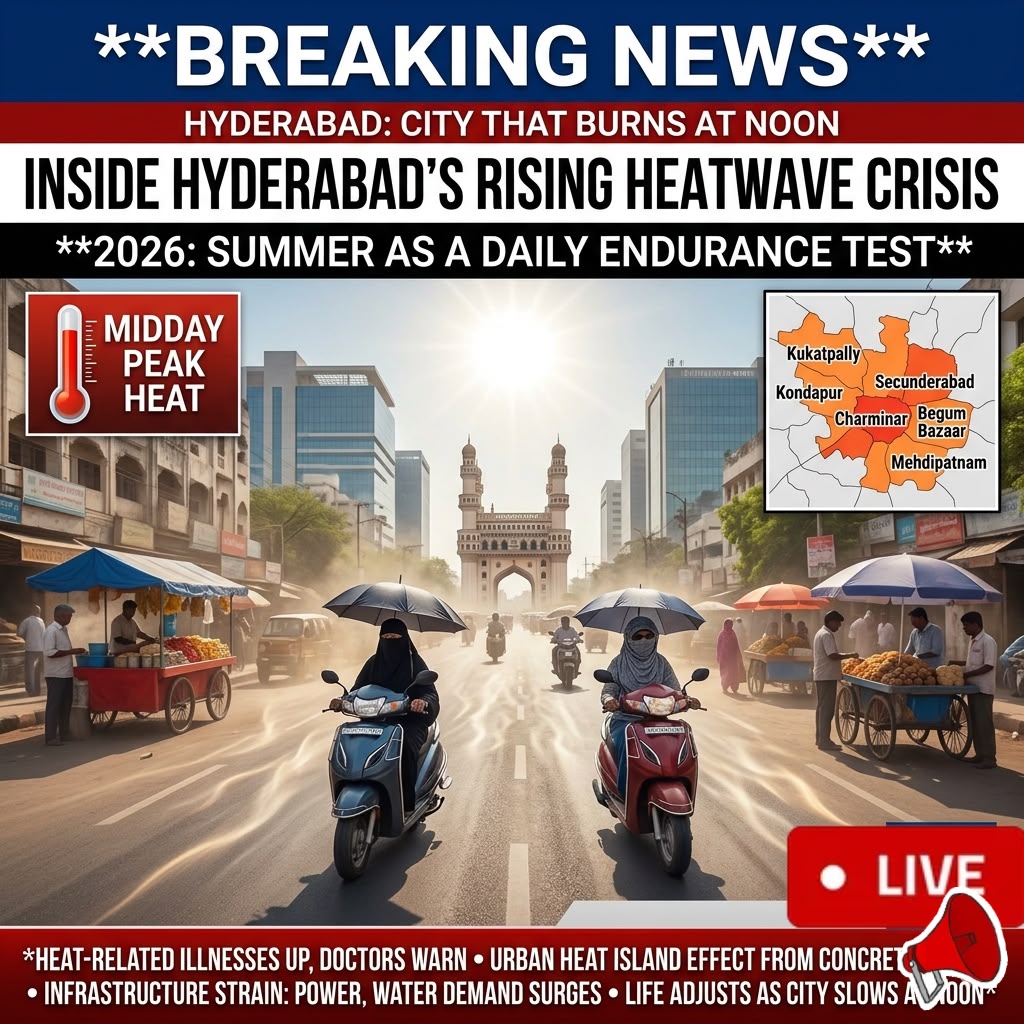
The City That Burns at Noon: Inside Hyderabad’s Rising Heatwave Crisis
By the time the clock nears noon, Hyderabad begins to feel like a different place altogether.
The mornings still carry a familiar energy—autos weaving through traffic, school buses rattling through lanes, office-goers grabbing tea at street corners. But as the sun climbs higher, the city seems to quietly retreat. Roads start shimmering as if water has been spilled across the asphalt. Heat rises in visible waves, bending the edges of vehicles and traffic lights. Even the wind feels tired.
In 2026, many residents no longer speak of summer as just a season. It has become something closer to a daily test—predictable, unavoidable, and demanding careful planning around every hour.
From the dense movement near Hyderabad’s Secunderabad Junction to the tightly packed lanes around Charminar, the heat has stopped being background weather. It has become a force that shapes how the city lives.
“We Plan Our Day Around the Sun”
For street vendors, time is no longer measured in hours—it is measured in sunlight.
By 5 or 6 a.m., fruit sellers, flower vendors, and tea stalls are already active, trying to complete most of their earnings before the heat becomes unforgiving. The early hours feel compressed, like the city is trying to fit an entire workday into a short window of tolerable weather.
“We cannot stay beyond noon,” says a fruit seller from Begum Bazaar. “After that, the heat is unbearable. Even customers don’t come.”
By early afternoon, the transformation is visible everywhere. Cart wheels are covered with cloth, shop shutters are pulled halfway down, and pavements that were crowded just hours earlier turn empty. The city does not stop—but it slows down dramatically, as if holding its breath.
For delivery workers and gig employees, the challenge is sharper. Long hours on two-wheelers under direct sunlight make even short trips exhausting. Water breaks under shade, quick stops near tea stalls, and the occasional pause under flyovers become essential survival routines.
Streets That Feel Different
In neighbourhoods like Mehdipatnam and Kukatpally, residents describe something unusual about the roads themselves.
They don’t just feel hot—they feel alive with heat.
Even after sunset, the ground continues to radiate warmth, as if it has stored the sun and refuses to let go. Two-wheelers move quickly not only due to traffic pressure but because stopping feels worse than moving through the heat.
Public transport stops become quiet gathering points. People cluster under whatever shade they can find—tree canopies, metro pillars, shop awnings, or the narrow sliver of shadow cast by buildings.
“I carry an umbrella even for short distances now,” says a college student commuting daily. “The sun feels heavier on the skin. It drains you faster than you expect.”
The Health Toll of Rising Temperatures
Doctors across the city report a steady rise in heat-related cases, especially during peak afternoon hours between 12 p.m. and 4 p.m.
Dehydration, heat exhaustion, dizziness, and sudden drops in blood pressure are becoming more common—particularly among outdoor workers, elderly residents, and those without access to cooling spaces.
Medical professionals warn that heat stress is often underestimated.
A physician explains, “People think only collapse cases are serious. But early symptoms—fatigue, headache, nausea—can escalate quickly if ignored in this weather.”
Children and senior citizens are the most vulnerable. Schools are increasingly adjusting schedules, and families are shifting outdoor activities to early mornings or late evenings to reduce exposure.
The Urban Heat Trap
Experts say Hyderabad’s rising heat is not only a matter of climate—it is also a matter of how the city has grown.
Rapid urbanisation, shrinking green cover, and expanding concrete surfaces have created what environmental scientists call an urban heat island effect, where cities become significantly hotter than surrounding rural areas.
Areas with dense traffic and heavy construction absorb heat during the day and release it slowly at night. As a result, even evenings no longer bring the relief they once did.
In many parts of Hyderabad, nights feel warmer than they used to be—a subtle but powerful shift that changes how people sleep, rest, and recover.
“Concrete stores heat,” explains an urban environment researcher. “So the city never fully cools down anymore. It just cycles heat from day to night.”
Life Adjusted in Small Ways
Despite the intensity, residents are adapting quietly, almost instinctively.
Homes rely more on coolers, shaded balconies, and early morning ventilation. Offices, where possible, shift working hours earlier in the day. Vendors increasingly stock cooling drinks—coconut water, buttermilk, lemon water—that often sell faster than anything else.
Even social life has shifted.
Parks and open spaces that once filled up in the early evening now remain empty until much later. Activity begins only after sunset, when the ground finally stops burning heat into the air.
“We don’t step out before 7 p.m. anymore,” says a resident from Kondapur. “That’s just how life is now.”
Pressure on the City’s Systems
The heatwave is not only a human experience—it is also a strain on infrastructure.
Electricity demand rises sharply as air conditioners and coolers run continuously through long afternoons and hot nights. Water usage increases across households, placing additional pressure on municipal supply systems.
Road surfaces in some areas show early signs of wear under prolonged exposure to extreme temperatures. Hospitals prepare for predictable seasonal spikes in heat-related cases, especially during peak afternoons.
The city continues to function—but with systems operating closer to their limits.
A Warning That Keeps Getting Louder
Meteorologists and environmental researchers warn that what Hyderabad is experiencing is part of a larger trend across urban India.
Rising global temperatures, combined with local environmental changes, are making heatwaves more frequent, longer, and more intense.
Without stronger long-term measures—expanding green cover, protecting lakes and water bodies, and redesigning urban spaces to reduce heat absorption—cities like Hyderabad may face increasingly difficult summers in the years ahead.
Learning to Live With the Heat
For now, Hyderabad adapts the only way it can—quietly, practically, and continuously.
Life has not stopped. It has adjusted.
Work begins earlier. Movement pauses at noon. The city waits out the harshest hours and comes back to life after sunset.
Hyderabad still moves, still grows, still breathes—but differently now. More cautiously. More deliberately. Always aware of the sun that governs its rhythm.
And as another summer stretches across the city, one truth becomes impossible to ignore:
In Hyderabad today, heat is not just weather—it has become a way of life.