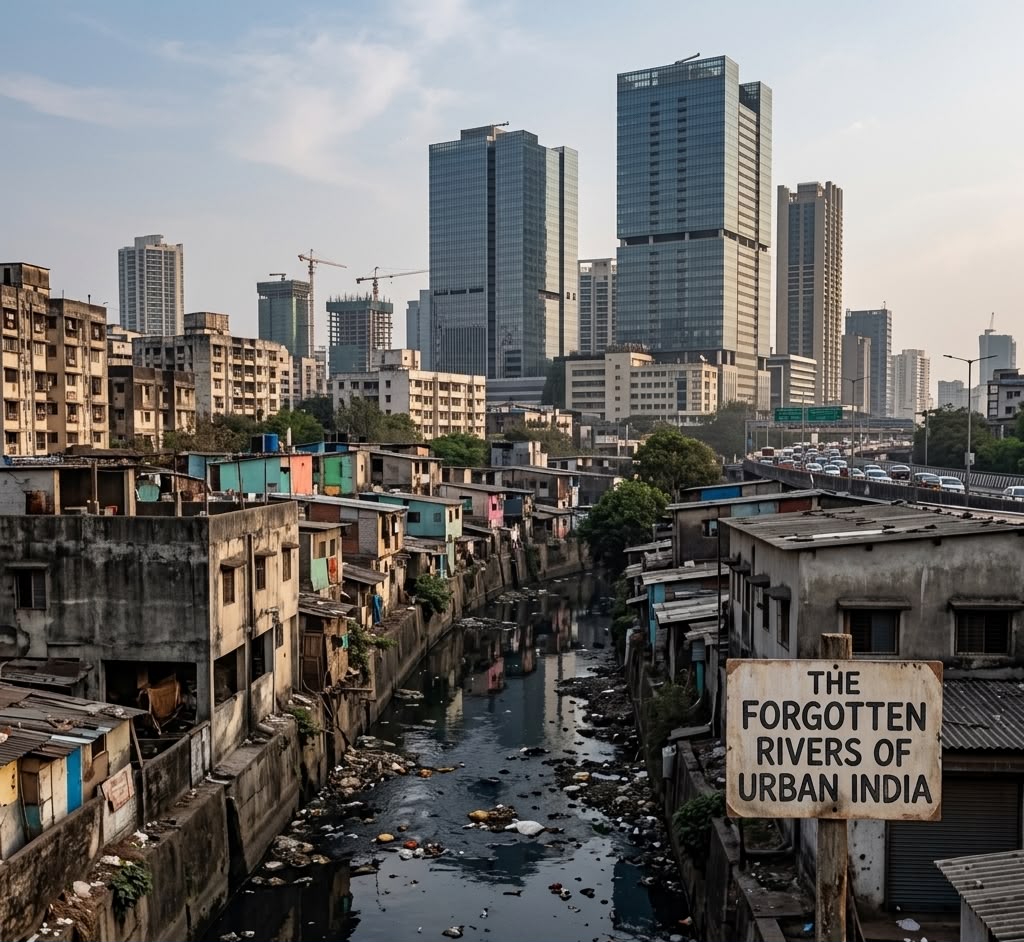
The Forgotten Rivers of Urban India
Beneath the noise of traffic, the rise of glass buildings, and the relentless pace of urban expansion, many of India’s cities hide a quieter story—one that flows underground, often unseen and increasingly forgotten. These are the rivers that once shaped civilizations, sustained communities, and defined the geography of early settlements. Today, many of them are reduced to drains, encroached channels, or polluted streams struggling for survival.
Across urban India, the story of rivers is no longer just about water—it is about memory, neglect, and the urgent question of revival.
Rivers That Built Cities
Indian cities were historically built around rivers. Water sources determined trade routes, agriculture, settlement patterns, and even cultural life. Rivers were not just natural features; they were lifelines.
However, rapid urbanization over the past few decades has drastically altered this relationship. As cities expanded, rivers were straightened, narrowed, diverted, or encroached upon. In many cases, natural drainage systems were replaced by concrete structures, disrupting the ecological balance.
What once served as sources of drinking water and irrigation have now, in many places, become channels for sewage and industrial waste.
The Case of Urban Waterways in Delhi and Mumbai
In cities like Delhi, several small tributaries of the Yamuna have either disappeared or exist only in fragmented stretches. Seasonal streams that once carried rainwater have been converted into covered drains or construction zones.
Similarly, Mumbai’s Mithi River has become a stark example of urban neglect. Once a natural flood buffer, it now struggles under the weight of industrial discharge and encroachment. Every monsoon, the river’s condition becomes a reminder of the city’s fragile drainage system.
These cases are not isolated. Across India, smaller urban rivers and streams face similar challenges, often overlooked until flooding or water shortages draw attention to them.
Bengaluru’s Vanishing Lakes and Channels
Bengaluru offers another perspective on urban water transformation. The city was once known as the “City of Lakes,” with interconnected water systems feeding agriculture and maintaining groundwater levels.
Over time, many of these lakes and connecting channels were encroached upon or disconnected due to infrastructure development. While restoration efforts have begun in some areas, the disruption to the natural water network has already had long-term consequences, including water scarcity and flooding in certain neighborhoods.
The Cultural Loss Alongside Ecological Damage
The disappearance of urban rivers is not only an environmental issue—it is also a cultural loss. Rivers in India have historically been associated with festivals, rituals, and community gatherings. Ghats served as spaces for social interaction, spiritual practices, and daily life.
As rivers deteriorate, these cultural practices also fade or shift elsewhere. The relationship between people and water becomes increasingly distant, replaced by pipelines and municipal supply systems.
This separation has changed how urban residents perceive natural resources. Water is now often seen as a utility rather than a living system.
Causes of Decline
Experts point to several factors behind the degradation of urban rivers:
– Unplanned urban expansion
– Encroachment on riverbanks
– Industrial pollution and untreated sewage
– Weak enforcement of environmental regulations
– Loss of traditional water management systems
In many cities, rivers have been treated as convenient disposal channels rather than ecological systems that require protection.
Efforts Toward Revival
Despite the challenges, restoration efforts are underway in several cities. River cleaning projects, wetland restoration initiatives, and stricter waste management policies are being implemented in phases.
Community-led movements have also emerged, with citizen groups advocating for cleaner rivers and the revival of natural water bodies. In some regions, revived lakes and river stretches have shown that ecological recovery is possible with sustained effort.
However, experts emphasize that restoration is not just about cleaning water—it requires rethinking urban planning itself.
A Question of Coexistence
The story of India’s forgotten rivers is ultimately a story about balance. Cities need infrastructure, housing, and economic growth, but they also depend on natural systems that sustain life.
As urban populations continue to grow, the challenge lies in integrating rivers into the fabric of modern cities rather than pushing them to the margins.
Rivers are not relics of the past. They are living systems that continue to influence rainfall patterns, groundwater levels, and urban resilience.
Rediscovering What Was Lost
In recent years, there has been growing awareness about the need to reconnect cities with their waterways. Urban planners, environmentalists, and citizens are beginning to recognize that restoring rivers is not an aesthetic choice—it is an ecological necessity.
The forgotten rivers of urban India may no longer flow as freely or visibly as they once did, but their presence still shapes the land beneath our cities.
Bringing them back into public consciousness may be the first step toward bringing them back to life.
Until then, they remain silent witnesses to the transformation of India’s urban landscape—flowing, in memory if not always in sight, beneath the cities built upon them.