Immigration & International Update: Reports Indicate FY2026 EB-2 Green Card Limit Reached for Indian Applicant
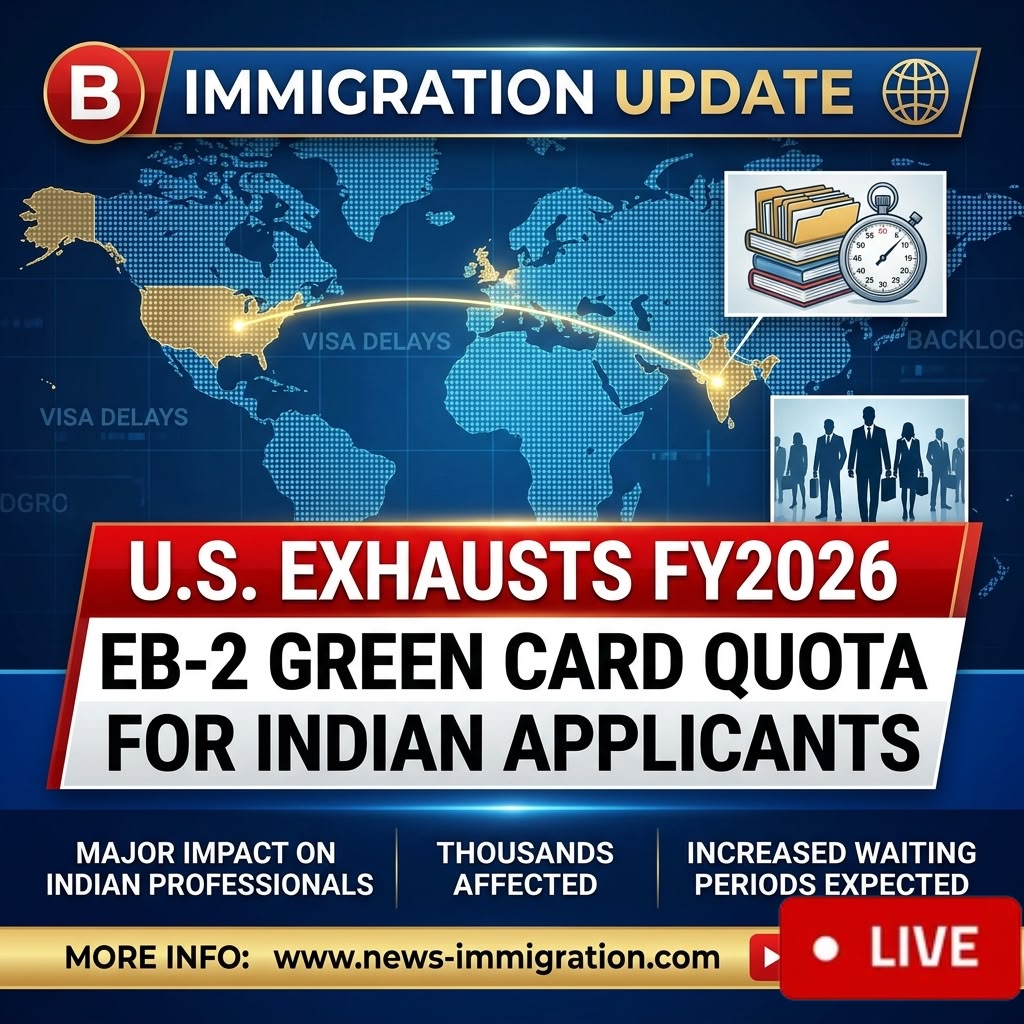
Recent immigration reports and analyst discussions suggest that the United States may have reached the FY2026 Employment-Based Second Preference (EB-2) Green Card allocation limit for Indian applicants, potentially affecting thousands of skilled professionals waiting for permanent residency approvals.
The development, if confirmed through official immigration updates, is expected to impact Indian professionals working in sectors such as information technology, engineering, healthcare, finance, research, and academia.
The EB-2 visa category is generally intended for highly skilled professionals, advanced degree holders, researchers, engineers, healthcare specialists, and individuals considered to possess exceptional abilities.
Immigration experts state that reaching annual visa allocation limits could result in additional waiting periods for pending applicants, further increasing the backlog already faced by many Indian nationals within the U.S. immigration system.
Indian professionals have historically represented one of the largest applicant groups under U.S. employment-based immigration programs. Due to high demand and country-specific visa caps, Indian applicants often experience significantly longer waiting times compared to applicants from several other countries.
The U.S. immigration system allocates a fixed number of employment-based Green Cards each fiscal year, while country caps restrict the percentage of visas available to applicants from any single nation. Because of the large volume of applications from India, substantial backlogs have accumulated over the years across multiple employment-based categories.
The EB-2 category is considered important for skilled immigrants seeking long-term career stability and permanent residency in the United States. Many applicants continue working on temporary employment visas, including H-1B visas, while waiting for Green Card processing to progress.
Immigration analysts believe prolonged delays may continue affecting not only principal applicants but also their spouses and dependent children. Delays in permanent residency processing can create uncertainty regarding career planning, travel flexibility, long-term settlement decisions, and dependent immigration status.
The issue has once again triggered discussions surrounding U.S. immigration reform, especially regarding country-based visa caps and the growing backlog faced by Indian applicants. Industry groups and immigration advocates have repeatedly called for reforms aimed at modernizing employment-based immigration processes.
The United States remains a preferred destination for Indian professionals because of opportunities in technology, healthcare, research, higher education, and multinational industries. Indian-origin professionals continue to contribute significantly across major American sectors, particularly in technology and innovation-driven fields.
Experts also note that extended Green Card waiting periods may encourage some skilled professionals to explore alternative immigration destinations such as Canada, Australia, the United Kingdom, and European countries that may offer comparatively faster permanent residency pathways.
Immigration attorneys and policy observers recommend that applicants regularly monitor official U.S. Department of State Visa Bulletin updates and consult authorized immigration professionals regarding visa compliance and status management.
The broader discussion surrounding employment-based immigration continues to highlight long-standing structural challenges within the U.S. immigration framework, including visa allocation limits, processing delays, and increasing global competition for skilled talent.
For many Indian professionals and their families, uncertainty surrounding employment-based Green Card processing remains an important concern influencing long-term career and settlement decisions.