West Bengal is witnessing renewed attention in India’s economic landscape as the state gradually transitions from its legacy industrial economy toward a services, logistics, and technology-driven growth model. Economic data from recent years indicates improving growth trends, renewed infrastructure investment, and increasing focus on connectivity with eastern and northeastern markets.
Historical Economic Importance
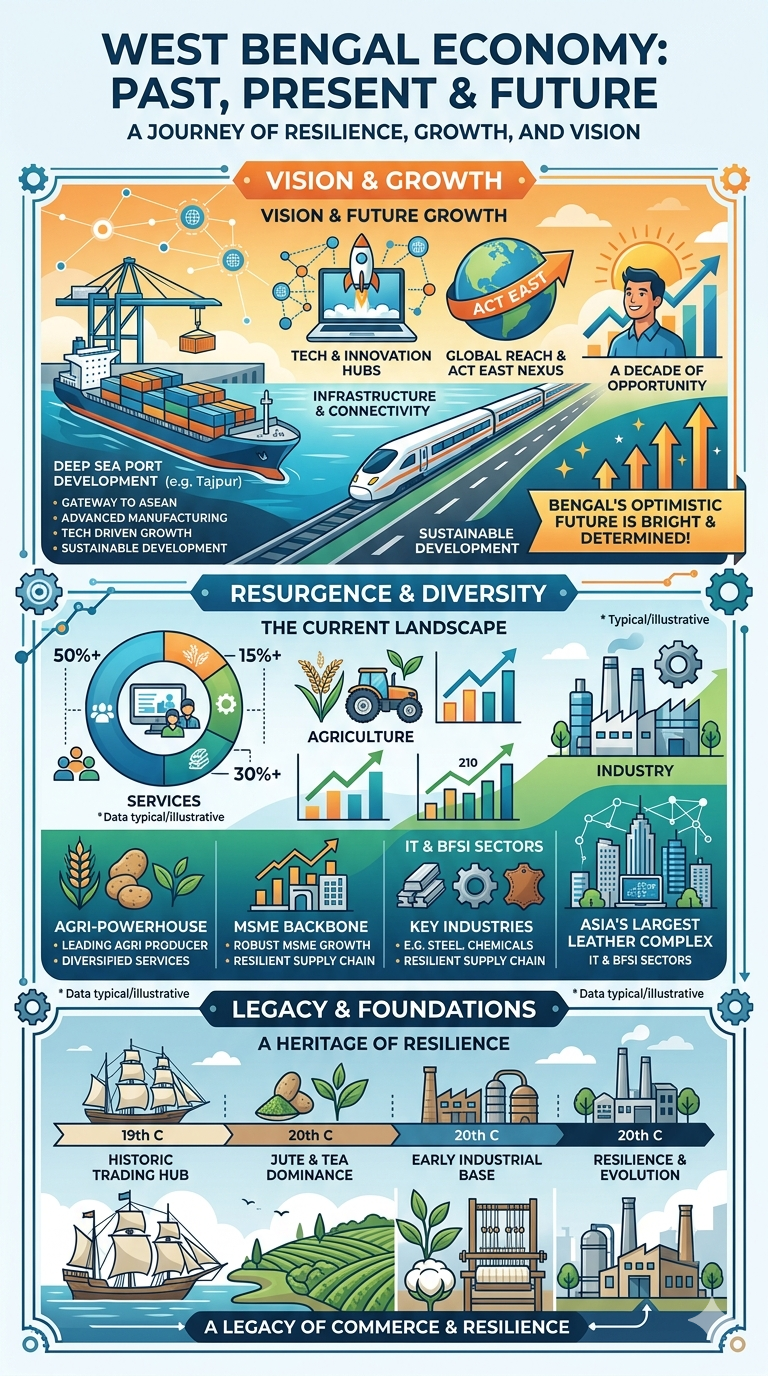
During the British colonial period, Kolkata served as one of the most important commercial and financial centers in the Indian subcontinent. Trade activities linked to tea, jute, shipping, and manufacturing contributed significantly to the region’s economy.
However, after independence, several structural and policy-related challenges affected industrial growth in the state. Analysts often cite the impact of the 1952 Freight Equalisation Policy, industrial decline, labor unrest, and migration of private investment toward western and southern India as factors that slowed West Bengal’s economic momentum over several decades.
Current Economic Trends
According to recent state economic assessments, West Bengal’s Gross State Domestic Product (GSDP) continues to show steady growth. The services sector currently contributes the largest share of the state economy, supported by information technology, logistics, banking, and retail activities.
West Bengal Economic Snapshot (FY 2025–26)
| Economic Indicator | Estimated Value |
|---|---|
| Projected GSDP | Approx. ₹20.32 trillion |
| Estimated Growth Rate | Around 7.6% |
| Services Sector Contribution | 53.1% |
| Industry Contribution | 29.8% |
| Agriculture Contribution | 17.1% |
Technology and IT-related activities in areas such as Salt Lake Sector V and New Town have emerged as important growth centers. At the same time, the state continues to maintain a strong base in agriculture, leather processing, small industries, and inland fisheries.
MSMEs and Industrial Diversification
Micro, Small, and Medium Enterprises (MSMEs) continue to play a major role in the state’s employment and economic activity. The leather industry, especially the Bantala Leather Complex, remains one of the largest organized leather processing hubs in Asia.
Manufacturing activities linked to steel, chemicals, food processing, and textiles also contribute to the state’s industrial economy.
Infrastructure and Logistics Push
One of the major development projects attracting attention is the proposed Tajpur Deep Sea Port in East Midnapore district. The project is expected to improve maritime trade capacity and strengthen logistics connectivity in eastern India.
The development of freight corridors, road connectivity, and regional trade infrastructure may further support West Bengal’s role as a gateway to neighboring countries such as Bangladesh, Bhutan, and Nepal, as well as ASEAN markets.
Digital and Consumer Growth
Internet penetration and digital adoption have expanded rapidly across the state in recent years. Analysts believe this trend is contributing to the growth of e-commerce, digital services, startups, and local entrepreneurship.
Urban infrastructure development and expansion of commercial activity in Kolkata and nearby regions are also contributing to changing investment patterns.
Challenges Remain
Despite positive indicators, West Bengal continues to face several economic challenges, including:
- Fiscal pressure and debt management
- Employment generation in the formal sector
- Industrial investment competition from other states
- Business environment perception among investors
Experts believe that long-term economic growth will depend on sustained infrastructure development, industrial policy stability, and improved ease of doing business.
Conclusion
West Bengal’s economy appears to be entering a new phase driven by services, logistics, digital infrastructure, and regional connectivity. While challenges remain, ongoing investments and infrastructure projects are gradually reshaping the state’s economic profile.
The coming decade will likely determine whether West Bengal can successfully strengthen its position as a major economic and trade hub in eastern India.