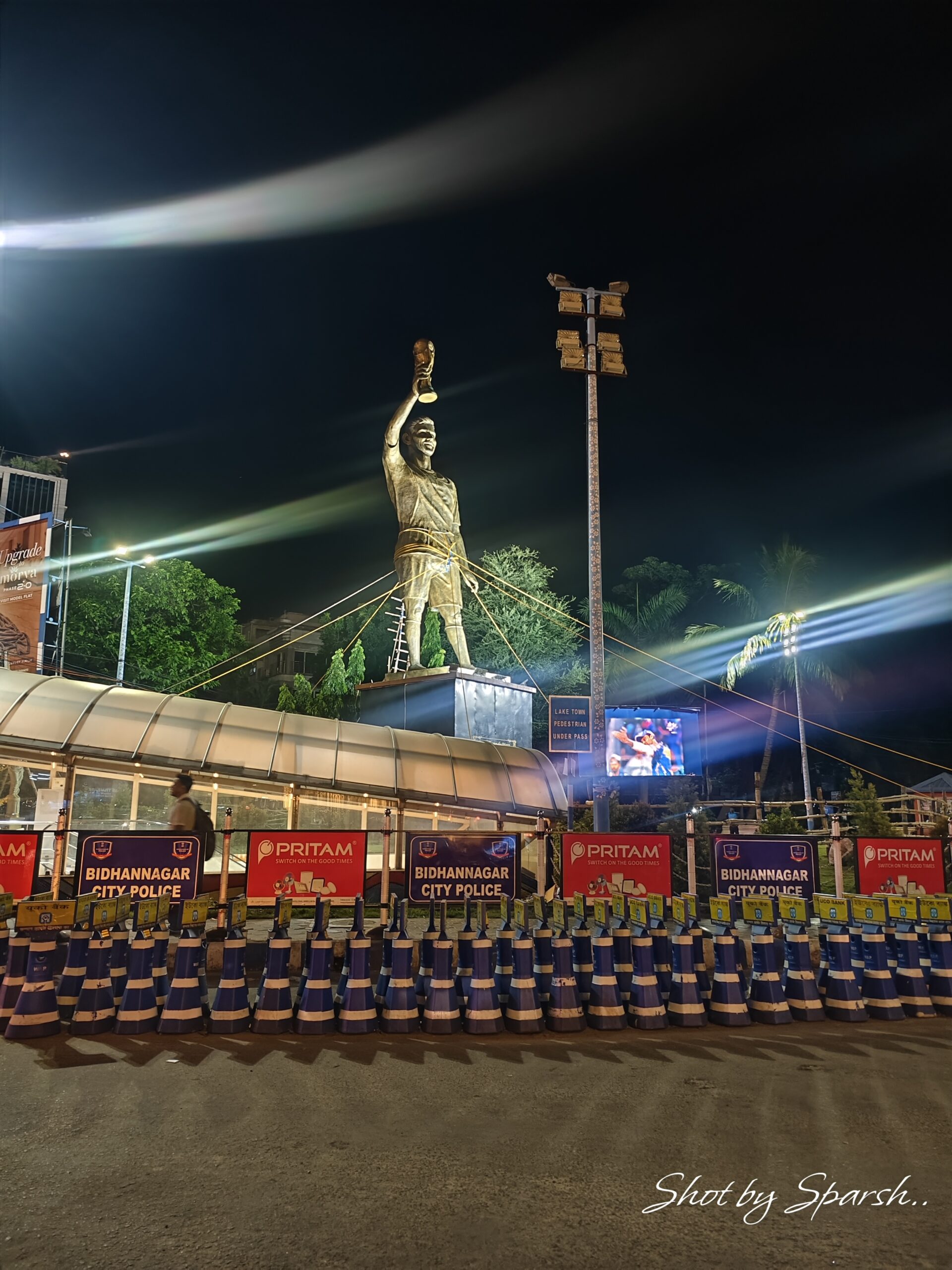
The decision to remove the giant Lionel Messi statue from Kolkata’s Lake Town has disappointed thousands of football lovers across the city. For many fans, the monument was more than just a structure—it was a symbol of admiration for one of the greatest footballers of all time and a reflection of Kolkata’s deep-rooted football culture.
The towering statue, measuring around 70 feet in height, was unveiled in December 2025 during Lionel Messi’s visit to India as part of his GOAT Tour. Designed to depict the Argentine legend lifting the FIFA World Cup trophy, the structure quickly became a landmark and a point of pride for football enthusiasts.
However, recent developments have brought an unfortunate turn to the story. According to reports from government officials and engineers, the statue was found to be structurally unstable after concerns were raised by local residents. Witnesses reportedly observed the monument swaying during strong winds and storms. Following inspections by the Public Works Department (PWD), authorities concluded that the structure posed a potential safety risk and recommended its removal.
Public safety must always remain the highest priority. No monument, regardless of its emotional or cultural significance, can be allowed to remain if there is a possibility of endangering lives. In a densely populated urban area, even a small structural failure could have serious consequences.
At the same time, the episode raises important questions about planning, engineering oversight, and approval processes for large public installations. When a structure of such scale is erected, thorough structural assessments, wind-load studies, safety certifications, and regulatory clearances should be treated as non-negotiable requirements rather than formalities.
What makes this situation particularly unfortunate is that the statue had become a symbol of Kolkata’s passion for football within a very short period. The city has long shared a unique emotional connection with the sport, and the monument represented that spirit. Its removal therefore feels like the loss of a cultural landmark, even if the decision itself may be justified.
There is, however, a positive way forward. Instead of viewing this as the end of the project, authorities can consider relocating the statue to a safer location after proper structural modifications and expert certification. If redesigned and reinforced according to engineering standards, the monument could continue to inspire fans without compromising public safety.
The Messi statue controversy is ultimately a reminder that civic pride and public safety must go hand in hand. Great cities are not defined only by the monuments they build, but also by the responsibility with which they build them.
Kolkata’s love for football remains unchanged. The challenge now is to ensure that future symbols of that passion are created with the same level of engineering excellence as the emotions they represent.