The Remarkable Journey of Dr. Milan Gautam from Kathmandu’s Cath Labs to Curating Sacred Art
In the labyrinthine lanes of old Kathmandu, where the air carries the scent of incense and the sound of prayer bells, a young boy once watched his grandmother apply gold leaf to a Thangka painting. She wasn’t an artist by profession—just a devout woman preparing offerings for the local monastery. But in that moment, something stirred in the child’s heart that would take decades to fully understand.
Today, that boy is Dr. Milan Gautam, one of Nepal’s most distinguished interventional cardiologists, a PhD graduate from Japan’s prestigious Shinshu University, author of 12 books bridging science and spirituality, and now—in a plot twist that seems almost scripted—a passionate curator of the very art form that captivated him in childhood.
And he has chosen Mumbai as the stage for his second act.
From the Operating Table to the Canvas
Dr. Gautam’s journey is anything but conventional. Trained in Japan, with over a decade of experience handling complex cardiac cases in Nepal’s leading hospitals, he has held literally thousands of hearts in his hands. His scientific credentials are formidable: multiple publications in international journals, presentations at the American Heart Association and European Society of Cardiology conferences, and pioneering research on stem cell transplantation for cardiac repair.
But the heart, he discovered, is not just a muscle that pumps blood.
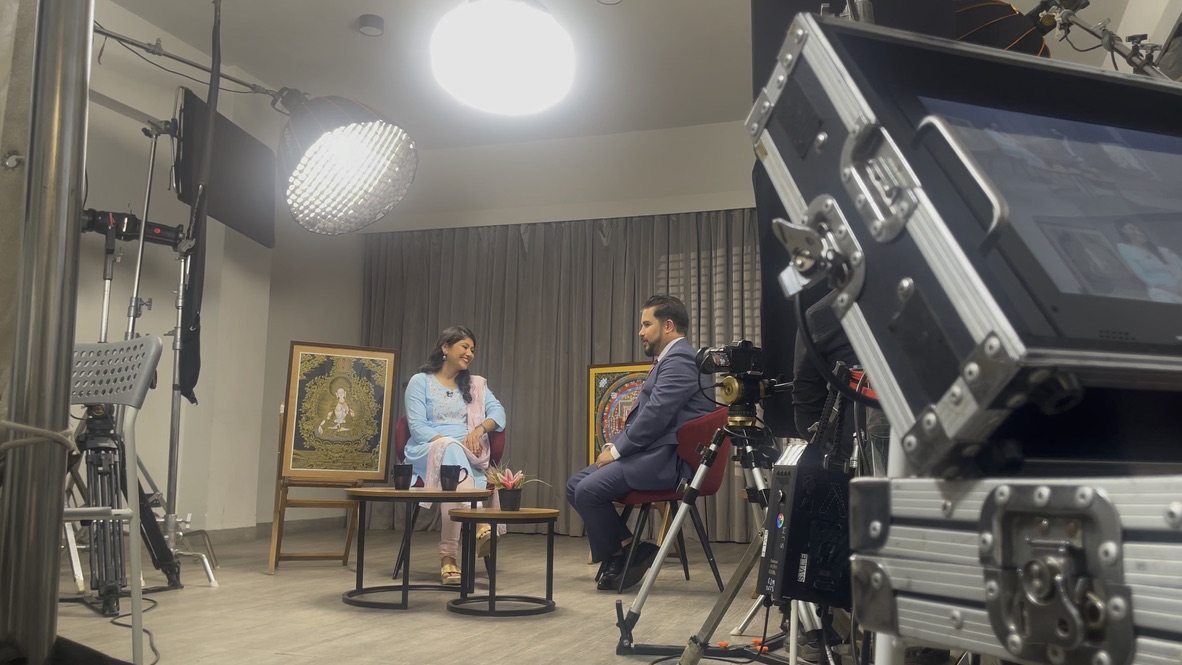
“The more I studied the heart scientifically, the more I realized its mystical dimensions,” Dr. Gautam reflects, sitting in his study in Kathmandu, surrounded by Thangka paintings that glow with 24-karat gold. “In every culture, the heart represents more than biology. It’s the seat of consciousness, the bridge between the material and the divine.”
When asked how he finds balance between the precision of medicine and the expressive world of Thangka art, he offers a thoughtful response:
“My journey in interventional cardiology has indeed been fulfilling and demanding, requiring a meticulous approach to achieve precision in patient care. Interestingly, I find a unique synergy between the precision demanded by medicine and the expressive world of Thangka art. In both fields, attention to detail is crucial. In interventional cardiology, it’s about ensuring the accuracy of procedures for optimal patient outcomes, while in Thangka art, the intricate details and symbolism require a similar level of dedication.
The artistic aspect of Thangka, with its rich cultural and spiritual significance, provides a refreshing counterbalance to the structured and methodical nature of my medical practice. Engaging with art allows me to tap into a different kind of creativity and expression, fostering a holistic approach to my well-being. I believe that the appreciation of art has not only enriched my personal life but has also positively influenced my approach to patient care, instilling a sense of empathy and understanding beyond the clinical setting.
In essence, the delicate dance between the precision of medicine and the expressive world of Thangka art has enhanced my ability to navigate the complexities of both fields, contributing to a more well-rounded and compassionate approach to life and healing.”
This realization sent him on a parallel journey—one that led to 12 books exploring the intersection of modern science and ancient wisdom:
1. SHIVA: THE COSMIC PULSE – A Cardiologist’s Journey into the Infinite
2. Shiva’s Pulse: An Interventional Cardiologist’s Journey Through Ancient Wisdom and Modern Science
3. Third Eye: Science and Spirituality
4. OM: The Cosmic Syllable – A Journey in Science and Spirit
5. Shiva the Primordial Code – Unveiling Consciousness From Atom To Absolute
6. The Conscious Cosmos: The Divine Equation of Existence
7. Ananta: The Infinite Embrace
8. The Infinite Octave: The Ashta Siddhis as Bridges to a Unified Consciousness
9. Nava: The Womb of Creation – A Journey from Cell to Cosmos
10. MY TENFOLD PRACTICE – A Cardiologist’s Dialogue with Shakti
11. In the Lap of the Infinite: Lullabies from Ten Mothers – A Son’s Journey of Surrender to the Divine
12. THE 12TH DIMENSION: Consciousness as the Supreme Reality
And it led him back to the Thangka paintings of his childhood.
The Sacred Art That Traveled Through Millennia
The story of Thangka begins not in Nepal, but in the very heart of ancient India.
Legend holds that the very first image of the Buddha was created during his own lifetime. King Bimbisara, a devoted disciple, is said to have commissioned a painting of the Enlightened One so that he could gaze upon his form when the Buddha was away. The artist, unable to look directly at the Buddha’s radiant form, is said to have drawn his reflection in water—giving birth to the first Buddhist icon.
Whether myth or history, the story captures something essential: from the very beginning, Buddhist art emerged from devotion, from the desire to connect with the sacred.
Over centuries, this tradition flourished. The caves of Ajanta and Ellora stand as magnificent testaments to early Buddhist painting, their walls adorned with scenes from the Buddha’s life and the Jataka tales. The great monastic universities of Nalanda and Vikramashila became not just centers of learning but also vibrant hubs of artistic creation, where monks and lay artists developed sophisticated iconometric systems for depicting enlightened beings.
As Buddhism traveled across Asia, so did its art. When monks carried texts across the Himalayas, they also carried painted scrolls. And in the Kathmandu Valley—geographically a crossroads between India and Tibet—Nepalese artists became the custodians of this visual heritage.
“When the great centers of Buddhist learning in India declined, Nepal became the guardian of this sacred artistic lineage,” Dr. Gautam explains. “For over a thousand years, Kathmandu’s artists have kept alive the traditions that once flourished at Nalanda. Every Thangka painted today carries within it the DNA of those ancient Indian masterpieces.”
The University of Nalanda and the Kathmandu Valley shared more than just religious texts—they shared artists, ideas, and aesthetic sensibilities. Newar masters refined and preserved these techniques over centuries, developing the distinctive Paubha tradition while also creating Thangkas for Tibetan patrons. The artistic DNA of Ajanta flows still in the brushstrokes of contemporary Thangka painters.
A Bridge Between Medical and Art Communities
When asked about his role as a bridge between these two seemingly disparate worlds, Dr. Gautam’s eyes light up with the same passion he brings to both his callings.
“My fascination with Thangka paintings stems from a profound appreciation for the cultural richness and spiritual depth they encapsulate. The intricate details, vibrant colors, and symbolic narratives in Thangka art have always captivated me. As a medical professional, I recognize the importance of balancing the precision of science with the beauty of art to achieve a more holistic understanding of life.
Being an art collector in the medical field, I see myself as a bridge between two seemingly distinct communities. Thangka art, with its roots in Tibetan Buddhism, carries a profound cultural and spiritual significance. By integrating this art form into my life and career, I aim to create a dialogue between the medical and art communities. Art has the power to transcend language barriers and connect people on a deeper level, fostering understanding and empathy.
In my role as a bridge between these communities, I hope to inspire conversations that explore the intersections of science, culture, and spirituality. Art can serve as a powerful medium for introspection and healing, complementing the advancements in modern medicine. By sharing my passion for Thangka art within the medical community and beyond, I aspire to encourage a broader perspective on well-being and foster a sense of unity between these diverse worlds.”
The Sacred Alchemy of Creating a Thangka
To understand Thangka is to understand that it is not merely painted—it is manifested through a profound spiritual process.
Step 1: The Canvas
The journey begins with cotton or silk, carefully stretched on a wooden frame and coated with a mixture of natural materials—traditionally including yak leather glue and calcium carbonate. Layer upon layer is applied, each dried and polished until the surface becomes perfectly smooth, like a cloud prepared to receive the divine.
Step 2: The Meditation
Before a single brushstroke is applied, the artist enters deep meditation. They visualize the deity for weeks or months, internalizing every detail—the exact curve of the eyes, the precise position of each hand, the subtle expression of compassion or wisdom. Only when the image is clear in their mind’s eye do they begin.
Step 3: The Sketch
Using charcoal or light pencil, the artist sketches the intricate outlines following strict iconometric guidelines passed down through generations. Every proportion is precisely measured—the length of fingers, the spacing of eyes, the posture of the body. There is no artistic license in traditional Thangka. The forms are sacred and must be accurate.
Step 4: The Colors
The pigments come from the earth itself. Lapis lazuli from distant mountains is ground into deep blues. Cinnabar becomes vermilion red. Malachite yields luminous greens. Gold—pure 24-karat gold—is ground into dust and mixed with binders, destined to illuminate the final work. Each color is prepared by hand, a laborious process that can take days for a single hue.
Step 5: The Painting
Working from background to foreground, the artist applies layer upon layer of color. Each layer must dry completely before the next is added. The process demands extraordinary patience—a single Thangka can take months or even years to complete.
Step 6: The Gold
With the finest brushes, the artist adds the luminous details that give Thangkas their ethereal glow—ornaments, jewelry, subtle highlights that seem to radiate light. The gold is not merely decorative; it represents the enlightened qualities of the deity, the radiance of awakened mind.
Step 7: The Blessing
Upon completion, many Thangkas receive a consecration ceremony. Mantras may be written on the back. The painting is treated not as art but as a vehicle for the divine—a sacred object through which blessings flow to all who behold it.
“A Thangka is not manufactured,” Dr. Gautam emphasizes. “It is manifested—through the artist’s visualization, their mantras, their months of focused intention. That is what makes it sacred. That is what makes it healing.”
The Cardiologist as Curator: Preserving Exclusivity and Tradition
What sets Dr. Gautam apart from other art dealers is his direct relationship with the artists themselves and his unwavering commitment to authenticity.
“Maintaining the exclusivity of each Thangka in my collection is indeed a priority for me. I approach the selection and collaboration with artists with a commitment to preserving the authenticity and individuality of each piece.
When selecting Thangkas, I prioritize artists who embody a deep understanding of the traditional techniques and spiritual significance inherent in this art form. Collaborating with these artists involves open communication and mutual respect for the cultural and artistic heritage they represent. I often engage in extensive discussions with the artists, delving into the symbolic elements, color choices, and narratives woven into each Thangka.
To ensure exclusivity, I often commission custom pieces that reflect not only the artist’s expertise but also resonate with my personal journey and values. This collaborative process allows me to contribute my perspective while respecting the artist’s creative autonomy.
Additionally, I actively seek out emerging artists and support their work, fostering a sense of mentorship and encouragement within the artistic community. This commitment to collaboration and supporting artists not only ensures the exclusivity of each Thangka but also contributes to the preservation and evolution of this incredible art form.”
Based in Kathmandu, he works personally with master Thangka painters, visiting their studios, understanding their processes, and ensuring they receive fair compensation for their work.
“I don’t buy from middlemen,” he states firmly. “I sit with the artists. I watch them grind minerals, apply gold leaf, meditate before beginning a new piece. These relationships are built on mutual respect, not commerce.”
This direct sourcing has profound implications—both financially and culturally. Financially, it means that a far greater portion of the collector’s investment reaches the artist who created the work. Culturally, it means that the artists are recognized not as anonymous craftspeople but as living treasures whose names, stories, and lineages become part of the painting’s provenance.
A Journey Home: Bringing Thangka Art to India
Dr. Gautam’s journey with Thangka art has taken him across the globe. He has held private exhibitions in several countries, sharing the beauty and spiritual depth of these sacred paintings with international audiences. Yet, through all his travels, a quiet pull grew stronger—a sense that the art needed to return to its source.
“I have been blessed to showcase these paintings in different parts of the world, and each experience has been meaningful,” he reflects. “But over time, my interest has shifted, almost magnetically, toward India. Specifically toward Mumbai.”
The reason, he explains, is profound.
“This art originated here. The seeds were planted in Indian soil—at Ajanta, at Ellora, at Nalanda. For centuries, Nepal became the caretaker, preserving and refining these traditions. But the roots remain here. Bringing Thangka art to India feels less like an export and more like a homecoming.”
He speaks of being “surrounded and supported by all good friends and well-wishers” in Mumbai—a network of connections that has transformed his vision into reality.
“This city has embraced me with such warmth. Friends who believe in the mission, collectors who understand the depth, artists who appreciate the connection—they have made this possible. I am not doing this alone. I am doing this with a community that shares the vision.”
Building Bridges with Mumbai: Three Exhibitions, Countless Connections
Dr. Gautam’s relationship with Mumbai is built on real connections forged over three successful private exhibitions in some of the city’s most prestigious venues.
The journey began at the Taj in Bandra, where a small gathering of art enthusiasts and collectors marked his first foray into the Mumbai art scene. The response was overwhelming. “People connected with the art in ways I hadn’t anticipated,” he recalls. “They didn’t just see paintings—they felt presence.”
Encouraged by this reception, he organized subsequent exhibitions at the JW Marriott in Juhu and Novotel in Juhu. Each event deepened his relationships with Mumbai’s collectors, interior designers, and art lovers. What started as curiosity evolved into trust, and trust into lasting partnerships.
These exhibitions were not about making sales—they were about building understanding. Dr. Gautam personally guided visitors through each Thangka, explaining the symbolism, the iconography, and the spiritual significance behind every brushstroke.
“Mumbai taught me something precious,” he says. “This city has a heart as big as its skyline. Once people understand what these paintings truly represent—the devotion, the tradition, the blessings—they open themselves to the art in a completely different way.”
Art, Healing, and the Aesthetics of Wellness
The intersection of Thangka art with healing is not merely philosophical for Dr. Gautam—it is deeply personal and experiential.
“The aesthetics of Thangka art hold a profound significance for me, intertwining with both my personal journey and the healing process for those who engage with my collection. The intricate details, vibrant colors, and symbolic narratives inherent in Thangka paintings create a visual tapestry that goes beyond mere decoration.
On a personal level, the aesthetics of Thangka art serve as a source of inspiration and tranquility. The contemplative nature of these artworks provides a meditative space, allowing me to find solace and balance amid the demands of my role as an interventional cardiologist. The harmonious blend of colors and the depth of symbolism often act as a visual sanctuary, fostering a sense of calm and introspection.
For those who experience my collection, I believe the aesthetics of Thangka art can contribute to the healing process on a broader scale. Art has the power to evoke emotions, stimulate the imagination, and provide a sense of connection to something greater than ourselves. In a medical setting, where stress and anxiety are prevalent, the presence of art can create a more soothing and empathetic environment.
Thangka art, with its spiritual and cultural roots, has the potential to resonate with individuals on a deeper level, offering a moment of respite and contemplation. Whether it’s patients, colleagues, or visitors, I hope that the aesthetics of my Thangka collection can play a role in enhancing well-being and contributing to a healing atmosphere.
In essence, the intersection of Thangka art aesthetics with the healing process is a testament to the transformative power of art in fostering a holistic approach to wellness, both for myself and those who engage with my collection.”
Elevating Nepali Artistry on the Global Stage
Beyond personal collection and commerce, Dr. Gautam’s mission carries a profound cultural dimension: elevating the recognition of Nepali artists internationally.
“Recognizing Nepal’s artists internationally is a mission that holds immense importance for me. I envision my efforts making a significant contribution to the broader recognition of Nepali artistry on the global stage.
By actively engaging with and supporting Nepali artists, my goal is to elevate their work and provide them with opportunities for international exposure. Through exhibitions, collaborations, and cultural exchanges, I aim to showcase the rich diversity and talent within Nepal’s art community.
Moreover, my commitment extends beyond individual artists to the broader narrative of Nepali artistry. I see myself as a facilitator, connecting the cultural richness of Nepal with the global art community. This not only enhances the visibility of Nepali artists but also contributes to a more inclusive and diverse representation in the international art scene.
I believe that the impact of these efforts goes beyond commerce, as it fosters cross-cultural understanding and appreciation. The recognition of Nepali artistry on a global scale not only brings deserved attention to the talent within Nepal but also creates a platform for cultural exchange, breaking down barriers and fostering a sense of unity through the universal language of art.
Ultimately, I envision my work contributing to a narrative where Nepali art is celebrated for its unique perspective, cultural depth, and artistic innovation, enriching the global artistic landscape.”
Healing Hearts, Preserving Heritage: The Mission Behind the Art
The phrase “healing hearts” is not metaphorical for Dr. Gautam. It is literal. And it extends far beyond the medical sphere.
A significant portion of every Thangka sold through his initiative goes directly to supporting orphaned and underprivileged children in Nepal. These funds provide healthcare, education, nutrition, and hope to those who have lost their families.
“My medical training taught me to heal physical hearts,” he reflects. “My spiritual journey taught me that healing has many dimensions. Through this work, I can support artists who are preserving a thousand-year-old tradition, and I can support children who deserve a chance at life. It all connects.”
This humanitarian mission has found particular resonance in Mumbai, a city known for its generous spirit and its deep appreciation for art and culture. Collectors who acquire Thangkas through Dr. Gautam know that their investment does more than beautify their homes—it transforms lives.
“When a collector in Mumbai purchases a Thangka, they become part of a story that reaches far beyond their walls. A child in Nepal receives medical care. An artist’s family is sustained. A thousand-year tradition continues for another generation. That is the power of art with purpose.”
Navigating Two Worlds: Challenges and Synergies
Balancing a demanding medical career with an active role in the art world is no small feat. Dr. Gautam is candid about the challenges.
“Balancing a demanding medical career with an active role in the art world indeed comes with its set of challenges. One of the primary hurdles I’ve faced is time management. The responsibilities of being an interventional cardiologist require a significant time commitment, leaving little room for extracurricular pursuits. Navigating this challenge has required a meticulous approach to scheduling and prioritization.
To overcome this hurdle, I’ve established a structured routine that allows me to allocate dedicated time to both my medical responsibilities and my involvement in the art world. Prioritizing tasks, setting clear goals, and maintaining a disciplined approach have been crucial in ensuring that I can fulfill my commitments in both spheres.
Another challenge has been the need for flexibility. Medical emergencies and unpredictable schedules are inherent in the field of healthcare. This has sometimes posed challenges to my art-related activities. However, by fostering open communication with artists, collaborators, and colleagues, I’ve been able to navigate these challenges effectively. Building a strong support system and surrounding myself with understanding individuals has been instrumental in managing unexpected demands on my time.
Moreover, I’ve learned to view the intersection of my medical career and art involvement not as a source of conflict but as a symbiotic relationship. The precision and discipline required in medicine complement the creativity and expression found in art, creating a harmonious balance that enriches both aspects of my life.
In essence, while challenges do arise, navigating them has been a learning process that has enhanced my ability to manage time, prioritize effectively, and find synergy between two seemingly disparate worlds.”
Art as a Universal Bridge: A Prayer for Peace and Prosperity
Dr. Gautam’s vision extends far beyond commerce or even cultural preservation. At its heart, his mission is about something more profound: the power of art to unite human beings across every boundary that divides us.
“Art speaks a language that transcends words,” he reflects. “A Thangka painted in Kathmandu carries the same devotion, the same blessing, whether it is viewed in Tokyo, New York, or Mumbai. The heart that responds to beauty is the same heart everywhere.”
In a time of global uncertainty—when borders harden, when conflicts rage, when anxiety seems to be the prevailing mood of our age—Dr. Gautam believes that art offers something essential.
“We live in an era of unprecedented unrest. Political divisions, environmental crises, spiritual disconnection—the weight of it all bears down on the human soul. In such times, what can possibly bring us together? Not politics. Not ideology. But beauty? Yes. Art? Yes. The silent recognition of something sacred? Absolutely.”
He pauses, gesturing to the Thangkas that surround us.
“These paintings have survived for over a thousand years. They have witnessed the rise and fall of empires, the passing of countless generations. They have traveled across mountains and oceans, carried by monks and merchants, scholars and seekers. They have never stopped speaking to the human heart. That is their power. That is their blessing.”
For Dr. Gautam, the current project is not merely about promoting Nepalese art in India. It is about participating in something much larger—a global conversation about what it means to be human, to seek meaning, to connect with something beyond ourselves.
“When a collector in Mumbai lives with a Green Tara Thangka, that painting continues its work. It blesses the space. It reminds the viewer of compassion. It creates a small oasis of peace in a chaotic world. And somehow, imperceptibly, that peace radiates outward.”
He quotes an ancient Sanskrit verse: “Yatha pinde tatha brahmande” — as in the individual, so in the cosmos.
“The healing of one heart contributes to the healing of the world. I believe this with my whole being—as a scientist, as a spiritual seeker, as a human being.”
A Vision for the Future: Spreading Love, Prosperity, and Peace
Looking ahead, Dr. Gautam’s aspirations extend beyond the exhibitions and collections that have defined his journey so far.
“This is only the beginning,” he shares with quiet intensity. “Later on, I will come up with more spiritual themes of painting—works that speak even more directly to the human condition, to our shared longing for meaning and connection.”
He envisions a series of collections organized around themes of universal resonance: love that transcends boundaries, prosperity that includes all beings, peace that radiates from the individual to the world.
“The paintings themselves carry these energies. A Green Tara Thangka embodies compassion. A Medicine Buddha radiates healing. A Mandala represents cosmic order. By curating them around spiritual themes, I hope to make their messages even more accessible, even more powerful.”
His ultimate goal is simple yet profound: to spread a message of love, prosperity, and peace through the art that has touched his own life so deeply.
“If even one person finds comfort in a Thangka during a difficult time, if even one home becomes a little more peaceful because of these paintings, if even one child in Nepal receives care because of a collector in Mumbai—then this work has meaning. Then it has purpose.”
A Prayer Through Art
As our conversation draws to a close, Dr. Gautam’s voice grows softer, more contemplative.
“If I could offer a prayer through this work, it would be this: May these sacred paintings touch every soul that beholds them. May they bring peace to the anxious, comfort to the grieving, inspiration to the seeker. May they remind us that beneath all our differences—of nationality, of religion, of culture—we share the same longing for beauty, for meaning, for connection.
In a world that often seems determined to tear itself apart, may art be the thread that weaves us back together. May the blessings carried in every brushstroke, every particle of gold, every prayer of the artist, reach across boundaries and touch hearts everywhere.
And may the children of Nepal—the orphans, the underprivileged, the forgotten—feel the ripple of compassion that begins when a collector in Mumbai opens their heart to this sacred art.
That is my prayer. That is my purpose. That is why I do this work.”
The Man Behind the Mission
Those who meet Dr. Gautam are struck by his calm presence—the same quality, perhaps, that serves him in the cath lab when a patient’s life hangs in the balance. He speaks softly but with conviction, and his eyes light up when he discusses either a complex coronary intervention or the precise shade of lapis lazuli in a Green Tara painting.
“I am asked sometimes whether cardiology and art curation are two different careers. For me, they are not. Both require presence. Both require precision. Both require love. The heart I hold in my hand and the heart I touch through art—they are the same heart.”
His 12 books have found readers across the world. His scientific publications continue to be cited by researchers. And now, his Thangka collection is finding its way into the homes and hearts of collectors who recognize that some things cannot be mass-produced.
“In a world of speed, we offer stillness. In a world of mass production, we offer the artist’s unique hand. In a world of noise, we offer a silent blessing. That is what Thangka art has always been. That is what it remains.”
A Bridge Between Worlds
“India and Nepal are not two separate stories,” Dr. Gautam reflects. “Our art, our spirituality, our hearts—they are woven together. The same currents that produced the Ajanta caves also flowed through the Kathmandu Valley. The same devotion that built Nalanda also sustained our Thangka painters. And now, the same city that never sleeps—Mumbai—is opening its heart to this ancient art.”
He pauses, looking at a Thangka of Green Tara that hangs on his wall.
“When I was a child watching my grandmother apply gold leaf, I had no idea where life would take me. I didn’t know I would become a doctor, or study in Japan, or write books, or travel the world with these paintings. But through all those journeys, something kept pulling me back here—to India, to Mumbai, to the place where this art was born.”
“And now, surrounded by friends and well-wishers who share this vision, I feel like I am exactly where I am meant to be.”
“What is that vision?”
He smiles. “To bring these sacred paintings home. To share their blessings. To spread love, prosperity, and peace through art. And to let that message travel from Mumbai to wherever it needs to go.”
At a Glance: Dr. Milan Gautam
Background: Interventional Cardiologist, MBBS (Nepal), PhD (Cardiology, Japan)
Email: drmilangautam999@gmail.com
Experience: Over 12 years in interventional and clinical cardiology at leading Nepalese hospitals including Nepal Mediciti Hospital, Grande International Hospital, and Shahid Gangalal National Heart Center
Research: Multiple publications in international journals; presentations at American Heart Association, European Society of Cardiology
Books: Author of 12 books exploring the intersection of science and spirituality
Art Curation: Directly sources authentic Thangka and Paubha paintings from master artists in Nepal
International Presence: Has held private exhibitions in multiple countries; now focused on promoting Thangka art in India, particularly Mumbai, where the tradition originated
Mumbai Presence: Three successful private exhibitions at Taj (Bandra), JW Marriott (Juhu), and Novotel (Juhu), supported by a growing community of friends and well-wishers
Humanitarian Mission: Portion of proceeds supports healthcare and education for orphaned and underprivileged children in Nepal
Future Vision: Upcoming collections exploring deeper spiritual themes, spreading messages of love, prosperity, and peace through sacred art
Upcoming: Quarterly charity exhibition series “Sacred Arts with Purpose” in Mumbai, with 100% of profits to orphan welfare