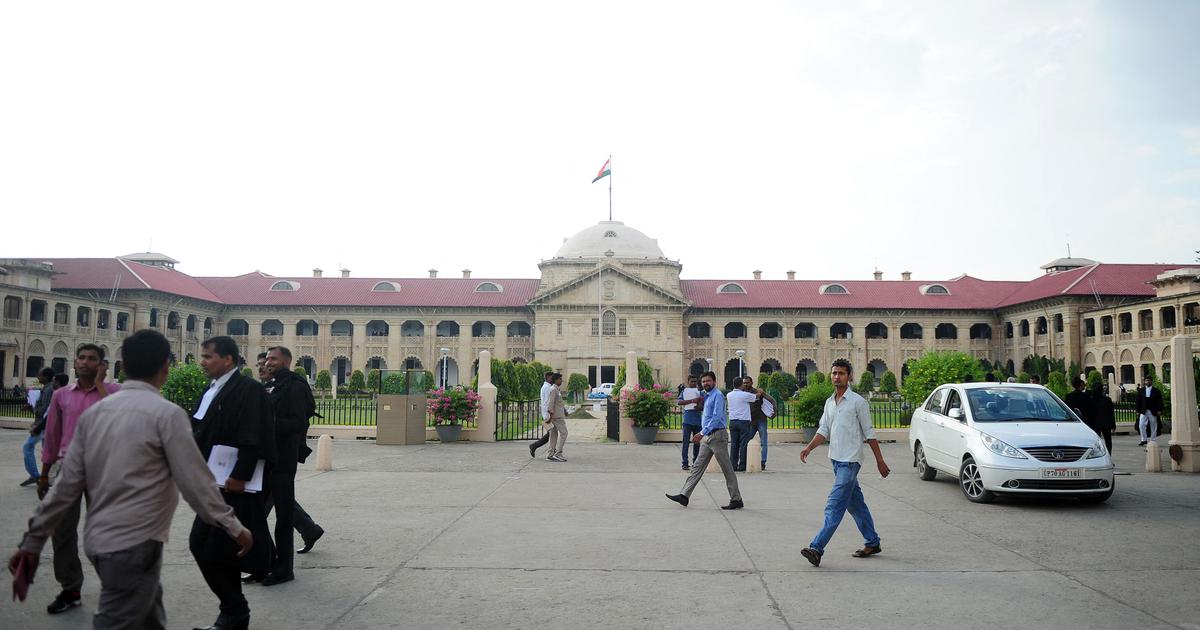
The Allahabad High Court has stepped in to protect a Muslim man who claimed he was barred from offering namaz on his own property in Bareilly district, Uttar Pradesh. In a ruling delivered on Wednesday, the court ordered the deployment of two security guards to ensure the safety of Haseen Khan and his family.
Khan reported that he faced intimidation from certain individuals who threatened to demolish his property in Mohammad Ganj village unless he complied with their demands in court. He also alleged that police officers coerced him into signing documents without properly explaining their content, which raises serious concerns about due process. In his plea, Khan requested the court to safeguard both his family and his assets amid these threatening circumstances.
The bench, consisting of Justices Atul Sreedharan and Siddharth Nandan, responded to Khan’s fears by mandating round-the-clock armed protection for him. The justices expressed that any violent act against Khan or his property would initially be presumed to have occurred with state complicity, although this assumption could be challenged later.
This case is particularly significant in light of an earlier judgment by the Allahabad High Court, which ruled on January 27 that individuals do not require formal permission to hold religious prayers on private property, as long as the practice remains within the confines of their premises. This aligns with the rights granted under India’s constitution, which advocates for freedom of religion.
The court’s recent decisions underscore an ongoing dialogue about religious freedom and individual rights in India, especially in contexts where communal tensions can arise. As this situation unfolds, it will be fascinating to see how local authorities and the judiciary navigate the complexities involved.