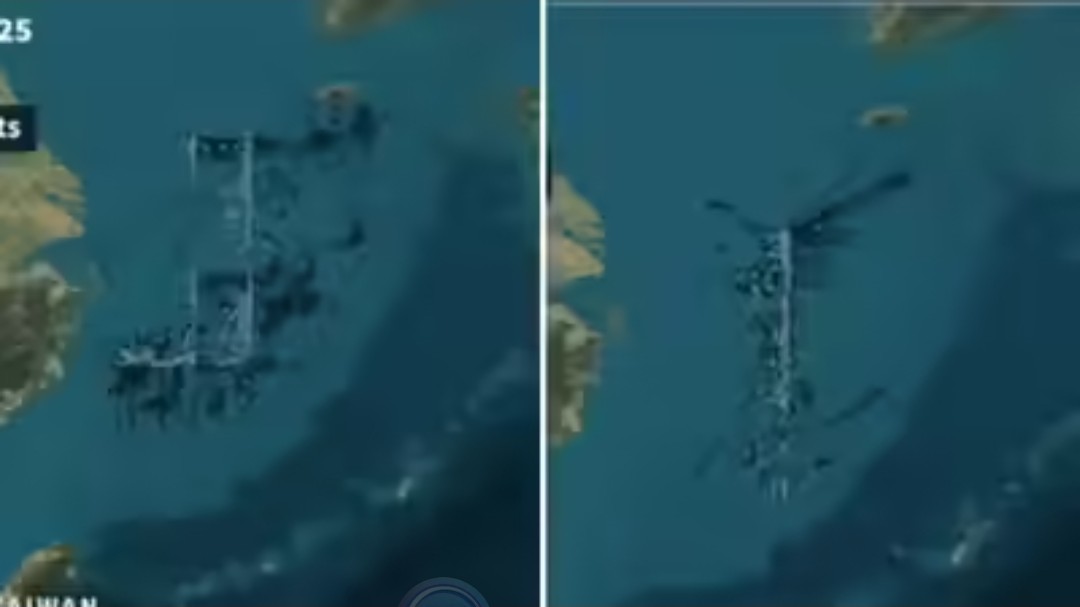
Beyond Fishing: Thousands of Chinese Vessels Form Strategic Patterns Near Taiwan
TAIPEI/BEIJING – A recent analysis of satellite imagery and AIS (Automatic Identification System) data has revealed “highly unusual” behavior among China’s massive fishing fleet in the East China Sea. Between December and January, thousands of vessels were observed abandoning traditional fishing routes to form precise geometric patterns, sparking concerns over a new phase of maritime mobilization.
The “Gray Zone” Maneuver
According to an investigation by AFP, these formations do not align with any known commercial fishing practices. Instead of following schools of fish, the vessels moved in synchronized, grid-like clusters.
Key findings from maritime and defense analysts suggest:
Civilian Mobilization: Beijing may be testing the “Maritime Militia”—a force of civilian ships that can be activated for logistics, blockades, or surveillance.
Swarm Tactics: The formations could represent a rehearsal for “swarming” techniques, intended to overwhelm the sensors and response capabilities of the Taiwanese or U.S. Navies.
A “New Normal”: By using civilian hulls, China can project power and assert territorial claims without technically deploying the People’s Liberation Army Navy (PLAN), complicating any international response.
Strategic Implications
Experts interviewed by AFP noted that the timing—mid-winter and near sensitive waters—points to a strategic exercise rather than a seasonal industry shift. “They are not fishing,” one maritime security expert noted. “This is a coordinated display of command and control over a non-military asset.”
While Beijing has not officially commented on the maneuvers, the incident adds another layer of tension to the cross-strait relationship, as observers wonder if these “geometric patterns” are a blueprint for a future blockade.
Quick Analysis: Why this matters
In modern geopolitics, China’s Maritime Militia acts as a “Third Sea Force.” By masking military intent with civilian boats, they create a “deniability” factor. If a coast guard ship hits a fishing boat, it looks like an accident or bullying; if it hits a destroyer, it’s an act of war.
Aranyak Chakraborty