Central Government Moves Towards Increasing Lok Sabha And Assembly Seats — How Many Seats For Each State –?
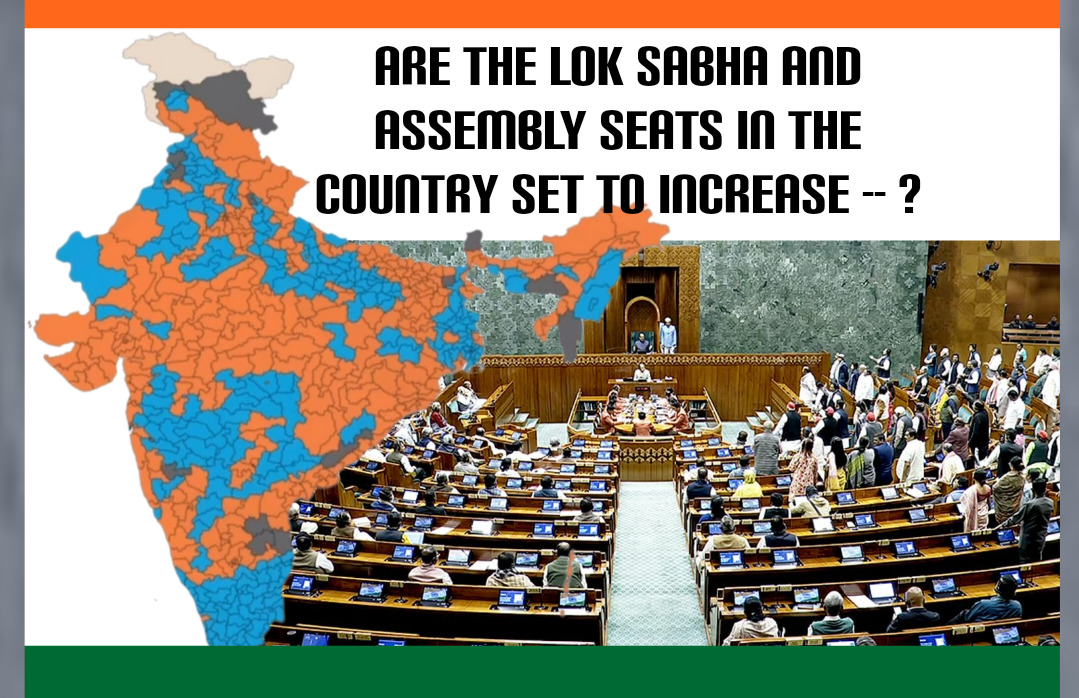
New Delhi, March 24, IPU Media Update News : The Central Government is taking steps to increase the number of seats in the Lok Sabha and State Assemblies by 50 percent. If this bill is enacted, the total number of Lok Sabha seats in the country will rise to 816, and Assembly seats will increase to 6,185.
The Central Government has taken a pivotal decision to increase both Lok Sabha seats and the Assembly seats of all states across the country by 50 percent. Accordingly, Prime Minister Narendra Modi’s government is currently working on introducing a bill to this effect during the ongoing parliamentary session itself. If this proposal is implemented, the number of Lok Sabha seats will increase from 543 to 816. Furthermore, the total number of Assembly seats nationwide will rise from 4,123 to 6,185. The Central Government intends to introduce amendments to relevant laws to expedite the delimitation (redrawing) of constituencies and the implementation of women’s reservations. It is actively working and taking concrete steps in this direction.
The Modi government has initiated measures to complete the national census by March 2027 and to implement this increase in seats—based on those census figures—by the time of the 2029 elections. Concerns persist that if the increase in seats were to be undertaken solely on the basis of population size, it would result in a disparity in political representation between the northern and southern states. Taking this matter into consideration, the Central Government has put forward a new strategy proposing a uniform 50 percent increase in seats across all states. Opposition parties, led by Mallikarjun Kharge, are scheduled to meet on Tuesday to respond to this proposal.
** Which States Will See an Increase in Lok Sabha Seats -? **
If Lok Sabha seats are increased by 50 percent, Uttar Pradesh stands to benefit the most. The number of Lok Sabha seats in UP, currently at 80, would rise to 120. Of these, 40 seats are proposed to be reserved for women. Seats in Maharashtra would increase from 48 to 72. West Bengal’s tally would go from 42 to 63, Bihar’s from 40 to 60; in Andhra Pradesh, Lok Sabha seats would rise from 25 to 38, and in Telangana, from 17 to 26. In Tamil Nadu, the number of Lok Sabha seats would increase from 39 to 59, while in Madhya Pradesh, they would rise from 29 to 44.
Among the smaller states, the Lok Sabha seats for Arunachal Pradesh, Goa, Manipur, Meghalaya, and Tripura could increase from 2 to 3 each. States such as Mizoram, Nagaland, and Sikkim—which currently hold one seat each—are likely to receive 2 seats apiece. Among the Union Territories, Lok Sabha seats in Delhi would increase from 7 to 11, and in Jammu & Kashmir, from 5 to 8. There is currently no clarity regarding whether the number of seats will increase in Union Territories that presently hold only one seat, such as Ladakh and Puducherry.
** To Be Implemented in the Upcoming 2029 Elections **
In order to facilitate an increase in the number of Assembly and Lok Sabha constituencies, certain amendments to the Constitution will be required. To this end, reports suggest that bills proposing amendments to the Women’s Reservation Act and the Delimitation Act are set to be introduced during the current parliamentary session. Once the relevant bill is passed in the Lok Sabha, the Central Government intends to constitute a Delimitation Commission. It appears that the process of increasing the number of seats will be expedited to ensure its implementation in the upcoming 2029 elections. Furthermore, it is reported that reservations for Scheduled Castes (SCs) and Scheduled Tribes (STs) will also increase in proportion to the expansion of seats.
** Centre Seeks Support from All Political Parties **
According to the bill passed in September 2023, a 33% reservation for women was scheduled to come into effect starting in 2034. As per Articles 170(3) and 81(3) of the Indian Constitution, there is a stipulation that the delimitation (redistribution) of constituencies across the country must be carried out based on the census data published after 2026. Consequently, it was previously assumed that the Central Government would implement the women’s reservation policy only from 2034 onwards. However, the census is now expected to be completed by March 1, 2027. This would allow for the immediate commencement of constituency delimitation proceedings following the announcement of the preliminary census data. The Central Government has already initiated efforts to garner support from all political parties regarding this matter.
— M Venkata T Reddy, News Editor and Investigative Journalist