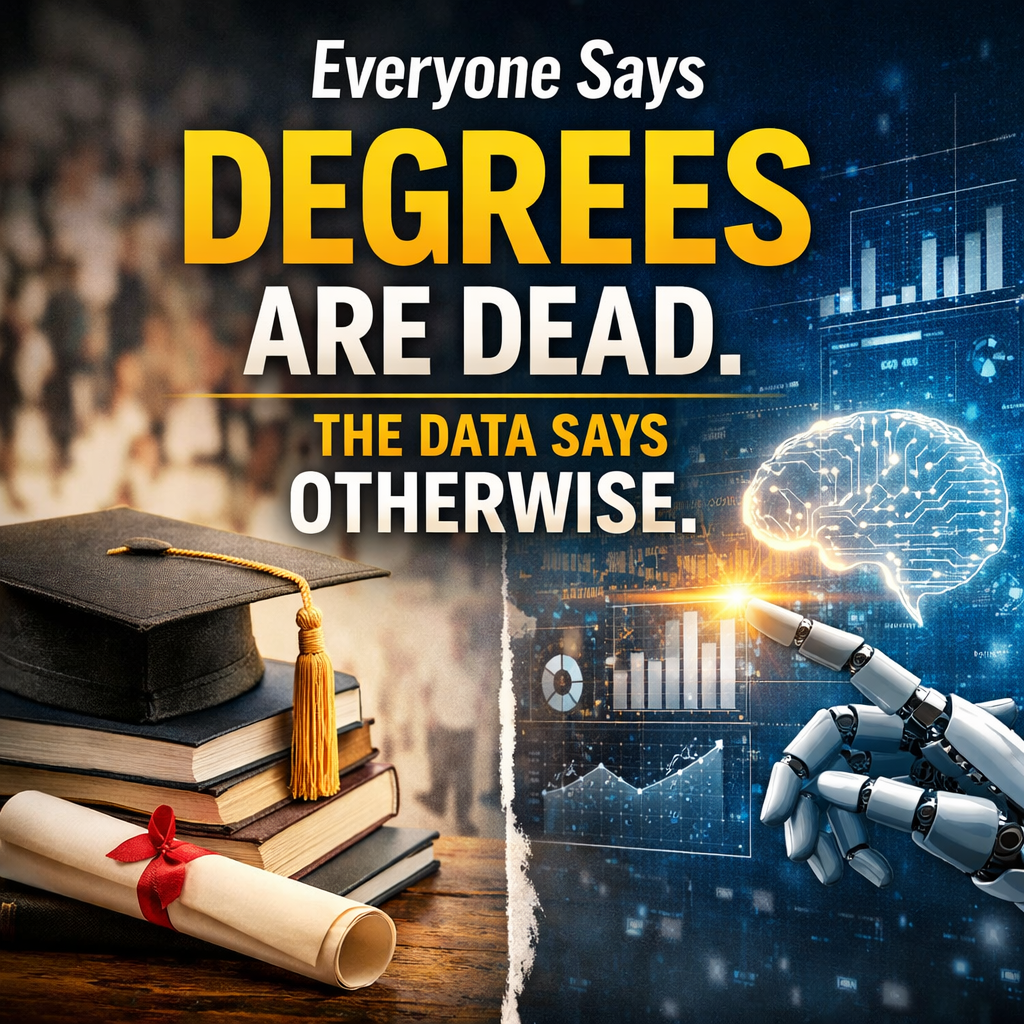
Higher education is criticized more than ever—yet remains the backbone of the modern workforce
In cafés, on podcasts, and across social media, a new narrative has taken hold: college degrees are losing value. Commentators argue that MBAs, engineering degrees, and traditional bachelor’s programs no longer guarantee employment. Stories circulate about graduates driving taxis, coding bootcamps replacing universities, and billionaires who dropped out of college.
Yet beneath the headlines lies a more complex reality. The modern formal economy—from technology companies to financial institutions, consulting firms, and healthcare systems—is still overwhelmingly powered by graduates. The paradox of our time is this: people question the value of higher education precisely when it has become more central to the workforce than ever before.
The issue is not whether degrees matter. The issue is what skills accompany them—and how they are applied.
Across OECD countries, about 86% of adults with a bachelor’s degree are employed, compared with far lower employment rates among those with only secondary education. Those with master’s or doctoral degrees see employment rates rise further to around 90–93%. Even in periods when graduate hiring slows—as seen in the United Kingdom and United States recently—graduates still outperform non-graduates over the long term in both employment and earnings.
The Perception Gap: Degrees Without Skills
Part of the criticism stems from a genuine problem: a mismatch between academic knowledge and workplace skill. In many countries, universities expanded rapidly over the last two decades. More people now graduate each year than ever before. At the same time, entry-level job growth has not always kept pace. The result is visible in labor statistics. Some graduates struggle to find their first job, and in some cases they accept roles that do not require their degree.
Employers today increasingly look for graduates who combine formal education with:
1. Digital literacy
2. Data analysis
3. Critical thinking
4. Communication and collaboration
5. Real-world project experience
In other words, education provides the foundation—but skills create employability.
The Silicon Valley Myth
Perhaps the most persistent myth in the debate is the image of the college dropout billionaire.
Yes, technology history includes famous exceptions: Bill Gates, Steve Jobs, Mark Zuckerberg. But these individuals are statistical anomalies, not workforce trends.
The reality is that the largest technology companies in the world—such as OpenAI, Google, and Meta—are overwhelmingly staffed by highly educated professionals.
Software engineers, machine learning researchers, product managers, and data scientists typically hold degrees in computer science, mathematics, engineering, or related disciplines. In advanced research roles, master’s and PhD degrees are often the norm.
The myth of the dropout founder obscures the reality of modern innovation: the AI economy is built largely by graduates with advanced technical training.
The AI Paradox
Ironically, the rise of artificial intelligence may increase—not decrease—the value of education.
As routine tasks become automated, jobs will increasingly require deeper cognitive capabilities, interdisciplinary thinking, and the ability to design systems rather than merely operate them.
These are precisely the kinds of capabilities universities aim to develop.
The End of the Degree Debate
The debate over whether higher education is “worth it” often frames the issue incorrectly.
The real question is not whether degrees matter.
The real question is whether individuals and institutions can translate education into capability.
Degrees remain the backbone of the professional workforce because they provide the intellectual frameworks necessary for complex problem-solving.
But in the AI age, those frameworks must be paired with practical skills, technological fluency, and the ability to apply knowledge dynamically.
In short, the future belongs neither to degrees alone nor to skills alone.
It belongs to those who combine structured learning with continuous adaptation.