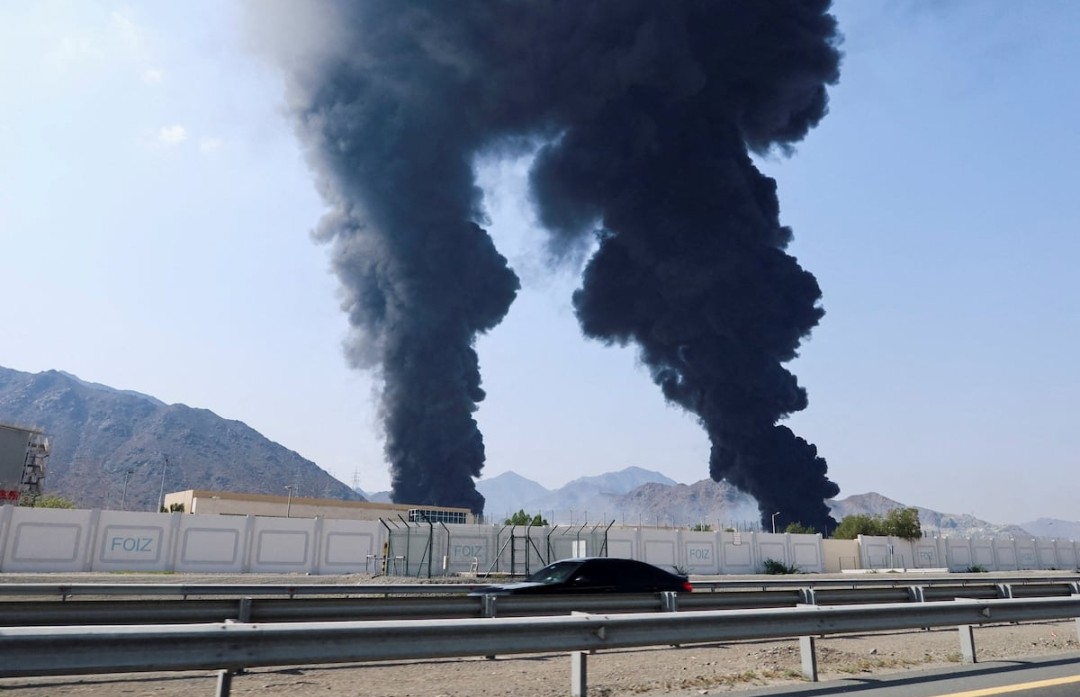
Fujairah Oil Operations Resume Following Drone Strike and Fire
FUJAIRAH, UAE – Oil loading operations at the Port of Fujairah, a critical global bunkering hub and crude export terminal, have officially resumed following a temporary suspension triggered by a drone attack on Saturday.
Industry sources confirmed on Sunday, March 15, 2026, that the facility—located strategically outside the Strait of Hormuz—is once again operational. The resumption provides a much-needed “safety valve” for global energy markets as regional hostilities continue to intensify.
The Incident
Early Saturday morning, the Fujairah Oil Industry Zone was targeted in a drone strike that sparked fires in at least two crude storage tanks. Local authorities reported that the blaze was caused by falling debris following a successful interception by the UAE’s air defense systems.
Casualties: No injuries were reported.
Damage: While two tanks sustained damage, civil defense teams contained the fire quickly, preventing a wider catastrophe.
Operational Impact: Loading was halted for approximately 24 hours as a precautionary measure while safety checks were conducted.
Strategic Importance
Fujairah is the world’s third-largest bunkering hub and serves as the primary outlet for the UAE’s Murban crude. Its location is vital because it allows exports to bypass the Strait of Hormuz, which has seen restricted traffic due to the ongoing regional conflict.
”The resumption of loading at Fujairah is a pivotal development for global supply chains,” noted one market analyst. “With the Strait of Hormuz effectively shuttered, this port is the nation’s primary economic lifeline.”
Context of Escalation
The attack follows a series of high-stakes military exchanges in the region. Hours before the strike on Fujairah, U.S. forces reportedly struck military targets on Iran’s Kharg Island, a major Iranian oil export hub. In retaliation, Tehran had issued warnings that ports and docks in the UAE could be viewed as legitimate targets.
While Abu Dhabi National Oil Co. (ADNOC) has not issued a formal statement, market sources confirmed that tankers began docking at the terminal early Sunday morning. Brent crude continues to trade near the $100-per-barrel mark as traders monitor the stability of Gulf infrastructure.
Market Analysis: The Impact of Fujairah’s Resumption on Global Oil Prices
The resumption of operations at the Fujairah oil terminal is a critical development for a market currently operating under “war footing” conditions. While the immediate physical damage was contained, the incident has reshaped the risk premium for the coming week.
1. The “Hormuz-Bypass” Risk Premium
Fujairah is no longer just a secondary terminal; it is the primary lifeline for UAE exports while the Strait of Hormuz remains effectively blocked.
• The Fragility Factor: Traders now realize that even the “bypass” route is within drone range. Sunday’s price stability reflects relief that the port is back online, but a “fragility premium” of $5–$7 per barrel is likely to remain baked into Brent crude prices as long as regional air defenses are being actively tested.
• Inventory Draws: Before the resumption, analysts warned that a prolonged shutdown would force the UAE to curb production by nearly 3.5 million barrels per day. The quick restart prevents a massive global supply vacuum but keeps the market on edge regarding “what happens if the next one hits.”
2. Brent Crude Outlook ($95 – $110 Range)
Despite the resumption, Brent crude is trading near $101 per barrel as of Sunday afternoon.
• Resistance Levels: If Fujairah remains stable, prices may settle around the $98 support level. However, any sign of secondary damage or technical delays could push prices toward $110 by Tuesday’s market open.
• The IEA Factor: To counter the volatility from Saturday’s attack, the International Energy Agency (IEA) has discussed a coordinated release of 400 million barrels from strategic reserves. This “emergency floor” is the only factor preventing a spike toward $120 in the immediate term.
3. Impact on Bunkering and Shipping Costs
As the world’s third-largest bunkering hub, Fujairah’s brief shutdown sent shockwaves through the maritime industry:
• War-Risk Insurance: Insurance premiums for tankers docking in the Gulf of Oman are expected to rise by 10–15% this week following the fire.
• Fuel Surcharges: Global Very Low Sulfur Fuel Oil (VLSFO) prices are projected to average over $700/mt in the coming weeks. For logistics companies, this means higher operational costs that will eventually trickle down to consumer goods.
Key Indicators to Watch (March 16-20)
Indicator
Critical Level
Significance
Brent Crude
$105.00
A break above this indicates market panic over infrastructure safety.
ADNOC Statement
Official PR
Any mention of “long-term repairs” will trigger a fresh price rally.
Kharg Island Status
Satellite Intel
Further escalation at Iran’s terminal usually leads to retaliatory strikes on UAE hubs.
Aranyak Chakraborty