Guwahati — Once known primarily as the gateway to Northeast India, Guwahati today is steadily redefining itself as a symbol of modern urban transformation, blending infrastructure growth with natural beauty.
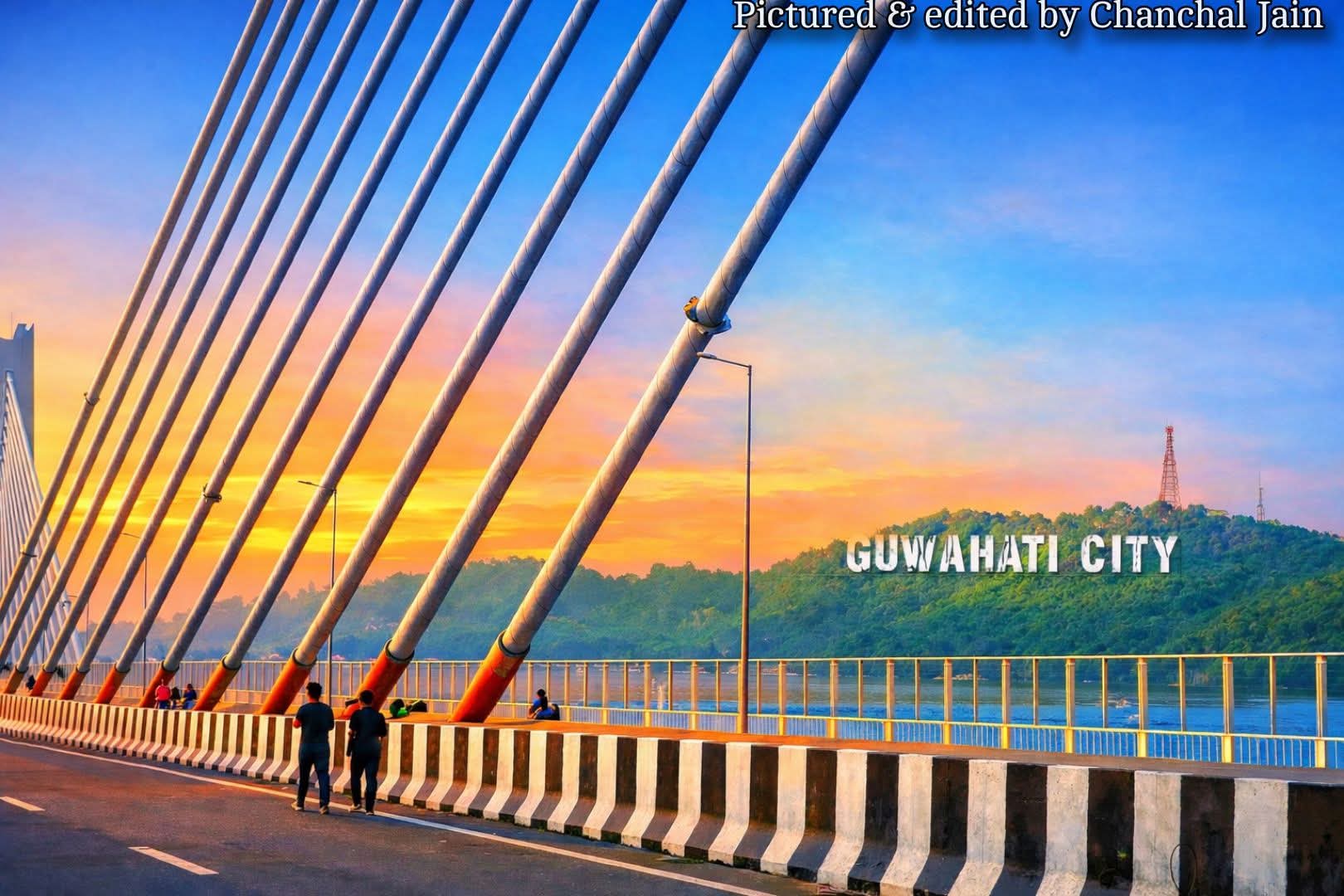
A recent visual capture of the city’s iconic cable-stayed bridge over the mighty Brahmaputra River reflects this transition vividly. Bathed in the golden hues of sunset, the bridge stands not merely as an engineering structure, but as a testament to Assam’s growing ambition. Its sweeping cables carve a striking silhouette across the sky, while the calm river below and the lush green hills in the distance preserve the region’s timeless charm.
This seamless blend of development and ecology underscores a larger narrative — one of a city advancing with purpose while staying rooted in its identity.
In recent years, under the leadership of Hon’ble Chief Minister Himanta Biswa Sharma, Assam has witnessed a renewed thrust on infrastructure and urban development. Strategic investments in road networks, bridges, and river connectivity have significantly enhanced mobility, not only within Guwahati but across the state.
Urban initiatives, including beautification drives, improved pedestrian infrastructure, and smart city planning, are contributing to a more organized and livable urban environment. The transformation is visible — cleaner roads, better public spaces, and thoughtfully designed projects that balance functionality with aesthetics.
Guwahati’s evolution is particularly significant given its strategic role. As the largest city in the Northeast, it serves as a commercial, cultural, and logistical hub. Strengthening its infrastructure has far-reaching implications, positioning it as a key driver of regional growth and economic integration.
What makes this transformation noteworthy is not just the scale of development, but the intent behind it. The focus has been on creating a city that is accessible, future-ready, and inclusive — without compromising its natural and cultural heritage.
This image, therefore, goes beyond its visual appeal. It captures a moment in time that reflects a broader story — of governance, planning, and aspiration. It speaks of a Guwahati that is no longer just evolving, but actively shaping its identity as a modern urban landmark.
A city once defined by its geography is now being redefined by its vision — confident, connected, and ready for the future.