Tourism is one of the most significant contributors to India’s economy, generating employment, foreign exchange, and cultural exchange. However, global and regional conflicts (wars) have a direct and indirect impact on the tourism sector. Even if India is not directly involved in a war, geopolitical tensions across the world influence travel behavior, safety perceptions, and economic stability.
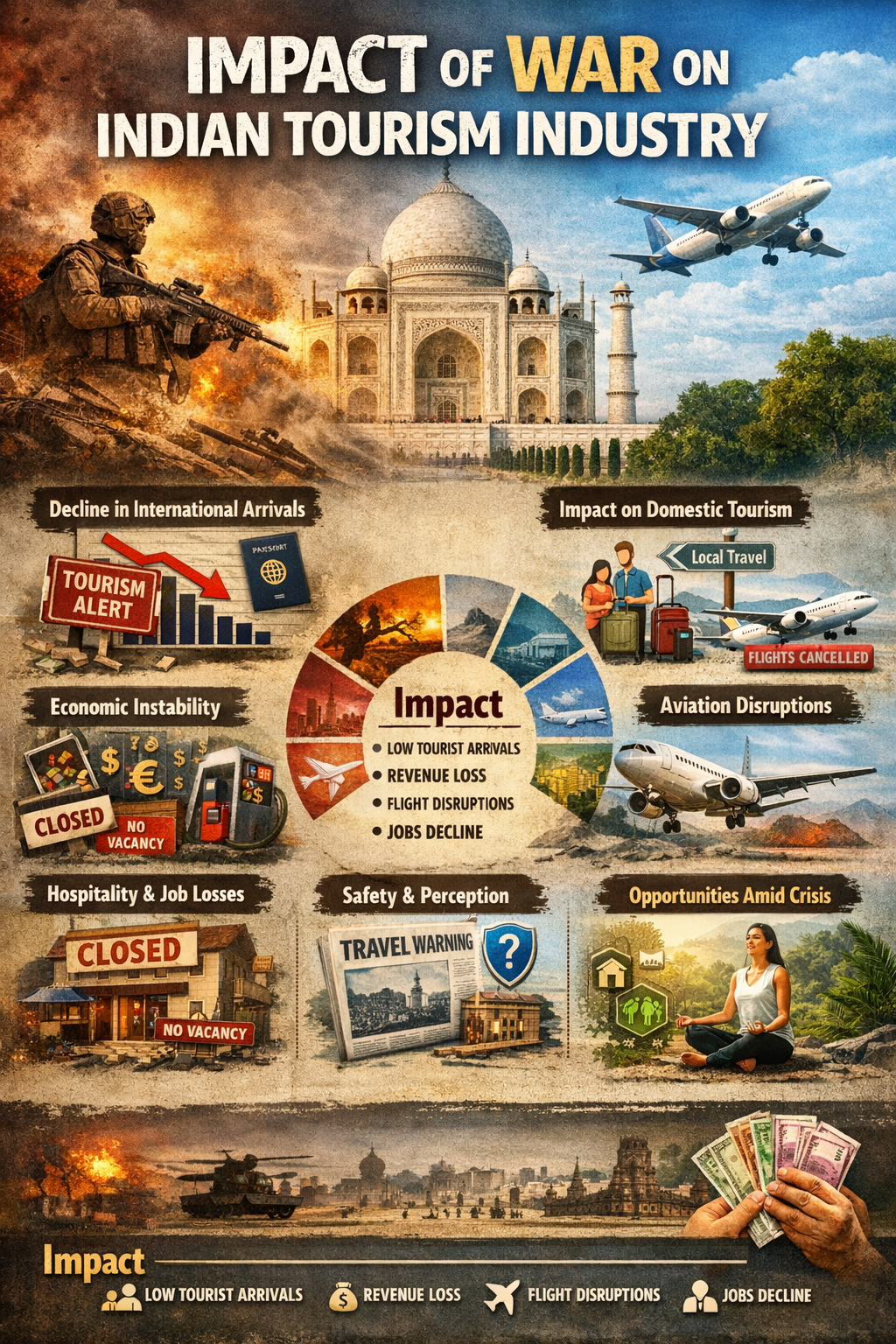
1. Decline in International Tourist Arrivals
One of the most immediate effects of war is a decline in foreign tourist arrivals. Travelers often avoid regions perceived as unsafe, even if the conflict is geographically distant.
Fear of uncertainty and security concerns reduce inbound tourism.
Travel advisories issued by foreign governments discourage travel to nearby regions.
Airlines may reduce routes, affecting accessibility.
2. Economic Instability and Reduced Spending
Wars often lead to global economic instability, inflation, and currency fluctuations.
Tourists cut down on leisure travel due to financial uncertainty.
Rising fuel prices increase travel costs (airfare, transport, accommodation).
Tourism businesses in India face reduced bookings and revenue losses.
3. Impact on Domestic Tourism
While international tourism may decline, domestic tourism can show mixed trends:
Some travelers prefer local destinations instead of international travel.
However, economic uncertainty can still reduce discretionary spending.
Budget travel increases, while luxury tourism may decline.
4. Aviation and Connectivity Disruptions
War zones often lead to restricted airspace and disrupted flight routes.
Longer flight durations and increased ticket prices.
Cancellation of flights connecting India to affected regions.
Reduced tourist inflow due to inconvenience.
5. Effect on Hospitality and Employment
The tourism and hospitality sector is labor-intensive.
Hotels, travel agencies, and tour operators face reduced occupancy.
Job losses or salary cuts in tourism-related sectors.
Small businesses like local guides, transport providers, and artisans suffer the most.
6. Image and Perception of Safety
Even indirect association with a conflict region can affect India’s image as a safe destination.
Media coverage influences tourist perception.
Tourists prefer destinations with political stability.
Recovery of trust takes time even after the conflict ends.
7. Opportunities Amid Crisis
Despite challenges, certain opportunities arise:
Increase in domestic tourism and regional travel.
Promotion of “safe tourism destinations” within India.
Growth of spiritual, wellness, and eco-tourism sectors.
Digital tourism marketing and virtual engagement.
8. Government Initiatives and Response
The Indian government and tourism authorities play a key role in mitigating the impact:
Campaigns promoting safe travel in India.
Financial support and relief packages for tourism businesses.
Strengthening domestic tourism infrastructure.
Enhancing safety and security measures.
Conclusion
War and geopolitical conflicts significantly affect the Indian tourism industry by reducing international arrivals, increasing costs, and creating uncertainty. However, with strategic planning, strong domestic tourism, and effective government policies, the sector can recover and adapt. India’s diverse cultural and natural attractions continue to hold strong potential, making resilience and innovation key to sustaining tourism growth during global crises.