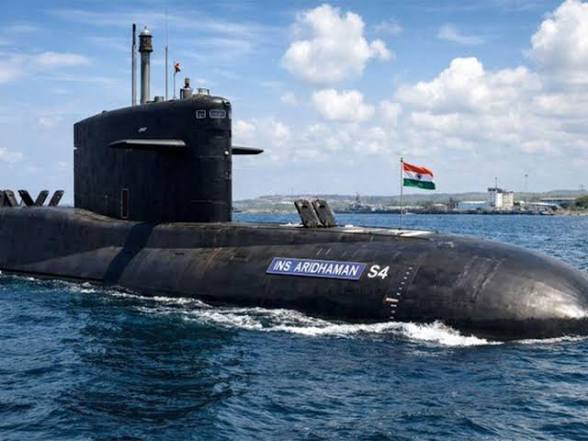
Feature Specification
Name INS Aridaman (S4)
Class Arihant-class (Stretch Variant)
Type SSBN (Nuclear-powered Ballistic Missile Submarine)
Commissioned April 3, 2026
Displacement ~7,000 Tonnes
Length ~130 Meters
Armament 8 VLS Tubes (K-4 / K-15 / K-5 SLBMs)
Propulsion 83 MW Pressurized Light-Water Reactor (CLWR)
On April 3, 2026, India reached a watershed moment in its maritime history with the commissioning of INS Aridaman (also referred to as Aridhaman). As the third indigenously built nuclear-powered ballistic missile submarine (SSBN), the Aridaman is not merely an addition to the fleet—it is a significant “stretch” in India’s technological and strategic reach.
The “Vanquisher of Foes”
The name Aridaman is derived from Sanskrit, meaning “Destroyer of Enemies.” While its predecessors, INS Arihant and INS Arighat, laid the foundation for India’s nuclear triad, the Aridaman represents a significant evolutionary leap in design and firepower.
Key Technical Advancements
Unlike the first two boats of the class, the Aridaman features a “stretched” hull, allowing it to carry a significantly larger payload:
Doubled Firepower: While the earlier vessels house four vertical launch system (VLS) tubes, the Aridaman is equipped with eight tubes. This allows it to carry either 8 long-range K-4 missiles (3,500 km range) or up to 24 K-15 Sagarika short-range missiles.
Enhanced Stealth: Utilizing refined hydrodynamics and an upgraded 83 MW pressurized light-water reactor, the submarine operates with a much lower acoustic signature, making it exceptionally difficult for enemy sonar to detect.
Indigenous Core: Roughly 70% of the submarine is built with indigenous components, including advanced USHUS sonar suites and internal communication systems developed by Indian scientists.
Strategic Significance
The commissioning of INS Aridaman solidifies India’s Second Strike Capability. Under India’s “No First Use” policy, the ability to maintain a survivable nuclear deterrent underwater is crucial.
Continuous At-Sea Deterrence: With three SSBNs now in the fleet, the Indian Navy is closer to maintaining a permanent “bastion” where at least one nuclear-armed submarine is always on patrol.
Indo-Pacific Stability: In an era of increasing maritime friction, a robust underwater nuclear leg acts as a stabilizer, ensuring that any potential aggressor faces a guaranteed retaliatory strike from an invisible location.
Path to K-5: The Aridaman is designed with the future in mind, capable of eventually hosting the K-5 SLBM, which is expected to have a range exceeding 5,000 km, putting all of Eurasia within reach from the safety of the Indian Ocean.
Looking Ahead
The Aridaman is the first of the “S4″ design tier. Work is already underway on the fourth submarine (S4*), which is expected to mirror these upgraded specifications. As India moves toward larger, more powerful 13,000-tonne S5-class submarines in the next decade, the Aridaman stands as the definitive bridge between a nascent capability and a world-class blue-water nuclear navy.
”It’s not just a word; Aridaman is power.” — Rajnath Singh, Defense Minister of India, during the commissioning.