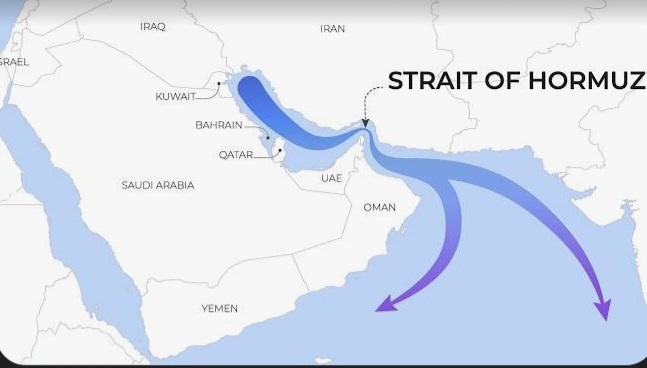
The Strait of Hormuz is a critical global maritime chokepoint linking the Persian Gulf to the Arabian Sea, essential for global energy supplies as over 20% of the world’s oil and liquefied natural gas (LNG) transits through it. It is the only sea route for many Gulf exporters, including Saudi Arabia, Iran, and Qatar, making its security critical for global energy prices and economic stability.
Key Aspects of the Strait’s Importance* :
1)Global Energy Gateway: Approximately 20 million barrels of oil per day passed through the waterway in 2025, which amounts to roughly $600 billion in energy trade annually.
2)Key Source of LNG: About 19% of global LNG trade passes through the strait, including ~93% of Qatar’s LNG and ~96% of the UAE’s LNG exports.
3)Minimal Alternatives: Very few alternatives exist to bypass the strait; only pipelines in Saudi Arabia and the UAE can bypass it, but their capacity is limited compared to the total volume passing through the channel.
4)Geopolitical Sensitivity: Any disruption can lead to immediate spikes in energy prices and severe disruptions to international supply chains, particularly impacting Asian countries, which receive about 82% of the oil leaving the strait.
5)Strategic Location: Situated between Iran to the north and Oman and the UAE to the south, the shipping lanes (Traffic Separation Scheme) are narrow, allowing little room for maneuver, and are subject to intense monitoring and occasional conflict.(some part taken from books)
Anil Kumar Namdeo
Gwalior