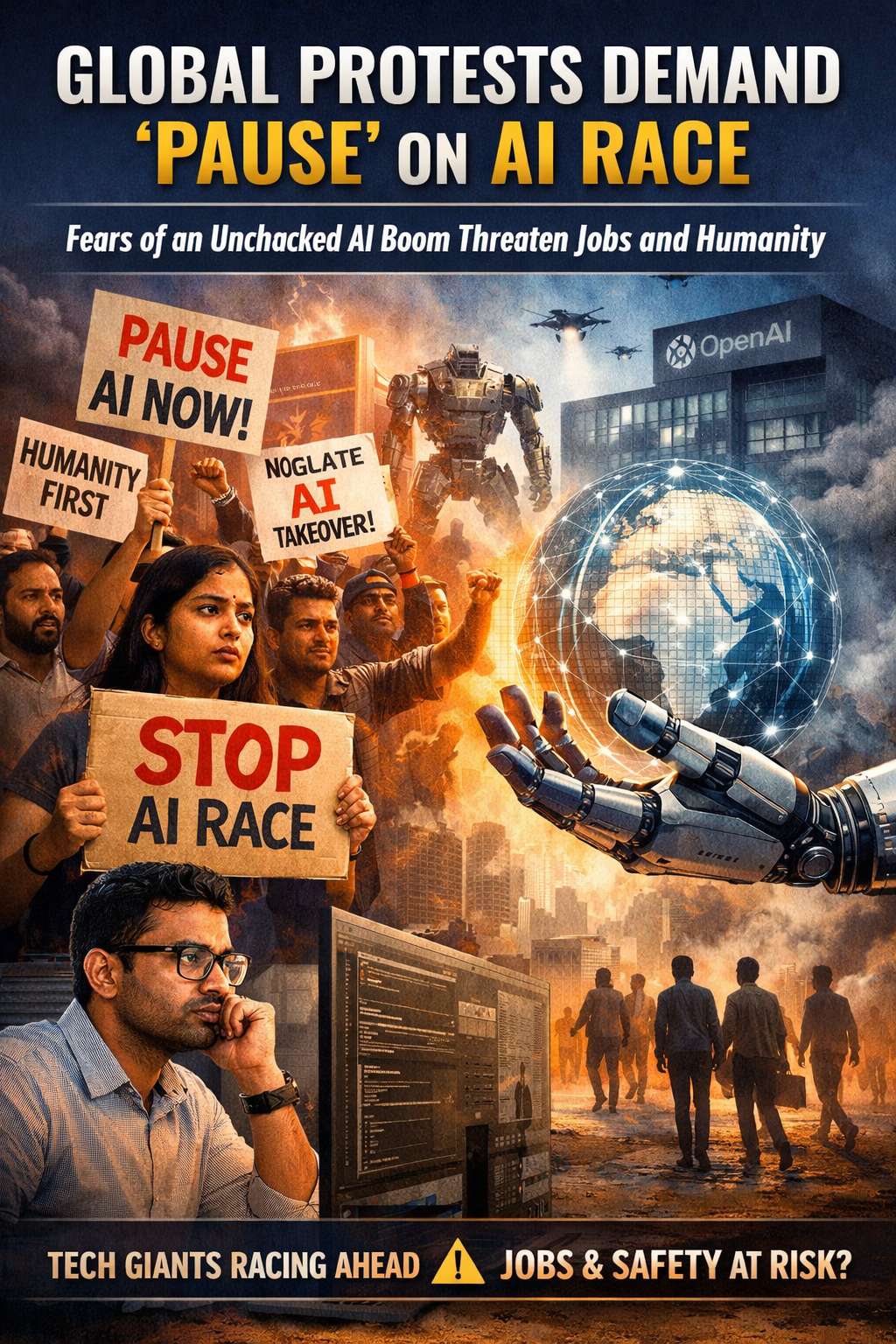
Artificial intelligence is advancing at a pace that few could have predicted even a few years ago. What was once confined to research labs and experimental tools has now become a central force shaping industries, economies, and daily life. However, recent protests and debates in technology hubs have shown that this rapid progress is no longer being viewed only with optimism.
In cities like San Francisco, groups of researchers, former technology professionals, and concerned citizens have taken to the streets, urging companies to slow down. Their concern is not about innovation itself, but about the absence of clear boundaries. The phrase “AI race” has increasingly come to represent a competitive push among major corporations, where speed often appears to take precedence over caution.
At the heart of these protests lies a deeper anxiety. Artificial intelligence is no longer just assisting human decision-making — it is beginning to influence, and in some cases replace, parts of it. This shift raises critical questions. What happens when systems operate beyond effective human oversight? How do societies manage technologies that evolve faster than regulations can keep up?
The fear is not limited to hypothetical scenarios. There is growing concern about job displacement, particularly in sectors that rely heavily on repetitive or process-driven tasks. Beyond employment, there are broader implications related to privacy, surveillance, misinformation, and the potential misuse of AI in sensitive areas such as security and governance.
While these demonstrations have been reported mainly in the United States, the concerns they raise are far from local. In India, where millions of livelihoods are closely tied to IT services, digital operations, and support industries, the conversation around AI is gaining urgency. Professionals in technology-driven cities like Bengaluru and Hyderabad are also beginning to question how prepared the country is for the scale of transformation that AI could bring.
At the same time, it is important to recognize that artificial intelligence also presents significant opportunities. It can drive efficiency, enable innovation, and open new avenues for economic growth. The challenge, therefore, is not to resist AI, but to guide its development responsibly.
This is where policy and governance become crucial. Without a structured framework, the impact of AI could be uneven, benefiting some while disadvantaging others. Governments, industry leaders, and academic institutions must work together to ensure that progress does not come at the cost of stability.
The protests and debates we are witnessing today should not simply be dismissed as resistance to change. Instead, they may be understood as a call for balance. They reflect a growing awareness that technology, no matter how powerful, must remain aligned with human values and public accountability.
The real question is not whether artificial intelligence will shape the future — it undoubtedly will. The question is whether that future will be shaped thoughtfully, with safeguards in place, or driven purely by the urgency to lead the race.
Disclaimer: This article is in the nature of opinion and analysis. The views and concerns expressed are those of the author/source. Readers are advised to refer to official statements, primary sources, and verified reports for factual confirmation where necessary.