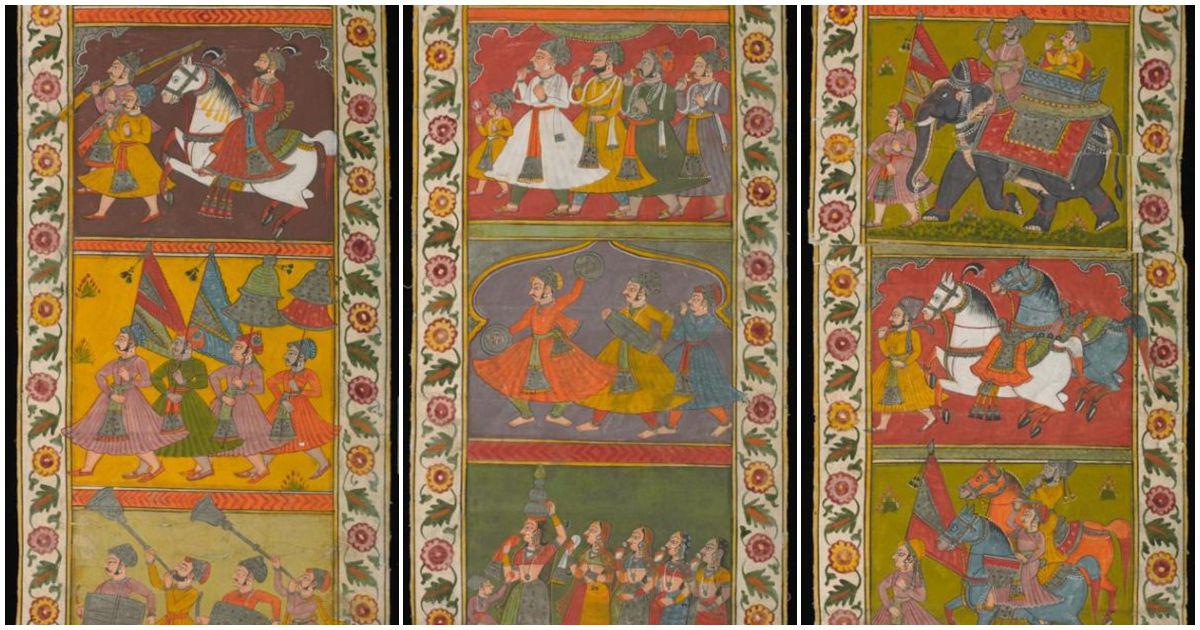
In a fascinating blend of artistry and historical narrative, a remarkable scroll from 1610 captures the essence of Mughal court life and the vibrant streets of Agra during the reign of Emperor Jahangir. Created by the talented artist Ustad Salivahan, this intricate piece features a profile of Jahangir at his jharoka, accompanied by a vivid representation of three noblemen – two with rolled parchments and one atop an elephant, offering a glimpse into the socio-political dynamics of the time.
The scroll transitions seamlessly from the royal setting to a bustling marketplace, populated with musicians, monks, merchants, and officials, thereby illustrating the rich tapestry of urban life in early 17th-century India. One particularly striking scene depicts two white-robed figures presenting a proclamation to a distinguished audience in a pavilion. This event, surrounded by disciples and performers, signifies the importance of communication and public announcements in the Mughal era. Notably, the parchment records how Jain priests successfully persuaded the emperor to issue a farman – a royal decree prohibiting animal slaughter during the eight sacred days of Paryushan.
Today, this three-meter-long scroll, which has been preserved in a fragile state, is not displayed in its original form but is accessible as a high-resolution digital scan at the Lalbhai Dalpatbhai Institute of Indology in Ahmedabad. This institute is renowned as one of the premier repositories of Jain art, showcasing the intricate craftsmanship and historical significance of such artifacts. The digital format allows for greater accessibility and appreciation of this cultural gem, enabling a wider audience to engage with the rich traditions of Jainism and Mughal history.
The Agra scroll serves not just as an artwork but as a historical document that sheds light on the intersection of religion, governance, and artistic expression. It exemplifies how religious communities like the Jains sought to influence political decisions and public policy through art and communication. The scroll’s detailed illustrations not only enhance its aesthetic value but also act as an important visual narrative that complements the written word.
Moreover, the scroll emphasizes the role of public ceremonies and the gathering of community members in disseminating important messages. By showcasing the participation of various social groups, this artwork provides insight into the collective life of the city, highlighting the interconnectedness of religious and civic duties in Mughal India. As scholars and art enthusiasts explore the intricate details of this scroll, they uncover layers of meaning that reveal the complex relationship between art, politics, and society during this vibrant historical period.