Karnataka Politics 2026: Budget Push, Leadership Tensions, and Governance Challenges Shape State’s Political Landscape
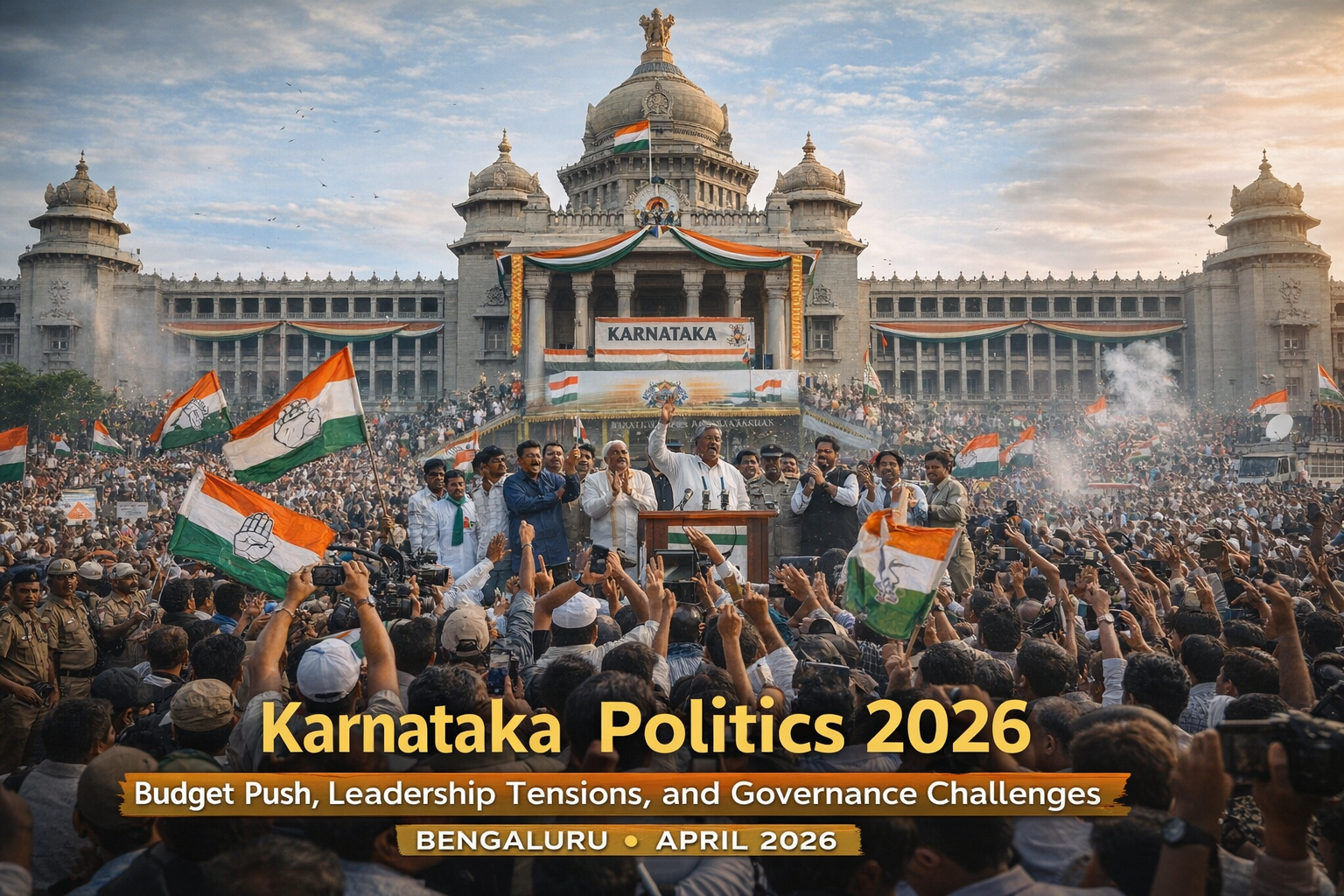
Karnataka politics in 2026 is witnessing a dynamic phase marked by economic decision-making, internal party tensions, and emerging governance challenges. The Congress-led government under Chief Minister Siddaramaiah has taken center stage with its ambitious budget, even as speculation over leadership changes and policy debates continues to influence the political narrative. From Bengaluru to district-level developments, the state’s political climate reflects both stability and underlying friction.
Budget 2026 Takes Political Spotlight
The Karnataka Budget 2026 has become a key focal point in the state’s political discourse. Presented in March 2026, the budget outlines a significant expenditure plan of over ₹4.48 lakh crore, emphasizing welfare schemes, infrastructure growth, and long-term development.
The government has continued its focus on flagship “guarantee schemes” such as free bus travel for women and financial assistance programs, while also investing heavily in urban infrastructure like metro expansion and job creation initiatives. These moves are aimed at strengthening the ruling party’s support base ahead of future elections.
However, opposition leaders have raised concerns about fiscal sustainability, arguing that excessive spending on welfare could strain the state’s finances. The government, in response, has defended its approach, stating that the budget strikes a balance between social welfare and economic growth.
Leadership Tussle Within Congress
One of the most talked-about aspects of Karnataka politics remains the internal dynamics within the ruling Congress party. Speculation over a possible leadership change between Chief Minister Siddaramaiah and Deputy Chief Minister D.K. Shivakumar has persisted for months.
Although party leaders have publicly denied any power struggle, reports of closed-door meetings and statements hinting at “patience” have kept the issue alive. Political observers believe that such internal tensions, even if controlled, could impact governance and decision-making in the long run.
The Congress high command has so far maintained a cautious stance, urging leaders to avoid public disagreements. Still, the recurring speculation indicates that leadership questions remain unresolved beneath the surface.
Economic Performance and Political Debate
Economic performance has also become a major talking point in Karnataka’s political discussions. Recent data shows that the state has recorded one of the highest growth rates in GST collections among major Indian states, highlighting strong economic activity.
At the same time, critics argue that despite growth, Karnataka still trails behind states like Maharashtra in overall revenue. This has triggered debates over the effectiveness of the government’s financial policies and the long-term impact of welfare spending.
The ruling party has used these figures to defend its governance model, while the opposition continues to question whether the growth is sustainable or unevenly distributed.
Social and Policy Challenges
Beyond economics and leadership issues, the state government is also dealing with social and administrative challenges. Incidents such as caste-related tensions in rural areas have drawn attention to the need for stronger law-and-order measures and social harmony initiatives.
Additionally, policy decisions—such as changes in textbook distribution rules—have sparked criticism from stakeholders, including private schools. These issues highlight the complexities of governance in a diverse and rapidly developing state like Karnataka.
Such developments often carry political implications, as opposition parties use them to question the government’s administrative efficiency and responsiveness.
What Lies Ahead for Karnataka Politics
Looking ahead, Karnataka’s political landscape is expected to remain active and competitive. Upcoming by-elections, continued debates over welfare policies, and the unresolved leadership question within the Congress party are likely to shape the state’s trajectory in the coming months.
At the same time, the government’s ability to deliver on its budget promises and maintain economic growth will be closely watched by both voters and political rivals.
Conclusion
Karnataka politics in 2026 reflects a mix of strong governance initiatives and underlying political tensions. While the state government pushes forward with its development agenda, internal party dynamics and public policy debates continue to influence the broader political narrative. The coming months will be crucial in determining whether stability or uncertainty defines Karnataka’s political future.