Special Investigative Report by Goovardhan Rao
A System Under Question
Kota, long regarded as the nerve center of India’s competitive exam preparation, is now facing uncomfortable scrutiny. Known for producing top rankers in IIT-JEE and NEET, the city attracts lakhs of students every year, all chasing the promise of success through hard work and discipline.
However, a recent investigation based on findings obtained through the Right to Information Act, 2005 (RTI) has raised serious concerns about the integrity of the examination ecosystem linked to this coaching hub.
The documents accessed reveal a pattern of exam-related complaints, alleged paper leaks, and weak enforcement mechanisms—pointing toward a system that may be far more vulnerable than it appears.
RTI Findings: What the Documents Reveal
The RTI responses collected from multiple authorities highlight troubling trends:
Repeated complaints of paper leaks and exam irregularities over the past several years
Limited action taken in most cases, with few investigations leading to strict punishment
Existence of “dummy school” enrollments, where students are officially registered but rarely attend classes
Multiple access points to question papers before exams, increasing the risk of leaks
Absence of a centralized monitoring mechanism for coaching institutes
While these findings do not directly prove large-scale organized wrongdoing, they indicate systemic weaknesses that could be exploited.
The Coaching Industry: A Multi-Crore Ecosystem
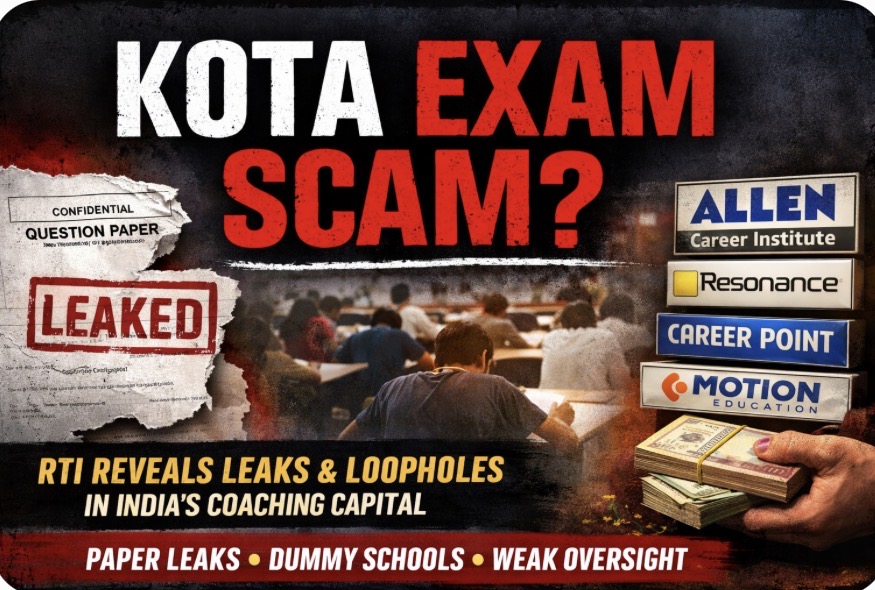
At the heart of Kota’s success lies its massive coaching industry, dominated by well-known institutions such as:
Allen Career Institute
Resonance
Career Point
Motion Education
These institutes have built reputations on producing consistent results and top-ranking students.
👉 Important Clarification:
There is no proven evidence linking any of these major institutes directly to paper leak activities. Their mention is relevant to understanding the scale and structure of the ecosystem—not to imply wrongdoing.
However, experts argue that the intense competition, high financial stakes, and pressure to deliver results may create an environment where unethical practices can emerge at the margins.
The Dummy School Model: A Parallel System
One of the most controversial aspects of Kota’s education structure is the rise of “dummy schools.”
In this system:
Students enroll in formal schools for board exam eligibility
Regular attendance is often bypassed
The primary focus remains entirely on coaching institutes
RTI responses indicate a significant number of such enrollments, raising concerns about regulatory oversight.
Critics argue that this model:
Weakens the formal education system
Creates gaps in monitoring student activity
Allows institutions to operate in a loosely regulated space
This parallel structure further complicates accountability when irregularities occur.
Where the System Breaks
The investigation highlights several critical vulnerability points where exam integrity could be compromised:
1. Question Paper Handling
From printing to distribution, multiple individuals and agencies are involved, increasing the risk of leaks.
2. Insider Access
RTI responses suggest that several officials may have access to question papers before exams, raising concerns about internal security.
3. Exam Center Management
Instances across the country have shown that local-level staff can sometimes be involved in malpractice.
4. Lack of Digital Tracking
In many cases, there is no robust system to track who accessed sensitive materials and when.
👉 These vulnerabilities indicate that the issue is systemic, not isolated.
Students Speak: Trust at Risk
For students, the implications are deeply personal.
Many aspirants invest:
2–3 years of intense preparation
Lakhs of rupees in coaching and accommodation
Emotional and mental energy
Yet, the possibility of paper leaks raises serious doubts.
“If someone gets the paper before the exam, what is the value of our hard work?” said a NEET aspirant in Kota.
Parents, too, are increasingly concerned about fairness and transparency.
The psychological impact is significant:
Loss of trust in the system
Increased stress and anxiety
Fear that merit may not be enough
Accountability Gap: Who Is Responsible?
One of the most critical findings of the RTI investigation is the lack of clear accountability.
When irregularities occur, responsibility is often spread across:
Exam conducting authorities
Local administration
Educational boards
Private institutions
This diffusion makes it difficult to:
Fix responsibility
Ensure punishment
Prevent future incidents
RTI responses suggest that many cases do not result in strong disciplinary action, raising questions about enforcement.
The Bigger Picture: Meritocracy Under Threat
India’s competitive exam system is built on a simple principle—equal opportunity based on merit.
However, repeated reports of leaks and irregularities challenge this foundation.
If even a small percentage of candidates gain unfair advantage, it can:
Distort rankings
Deny deserving students their opportunities
Undermine public trust
The issue is not just about individual exams—it is about the credibility of the entire system.
Government Response: Steps and Limitations
Authorities have taken some measures to address the issue:
Increased surveillance at exam centers
Proposals for stricter coaching regulations
Discussions around secure digital exam systems
However, critics argue that these steps are:
Reactive rather than proactive
Limited in scope
Slow to implement
There is a growing demand for:
Independent audit mechanisms
Real-time monitoring systems
Stronger penalties for malpractice
The Way Forward: Fixing the System
To restore trust, experts suggest a multi-layered approach:
1. Strengthening Paper Security
End-to-end encryption of question papers
Limited and tracked access
2. Regulating Coaching Institutes
Mandatory registration and audits
Transparent reporting standards
3. Eliminating Dummy School Loopholes
Strict enforcement of attendance rules
Integration of school and coaching systems
4. Enhancing Accountability
Clear responsibility framework
Fast-track investigations and penalties
5. Leveraging Technology
Digital exams with secure systems
AI-based monitoring for irregularities
Conclusion: A System at a Crossroads
Kota continues to symbolize ambition, discipline, and academic excellence. But the findings from this RTI-based investigation highlight a critical reality:
👉 Even the strongest systems can weaken without transparency and accountability.
It is important to emphasize that:
No major institute has been proven guilty
The issue lies in systemic vulnerabilities
Reform, not blame, is the need of the hour
For millions of students, the stakes are too high to ignore.
Final Word
“The real crisis is not just about leaked papers—it is about a system where trust is slowly slipping away.”
Unless decisive action is taken, the question will continue to haunt India’s education system:
👉 Is success still earned—or is it being influenced behind the scenes?