Managing million-dollar sinking funds, costly repairs: Do condo councils need mandatory training?
Managing million-dollar sinking funds, costly repairs: Do condo councils need mandatory training?
The Building and Construction Authority has proposed a requirement for council members to undergo mandatory training as part of its review of the Building (Strata Management) Act.
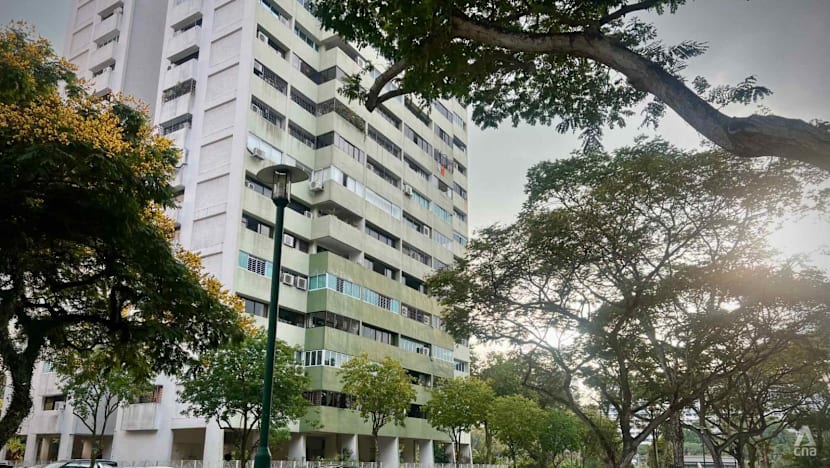
Pine Grove condominium is a former Housing and Urban Development Company (HUDC) estate. (Photo: CNA/Erin Liam)
SINGAPORE: Like most ageing developments, the bill to keep Pine Grove condominium running has grown steadily over the years.
The former Housing and Urban Development Company (HUDC) estate, which is more than 40 years old, is due for repainting works estimated to cost about S$1.8 million (US$1.4 million). Mandatory facade inspection, spalling concrete repairs and an upcoming structural inspection of the over 893,000 sq ft site will add another S$500,000.
The most urgent repair work – replacing the condominium’s 14 ageing lifts, whose parts have become obsolete – could cost at least S$1.4 million for the 660 households in the estate.
Such works are typically funded by the condominium’s sinking fund, which Management Corporation Strata Title (MCST) councils draw on for major repairs.
“Older estates, you definitely need a healthier sinking fund. So how to go about it? That is the challenge,” said Mrs Cheryn Liew, 67, Pine Grove’s MCST chairperson.
To cover the costs, the council intends to propose an increase to the maintenance fee at the next annual general meeting (AGM), although she could not say by how much.
Of the S$292 fee that households currently pay per month, about S$60 goes into the sinking fund. The remaining covers day-to-day expenditures.
Securing residents’ support for higher contributions requires both tact and persistence from the council, she said.
“The key point to make in addressing the residents is that this is undeniably an old estate and understandably, maintenance is required to ensure safe and habitable community living.”
Ultimately, it comes down to a vote. Proposals to raise sinking fund contributions or impose special levies can be defeated at condo meetings – delaying critical repairs in the process.
The struggle to collect adequate sinking funds for estate maintenance, especially at ageing condos, is one of the reasons the Building and Construction Authority (BCA) is reviewing the Building (Strata Management) Act.
The public consultation, which ends on Apr 8, includes a proposal for council members to undergo mandatory training.
“Many elected council members are lay people who may lack the necessary knowledge to manage estates effectively or are overly reliant on the MA (managing agent) without understanding their responsibilities,” BCA said in a document detailing the proposed areas of review.
Proper training could help council members gain foundational knowledge of estate management, legal responsibilities and best practices, it added.
THE TROUBLE WITH SINKING FUNDS
Sinking funds are built from a portion of residents’ maintenance fees to the MCST, which are collected on a quarterly or monthly basis.
While there is no universal formula, about a third of fees – which range from a mid-point of S$500 to S$1,000 a month – typically goes into the sinking fund, said Mr Dennis Tan, president of the MCST Association of Singapore.
The target amount varies widely depending on a development’s age, facilities, infrastructure and asset condition, he added.
To project the required amount, managing agents and councils typically divide the expected capital expenditure by the equipment’s lifespan, then by the total number of shares in the development, said Mr Andrew Lioe, president of the Association of Strata Managers (ASM).
A survey by the association found that residential projects with 401 to 500 units, ranging from eight to 49 years old, had sinking fund balances of between S$700,000 and S$3 million as of December last year.
The problem, Mr Lioe said, is that many councils undercollect from the outset. When a building is new, everything is “bright and shiny”, and some councils set contributions low – assuming they can always raise them later when repairs become necessary.
“But the fact is that once a certain sinking fund figure is set at the first AGM or the earlier AGMs, it is rather challenging to increase it significantly over the years,” he said.
By then, residents may no longer be the original owners, or may be in a different financial position. Asking them to absorb a sharp increase is difficult, Mr Lioe said.
The result is delays in getting repairs done, and eventually breakdowns, which will inconvenience residents, he added.
“By that time, it may be year 15 or year 20, where time is against you. If you had started when you were younger, obviously the premiums are (lower) and you build up a bigger base. But when you start to increase your sinking fund at year 15 or 20, you’re playing a catch-up game,” he said.
Rising costs are compounding the problem. Ms Chan Lie Leng, 61, council chairperson at The Trizon, said costs have gone up “tremendously” in recent years.
A facade repaint at the 289-unit condominium cost around S$700,000 a few years ago. Similar-sized or smaller developments are now paying upwards of S$1 million for the same job.
“You realise that when you’re running the estate, there are just so many things to do with the estate. Repainting works cost a bomb. Changing lifts … it is another big bomb,” she said.
The Trizon is about 13 years old, and Ms Chan said its sinking funds are currently “quite decent”. But she added that “if something drastic happens, it also will not be sufficient”.
As part of its review, BCA is considering requiring MCSTs to submit financial information and records on essential facilities. It is also exploring co-funding support to help older private developments upgrade their lifts with newer safety features.
“We do not intend for it to be used to support R&R (repair and redecoration) and maintenance works, or to pay for the costs of general lift repairs or lift replacements. Such costs should be funded from the private development’s sinking and maintenance funds,” BCA said in a Facebook post on Mar 20.
In a well-managed development, councils typically raise contributions by 5 to 10 per cent periodically, said MCST Association president Mr Tan. But where fees have long been under-collected, far steeper increases may be unavoidable.
At some condominiums, residents have become so accustomed to low fees that any proposed increase is met with resistance, said Dr Lucy Ooi, 73, chairperson at Maplewoods MCST.
“And then they keep on saying, ‘Why do we need to?’ So the onus is really on the council to sort of reassure them, to remind them of evolving cost changes and costings, and all that,” she said.
Councils, she said, should move away from reactive maintenance towards life-cycle planning, backed by regular assessments and early engagement with residents.
As a council, it is hard to please everybody all the time, she said.
“We always have to be mindful that we are in a great ‘PR job’, where we keep people as happy as possible, living in an environment as pleasant as possible, where the grounds are clean, the security is not lax, and where the landscape is something they can be proud of,” she said.
Pine Grove’s Mrs Liew said many people have asked why she wants to commit to a “thankless job”.
“And of course, 660 units, over 2,000 people. You’re bound to step on some toes,” she said. But her answer is simple.
“My conscience is clear. I’m here because I love my estate and I don’t want our contributions – management fund, sinking fund – going to something else which is not for the good of the estate.”
TRAINING AND SKILLS
Managing such responsibilities well demands expertise. MCSTs that CNA spoke to said council members ideally should bring engineering, architecture, accounting, operations or legal skills to the table.
In practice, that rarely happens. “Because these are all volunteers, and it does take a certain amount of time – most people would just rather take a backseat and treat their home as the haven where they just want to go home and rest,” said ASM’s Mr Lioe.
Beyond financial skills, council members should have the technical know-how to understand and explain to residents why a particular repair is needed. Other useful skills range from knowing which type of security service to engage, to handling neighbourly disputes.
In reality, residents may join councils because they have a personal agenda, an ego, or want to prove themselves, said MCST Association of Singapore’s Mr Tan.
“Unfortunately … without the minimum knowledge to run the estate, it actually sometimes creates a lot of problems and disamenities among the subsidiary proprietors,” he said.
Most council members agreed that training could help raise standards, but raised concerns about making it compulsory.
BCA first launched voluntary e-learning courses for council members in 2024, covering procurement, accounting and dispute management, offered at no cost.
Take-up has been low, however, and the authority is now considering whether to make training mandatory – with potential consequences for non-compliance, such as ineligibility to stand for future council elections.
But some council members said mandatory training could deter residents – especially younger ones – from stepping up. Recruitment is already a persistent challenge. The role is generally unpaid and comes with no additional privileges.
Some members are retirees, and to make them attend classes, whether online or physical, without any form of assessment would defeat the purpose, said Mdm Yap Mee Mee, 68, the council secretary at Pine Grove.
“If you make it available to council members, those who wish to better their knowledge, yes, it’s a very good idea. But if you make it mandatory, then I think it’s going to be a challenge to recruit new members to join,” she said.
Managing agents, who advise councils and provide operational expertise, also have a key role to play. A capable managing agent is essential, said Mr Johnny Chua, 60, the council chairperson at Mi Casa.
They must be able to enforce house rules and advise the council on bylaws. On top of regular estate maintenance and improvements, they should also propose cost-saving ideas, he said.
“The problem is, due to cost competition, many (managing agents) recruited condo managers who lack the relevant experience. As a result, the estate is poorly managed, funds are overrun, wrong advice is given to council, and ended up with unhappy residents,” said the former project manager.
Mr Lioe, who is also managing director of strata and facility management firm A4 International, said the industry is working to encourage more firms to seek accreditation.
“Because at the end of the day, if you have an efficient and responsible managing agent running your MCST, there’s less need for the council members to be so involved in the day-to-day,” he said.
“So as much as the council members are being trained, we also believe that we ourselves as managing agents will need to be accredited and trained,” he added.
Beyond technical skills or financial know-how, some council members said the most important quality is simply commitment. Mrs Liew and Mdm Yap both lack formal training in engineering or accounting, but have built up their knowledge through years of hands-on experience.
“People like us, who are not trained in those fields, we learn. We really learn about it,” said Mrs Liew. “I always tell (Mdm Yap), we graduate from ‘Pine Grove University’.”
*Devashish Govind Tokekar*
*INDIAN PRESS UNION*
*District Reporter*