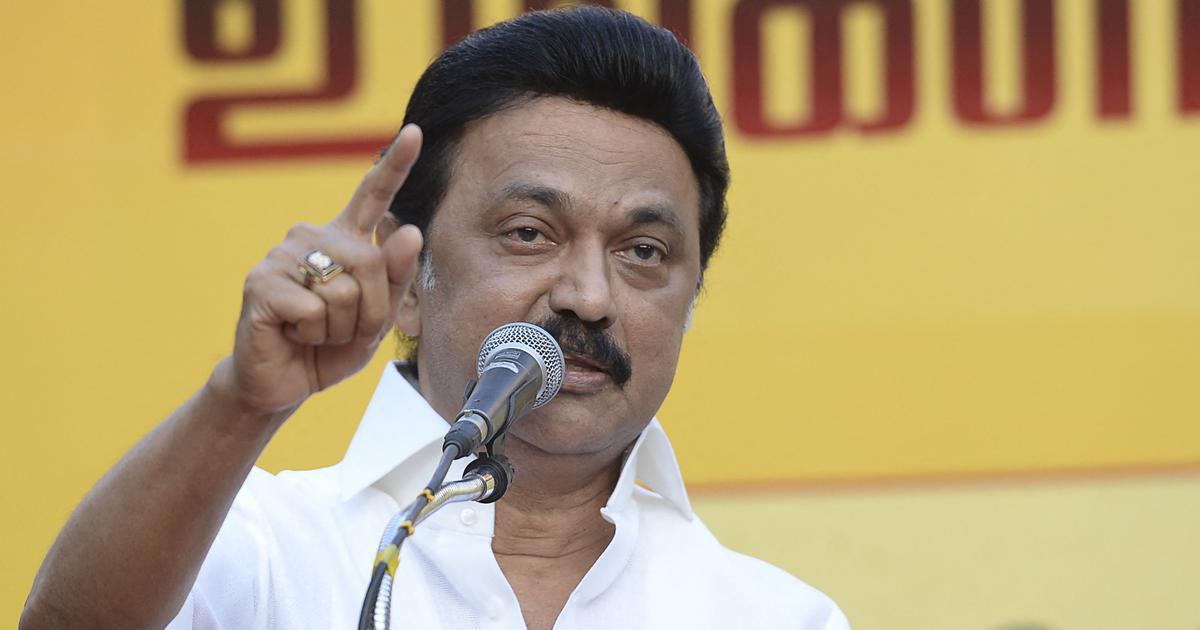
Tamil Nadu Chief Minister MK Stalin has raised serious concerns regarding the recently unveiled curriculum framework by the Central Board of Secondary Education (CBSE), labeling it a ‘calculated attempt at linguistic imposition.’ This new curriculum, which mandates the study of a third language starting from Class 6 in the academic year 2026-’27, has created a stir, especially in southern states. According to the framework, at least two of the three languages must be Indian, while English is categorized as a foreign language.
Stalin’s criticism focuses on what he describes as an implicit requirement for students in the southern states to learn Hindi. He questioned the fairness of this new rule, asking, ‘Where is the reciprocity?’ He further emphasized that students in Hindi-speaking regions are not similarly required to learn languages such as Tamil, Telugu, Kannada, or Malayalam, nor are they encouraged to study other regional languages like Bengali or Marathi.
The Chief Minister accused the ruling Bharatiya Janata Party (BJP) government of pushing a centralizing agenda under the guise of promoting Indian languages, suggesting that the initiative primarily benefits Hindi at the expense of India’s rich linguistic diversity. Stalin remarked, ‘The so-called three-language formula is, in reality, a covert mechanism to expand Hindi into non-Hindi speaking regions.’ His statements resonate with many who fear that such policies may erode local languages and cultures.
Stalin also highlighted the historical neglect of Tamil within the national education system, noting that Tamil has not been made a compulsory subject in Kendriya Vidyalayas. He pointed out the lack of adequate Tamil teachers in these schools, questioning the commitment of the central government to truly promote Indian languages. ‘Now, they wish to lecture states on how to enhance the status of Indian languages while ignoring their own failures,’ he asserted.
This controversy surrounding the new curriculum reflects a broader tension between regional identities and the nationalistic policies propagated by the central government. Critics of the three-language formula argue that it may deepen divisions rather than foster unity among the diverse linguistic communities in India. As this debate unfolds, it raises important questions about educational policies and their implications for India’s cultural landscape.