Most Advanced Swing-Role Fighter Jet in the World to Get New Low-Cost Counter Drone Solution
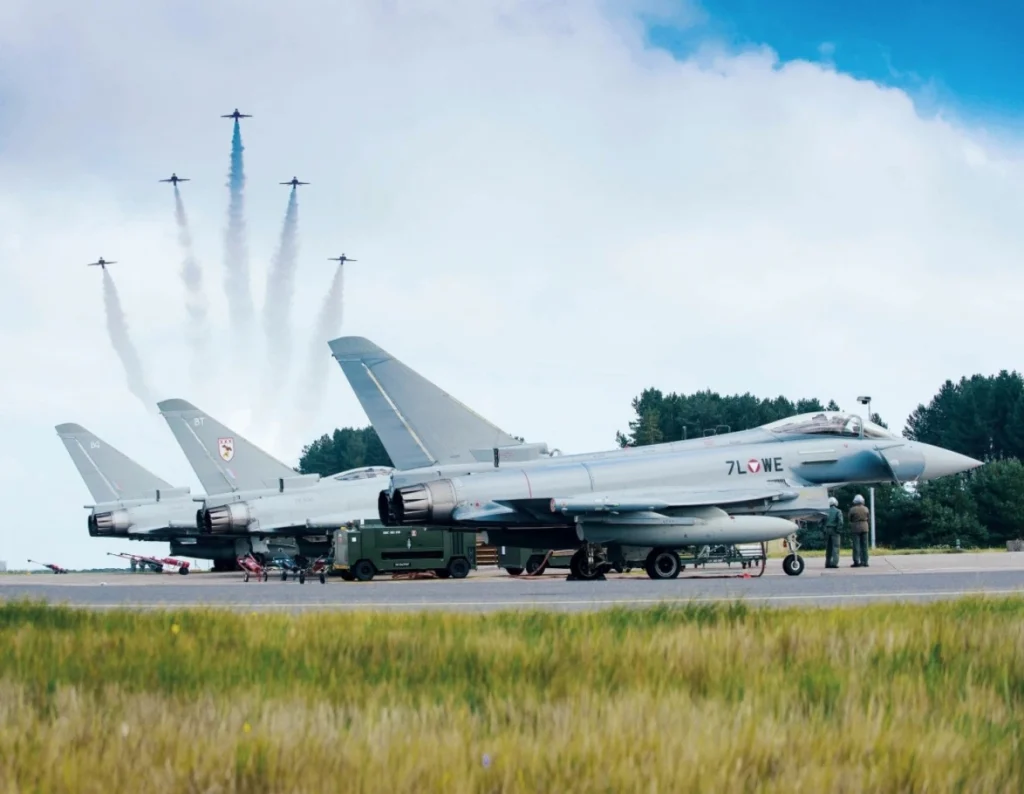
BAE Systems has successfully tested the low-cost Advanced Precision Kill Weapon System (APKWS) aboard a Eurofighter Typhoon fighter jet from its Warton flight test center in Lancashire, England.
The March 2026 trial, supported by the UK Ministry of Defence (MoD), involved a UK Royal Air Force (RAF) Eurofighter test and evaluation aircraft striking a ground-based target at a British military test range.
This test used the air-to-air optimized variant of the BAE Systems Inc. AGR-20A 70 mm laser-guided rocket.
It marks a key step toward giving the fourth-generation swing-role fighter an affordable counter-drone capability while preserving expensive missile stocks.
BAE Systems completed the first live-fire trial of the APKWS laser-guidance kit on the Eurofighter Typhoon.
The firing took place from the company’s flight test development centre in Warton, Lancashire, England.
A RAF test and evaluation aircraft launched the rocket and achieved a successful strike on a ground target at a UK military testing range.
The APKWS system converts unguided 2.75-inch (70 mm) Hydra 70 rockets into precision-guided munitions by adding a laser-guidance kit. This combat-proven US product delivers high accuracy at far lower cost than traditional missiles.
Reported by Breaking Defense, the trial provides valuable insights into integrating low-cost precision weapons, especially for counter-UAS missions where affordable interception options are in high demand.
Richard Hamilton, managing director of air operations at BAE Systems’ Air sector, stated that the trial demonstrates a game-changing capability and a cost-effective solution that would enhance Typhoon’s already impressive range of weapons capabilities.
The activity was completed rapidly through close collaboration between BAE Systems teams and the RAF.
The test forms part of broader capability enhancements planned for the Typhoon to increase its potency in current and future combat air operations.
A BAE spokesperson told Breaking Defense that the air-to-surface test was internally funded as part of the company’s commitment to invest in advanced capabilities customers require.
Next steps include air-to-air testing with aerial targets. BAE has not disclosed further details or timelines yet.
Strong interest exists in the APKWS option as operators seek multi-mission solutions for both air-to-surface and air-to-air roles.
Recent conflicts highlight the need for such capabilities. Iran’s use of low-cost Shahed-136 attack drones, priced around $20,000 to $50,000, has forced defenders including the UK to expend high-end weapons.
In March 2026, a RAF Eurofighter from the joint UK-Qatar Typhoon squadron downed an Iranian drone approaching Qatari territory using an air-to-air missile.
RAF Typhoons currently carry AIM-120 AMRAAM, ASRAAM, and Meteor for air-to-air missions. Air-to-ground options include Paveway IV bombs, Brimstone 2 missiles, and Storm Shadow cruise missiles.
APKWS offers a practical way to engage cheaper threats without depleting these inventories.
The Eurofighter Typhoon operates with partner nations Germany, Italy, Spain, and the UK, plus export customers such as Qatar.
Adding the low-cost APKWS capability could ease operational burdens across the multinational fleet once testing concludes and integration decisions are made.