Myths and Superstitions at Sea
On one of my previous ships, there was a third engineer who never washed his socks or boiler suit for the entire duration of his contract. His socks were always left inside his shoes in the changing locker, filling the space with an unmistakable odor. After repeatedly advising him to maintain basic hygiene, I finally gave up.
One day, I decided to ask him directly why he refused to wash his clothes. His reply was unexpected: “Every time I wash my socks or boiler suit, there is an accident on board.”
Was this the height of laziness, or was it a genuine fear rooted in superstition? I could not tell.
“Seeing is believing”—a phrase that often comes to mind whenever I hear stories of superstition. Personally, I have not experienced anything supernatural. Yet, during my years at sea, I have heard incidents that could unsettle even the most rational mind.
On a previous vessel, our cook claimed he repeatedly saw a child running behind him whenever he was alone in the galley. Around the same time, a wiper reported hearing a whistle followed by a child’s laughter in the laundry area. Adding to this, one of the engineers said he saw a lady dressed in white in the engine control room during his watch.
Were these mere illusions, coincidences, or something beyond explanation? We may never know. But with three separate accounts from different individuals, one could not entirely dismiss the possibility of unseen “companions” onboard.
We chose not to dwell on it. Instead, we prayed—and nothing ever harmed or troubled us.
There are also beliefs passed down through generations of seafarers. One such belief is about birds onboard. It is often said that if a bird lands on a ship, it should be left undisturbed. Do not cage it or attempt to capture it—otherwise, bad weather may follow. Birds, like ships, are meant to roam free across the vast ocean.
Captain Ashok Mason once shared his perspective:
“I don’t know if every seafarer believes in myths or superstitions. Personally, I do not. I believe only in God—my Saviour and my Shepherd. When I am a master, He is my Admiral. When I am in doubt, He gives me strength.”
He also recalled a tradition from his early days at sea:
“On my first ship as a cadet, when I crossed the equator, the crew insisted I shave my head—otherwise, my ‘sea mother’ would not treat me well. So I did. The captain even arranged a celebration afterward.”
Was this superstition, or simply maritime culture passed down through generations?
I consider myself a skeptic—a free thinker. I do not accept myths as facts. My beliefs rest on science, evidence, and reason. Yet, I cannot deny that there are still countless mysteries waiting to be uncovered. That is part of what makes seafaring so fascinating—the unpredictability of the unknown.
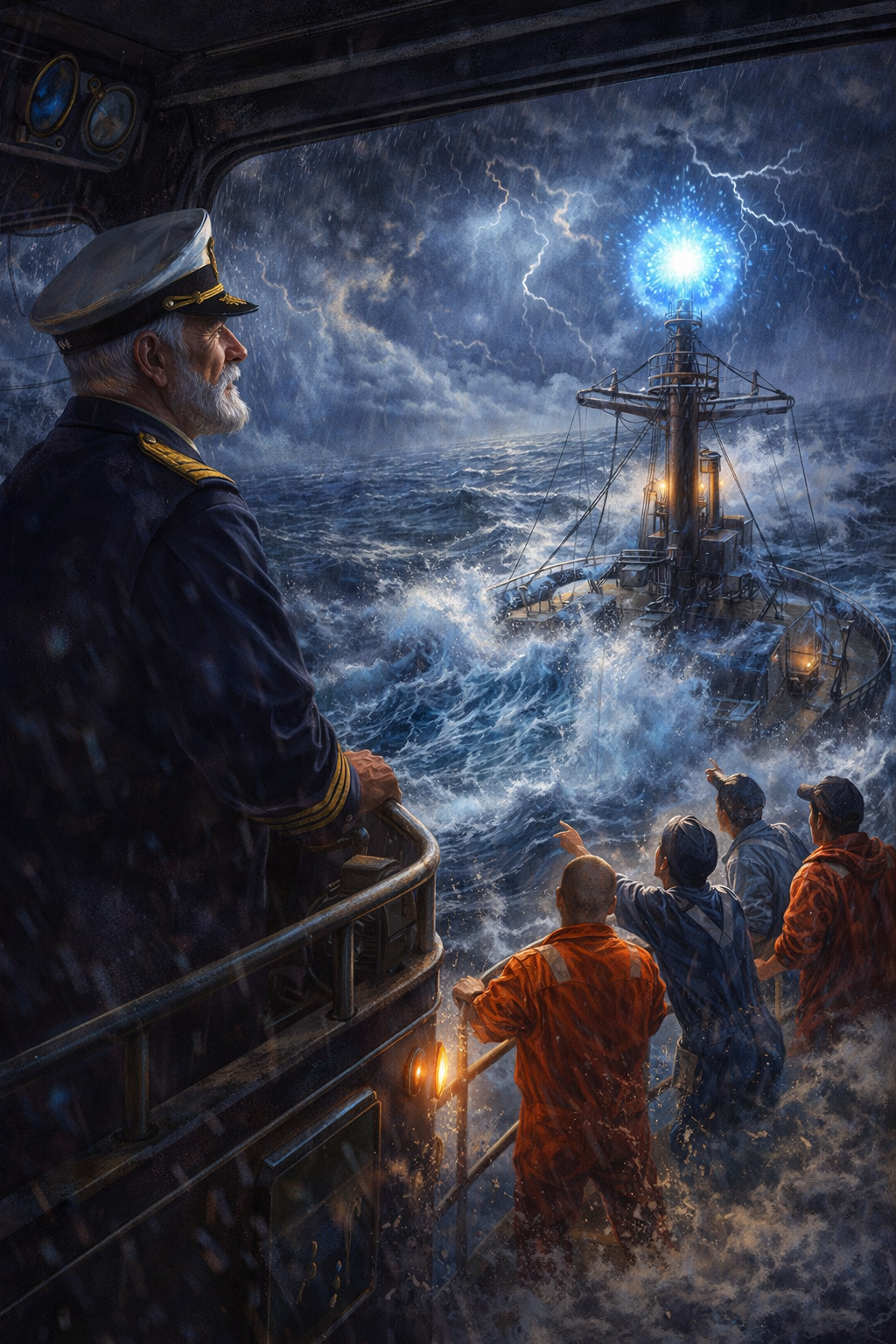
One unforgettable experience reinforced this thought. While sailing near the equator, our second officer suddenly shouted from the bridge that there was a bluish ball of fire near the ship’s mast. We all rushed to see it—and there it was. A glowing sphere of light, moving up and down against the dark backdrop of the sea. The captain calmly explained that it was St. Elmo’s Fire—a rare natural phenomenon. It is a luminous blue or violet plasma caused by atmospheric electricity during thunderstorms, often seen on pointed structures such as ship masts.
What appeared mystical at first was, in fact, science at work—though no less awe-inspiring.
Some myths endure because they capture the imagination. As a child, I often heard stories of mermaids—sea creatures with human features living beneath the waves. My grandparents would say: “Whatever you see on land exists in the sea—perhaps even more.”
Such ideas, though unproven, spark wonder about the hidden depths of the oceans.
In earlier times, sailors feared sea serpents believed to destroy ships. Today, we understand that many of these stories likely arose from exaggerated sightings of oarfish or large sea snakes, along with drifting masses of seaweed that created eerie illusions.
Another widely known belief is that one should never whistle on deck. Sailors believed that whistling could “call the wind” and provoke storms, as if challenging the forces of nature.
Similarly, maritime traditions warn against carrying bananas onboard, emphasize the use of horseshoes for luck, and encourage reliance on religious symbols or rituals. These practices were less about inviting good fortune and more about avoiding misfortune.
Such customs may seem irrational today, yet they once served an important purpose. In an unpredictable and often dangerous environment, they provided sailors with a sense of control and comfort—helping them explain the unexplainable.
Even in an age of advanced technology and scientific progress, myths continue to sail with us.
Perhaps they always will.
Novin Christopher