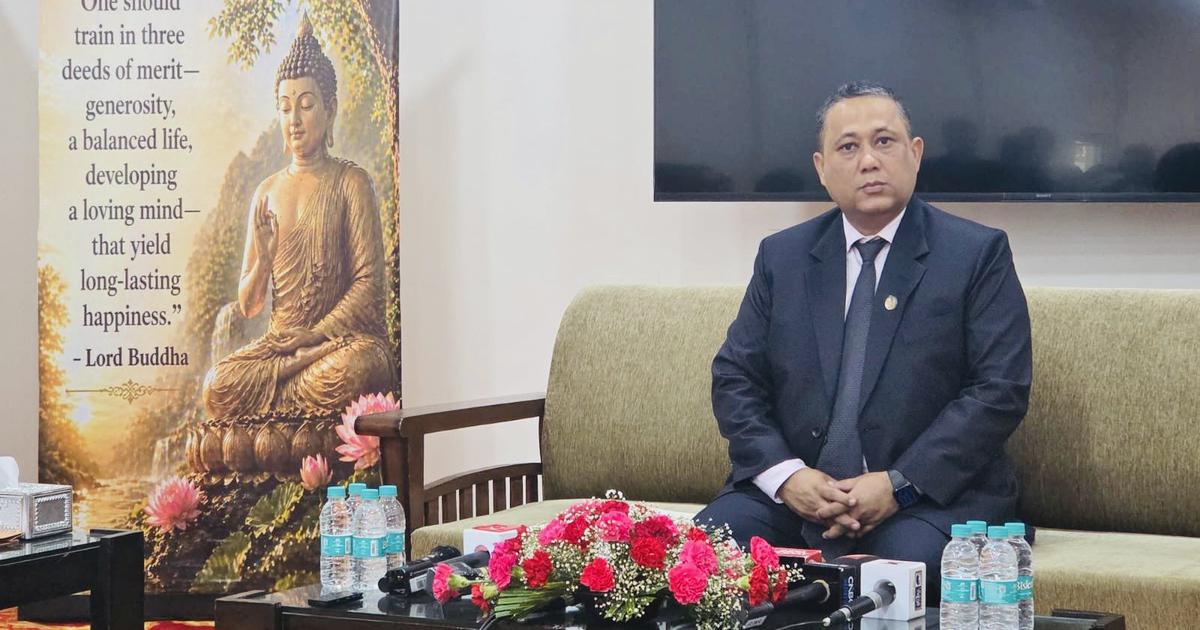
Nepal’s Foreign Minister, Shisir Khanal, emphasized on Sunday that the Himalayan nation is committed to resolving its border disputes with India through direct negotiations, without the involvement of third-party mediation. This statement, made during a press conference at the Nepali embassy in New Delhi, underscores Nepal’s intention to address its territorial claims concerning the contested Kalapani-Limpiadhura-Lipulekh region directly with India.
Khanal informed that Nepal has already communicated its claims regarding the disputed territory to India through established diplomatic channels. The Indian government, however, maintains that the area in question is part of Uttarakhand, firmly rejecting Nepal’s assertions. This ongoing tension highlights the complexities of Indo-Nepal relations, especially given the historical significance of the territories in dispute.
The recent remarks by Khanal were prompted by inquiries about comments from Nepal Prime Minister Balendra Shah, who had mentioned discussions with China and the United Kingdom regarding the border issue. The Prime Minister noted that the region sits near the trijunction of India, Tibet, and Nepal, making it a focal point for discussions with neighboring countries. His references to past colonial dynamics imply a historical context that both countries must navigate.
Shah’s position reflects a broader narrative that seeks international attention towards Nepal’s territorial claims, particularly invoking the UK’s historical role in the region during the British colonial era. He argued that the UK should also show interest in the matter, as the roots of the dispute can be traced back to that period. This perspective adds a layer of complexity to the already tense relations between India and Nepal.
On June 2, in response to these developments, India’s Ministry of External Affairs reiterated that there is no place for third-party intervention in matters that are fundamentally bilateral. Ministry spokesperson Randhir Jaiswal reinforced this sentiment, stating that both nations have robust mechanisms in place to manage boundary-related discussions. This assertion aligns with India’s longstanding policy of maintaining sovereignty over its territorial integrity while encouraging dialogue.
As these discussions unfold, both nations are likely to remain vigilant, emphasizing diplomatic engagement to resolve outstanding issues. For Nepal, the emphasis on bilateral talks signals a strategic approach, aiming to reinforce its sovereignty while seeking amicable solutions to territorial disputes. For India, maintaining a clear stance against third-party involvement is crucial in asserting its regional influence and fostering stability in its relations with Nepal.