Chessworld AI - The Startup Teaching Indian Chess to Remember Itself
There is a particular kind of loss that every chess parent in India knows well. Their child plays a gruelling seven-hour game at a national championship, makes a costly blunder in a winning position, and then that game — the one moment worth studying for weeks — simply vanishes into a scorebook that no one will open again. Multiply that by thousands of games, across hundreds of tournaments, every year, and you get a sport that produces enormous amounts of learning material and then throws almost all of it away.
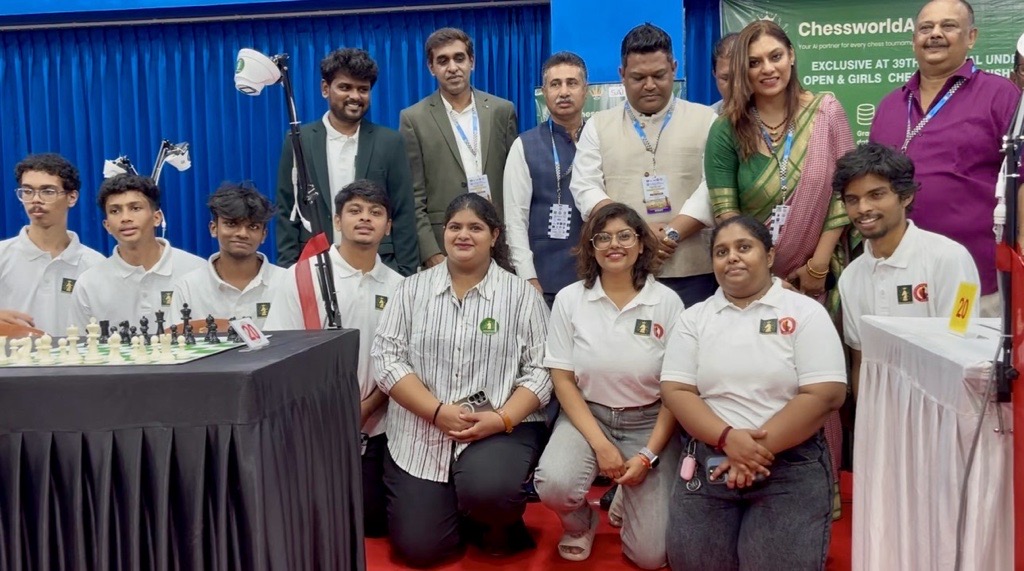
That is the problem a small Bengaluru-based startup, Chessworld AI, has set out to fix — and this week, at the 39th National Under-11 Open & Girls Chess Championship in Mangaluru, Karnataka (August 2–8, 2026), its technology is being tested at national scale.
*A founder who lived the problem*
Chessworld AI was started by Damodar Mundrikeri, who grew up playing competitive chess in Kalaburagi before building the company from Bengaluru. His pitch isn't complicated: young Indian players are producing serious tournament data every single weekend, and almost none of it is being captured in a form anyone can actually use. Coaches don't have time to transcribe games by hand for every student. Parents, often without a chess background themselves, have no real way to track whether their child is improving. And the games themselves — the actual raw material of learning — get lost.
The company's stated philosophy is blunt about this: "Every game teaches something. No game should ever go unanalyzed."
*How the system actually works*
Chessworld AI didn't start with cameras. It started with something much lower-tech: physical scoresheets. The team partnered with tournament organizers, collected scoresheets after games, and used AI-assisted processing to turn handwritten notation into digital PGN files — the standard format chess software uses to store and replay games. That gave players access to opening analysis, tactical pattern recognition, opponent scouting reports, endgame evaluation, and improvement suggestions generated with chess-engine support.
The scale so far is not small for a young startup: more than 15,000 tournament and online games processed, checked against a reference set of around 1.5 lakh public games, and a user base of 500-plus, largely made up of active tournament players.
What's different in Mangaluru is the next layer of the technology. Chessworld AI has been building camera-based capture that reads moves directly off a physical board while the game is still being played, feeding a live-streaming system so that games can be broadcast and analyzed in real time rather than reconstructed afterward. This isn't a Nationals debut from a standing start — the same system was trialled earlier this year at the Karnataka State Under-7 Chess Championship, and the team has brought a refined version to a much bigger stage.
*Why the parents in the hall matter as much as the players*
It's easy to focus a story like this on the players, but talk to organizers at any Indian age-group tournament and they'll tell you the parents are just as central to the experience — and just as underserved by it. A parent who has flown or driven their child across the country for a national championship typically gets to watch a handful of games, understands only some of what's happening on the board, and leaves with little more than a final standing sheet.
Live-streaming changes the access problem directly: relatives who couldn't travel can follow specific boards remotely. The digitized-game layer changes the understanding problem: a parent doesn't need to read a position themselves if the platform can flag where a game turned, what opening was played, and where a similar mistake has shown up before. For a family investing significant time and money into a child's chess development, that kind of visibility — measurable, not just anecdotal — is new.
Players, meanwhile, get something coaches have wanted for years but rarely had the staff-hours to deliver: a personal archive that survives the tournament, tagged and searchable, rather than a stack of paper that gets thrown into a bag.
*Backing from Karnataka's chess establishment*
The project isn't running on founder enthusiasm alone. It has public support from some of the state's most credentialed chess names — GM M.S. Thejkumar, Karnataka's first Grandmaster, WGM Isha Sharma, the state's first Woman Grandmaster, and IM Sharan Rao, who runs the Rao Chess Centre. In 2025, Chessworld AI was also picked for the Elevate Karnataka Startup Grant, selected out of 1,780 applicants — a competitive filter that suggests the idea has convinced people well outside the chess world too.
The bigger picture: grassroots chess catching up to the elite game
India's rise in world chess over the past several years has been told almost entirely through its top players — teenage grandmasters, world championship challengers, record-breaking rating climbs. What's largely missing from that story is the enormous base underneath it: district and state-level tournaments run on paper, played by children whose games are never seen by anyone outside the hall.
What's happening in Mangaluru is a test of whether that base can get some of the same infrastructure the top of the sport takes for granted — recorded games, engine analysis, opponent scouting — without needing a broadcast crew or a super-tournament budget. Chessworld AI has said it wants to digitize more than 100 tournaments across India over the next year and keep building out its real-time capture technology.
It's a modest-sounding goal — digitize the games, don't lose the data — but it points at something larger: a grassroots chess ecosystem in India that, until very recently, had no memory of itself at all.