Dr. Y. S. Rajasekhara Reddy: A Leader Who Walked With the People
Dr. Y. S. Rajasekhara Reddy: A Leader Who Walked With the People
Dr. Yeduguri Sandinti Rajasekhara Reddy, popularly known as YSR, remains one of the most influential and widely remembered political leaders in the history of Andhra Pradesh. A doctor by profession, a mass leader by nature and a politician who built a strong connection with ordinary people, YSR's political journey was defined by his focus on farmers, rural communities, the poor and the economically weaker sections of society.
Born on 8 July 1949 at Pulivendula, YSR entered active politics in 1978. Over the following decades, he rose from being a young legislator to one of the most powerful leaders in Andhra Pradesh politics. He served as a Member of Parliament, held ministerial responsibilities and later became the Leader of the Opposition before leading the Congress party to victory in the 2004 Assembly elections.
On 14 May 2004, YSR became the Chief Minister of Andhra Pradesh.
His tenure would go on to become one of the defining periods in the state's political and social history.
---
From Doctor to People's Leader
YSR's medical background had a significant influence on his outlook towards public service.
After completing his medical education, he worked as a doctor and later established a hospital in Pulivendula. His experience with patients and rural families gave him a first-hand understanding of the difficulties faced by people who could not afford quality healthcare.
That experience remained visible throughout his political career.
For YSR, politics was not merely about administration or elections. He believed that a government had to understand the problems of people by actually meeting them.
This philosophy became particularly evident during his historic padayatra.
---
The Padayatra That Changed Everything
In 2003, when the Congress party was in opposition in Andhra Pradesh, YSR undertook a massive padayatra across the state.
Walking for hundreds of kilometres and meeting people in villages, towns and rural communities, he listened directly to farmers, agricultural workers, women, students and families.
The journey exposed him to the realities of rural Andhra Pradesh—farmers struggling with agriculture, inadequate irrigation, unemployment, poverty, healthcare expenses and the difficulties faced by ordinary families.
The padayatra became more than a political journey.
It became a direct connection between a political leader and the people.
The issues he encountered during the journey later became important elements of his government's agenda.
---
2004: A New Chapter in Andhra Pradesh
The 2004 Assembly elections brought the Congress party to power under YSR's leadership.
On 14 May 2004, he took oath as the Chief Minister of Andhra Pradesh.
His government adopted a combination of welfare programmes, agricultural support, healthcare initiatives, irrigation development, housing and education-related measures.
One of the most important decisions of his government was providing free electricity to farmers.
For a state whose economy was deeply connected to agriculture, the move became a major political and social statement.
YSR's approach was clear: farmers and rural communities had to be given support if the state's development was to be meaningful.
---
Aarogyasri: Healthcare for the Poor
One of the most significant initiatives associated with YSR was Rajiv Aarogyasri.
The programme was designed to provide financial assistance for major medical treatments to economically disadvantaged families.
For poor households, a serious illness could mean years of debt, the sale of agricultural land or the loss of family savings.
Aarogyasri attempted to change that reality by enabling eligible families to access major medical treatment without bearing the entire financial burden themselves.
The programme became one of the most visible examples of YSR's belief that healthcare should not become a privilege available only to those who could afford it.
His background as a doctor added a personal dimension to his emphasis on healthcare.
---
108 Emergency Ambulance Service
Another initiative associated with the YSR era was the expansion of the 108 emergency ambulance service.
The service provided emergency medical transportation through a simple emergency number and became particularly important for people living in rural areas, where immediate access to hospitals could often mean the difference between life and death.
The model subsequently gained attention beyond Andhra Pradesh as well.
For ordinary citizens, 108 became more than a government programme—it became a symbol of emergency assistance being available when it was needed most.
---
Jalayagnam: The Vision of Irrigation
YSR strongly believed that the future of agriculture depended on assured water.
With this objective, his government launched Jalayagnam, an ambitious programme involving numerous irrigation projects across Andhra Pradesh.
The larger vision was to expand irrigation facilities, provide water to agricultural lands and improve the livelihoods of farming communities.
Water was not viewed merely as an infrastructure issue.
For YSR, irrigation was connected to agriculture, farmer incomes, rural employment and the overall development of villages.
Jalayagnam became one of the largest and most ambitious components of his administration. At the same time, its scale, expenditure, implementation and individual projects became subjects of political debate and criticism.
Nevertheless, irrigation remained one of the central pillars of YSR's development philosophy.
---
Welfare as a Form of Governance
YSR's administration became known for a broad welfare-oriented approach.
Among the programmes and initiatives associated with his government were:
- Free electricity for farmers
- Aarogyasri healthcare
- 108 emergency ambulance services
- Pavala Vaddi support
- Indiramma housing programmes
- Subsidised rice
- Support for women's self-help groups
- Educational fee reimbursement
- Irrigation and rural development programmes
The common thread connecting many of these initiatives was the attempt to make government assistance directly visible in people's lives.
YSR's politics was therefore not restricted to policy announcements.
He wanted people to feel that the government was accessible to them.
---
A Leader With a Rural Heart
Perhaps the most distinctive aspect of YSR's political personality was his connection with rural Andhra Pradesh.
His padayatra had taken him into villages and farming communities. As Chief Minister, he continued to focus heavily on agriculture, irrigation, healthcare, housing and welfare.
He understood that for a farmer, development could mean access to irrigation.
For a poor family, development could mean access to healthcare.
For a student, it could mean the opportunity to pursue higher education.
For a rural family, it could mean a house, electricity or access to emergency medical services.
This understanding helped YSR build a powerful emotional connection with sections of the population.
---
Development and Controversies
A complete assessment of YSR's political legacy also requires acknowledging the controversies surrounding his administration.
Large irrigation projects, government expenditure, welfare programmes, land-related issues and allegations of corruption became subjects of political debate.
Supporters viewed his policies as necessary investments in social welfare, agriculture and infrastructure.
Critics questioned the financial sustainability, implementation and governance surrounding some programmes and projects.
As with any major political administration, YSR's legacy therefore contains both achievements and controversies.
But even his critics acknowledged the extraordinary political impact he had on Andhra Pradesh.
---
2009: A Second Victory
The 2009 Assembly elections brought another major victory for YSR and the Congress party.
He returned as Chief Minister for a second consecutive term, demonstrating the strength of his political connection with the electorate.
His second tenure, however, would last only a few months.
On the morning of 2 September 2009, YSR began a journey that was intended to take him closer to the people once again.
He was travelling by helicopter to attend the Rachabanda programme, a government outreach initiative intended to take administration and welfare programmes closer to people in rural areas.
The helicopter lost contact during the journey over the Nallamala forest region.
For hours, the state remained anxious as authorities searched for the missing aircraft.
Eventually, the helicopter was located in the Nallamala forest.
YSR and the other people aboard had died in the crash.
---
2 September 2009: A Day Andhra Pradesh Will Never Forget
The tragedy sent shockwaves across Andhra Pradesh.
Millions mourned the sudden death of a Chief Minister who had become closely associated with welfare programmes and direct engagement with ordinary people.
There was also a deeply poignant dimension to the tragedy.
YSR was travelling to attend Rachabanda—a programme designed to take the government closer to the people—when his journey came to a tragic end.
A leader who had begun his political journey by walking through villages and listening to ordinary citizens was, even in his final journey, travelling to meet and serve the people.
That coincidence became a powerful part of his legacy.
He spent his political life going to the people, and on his final day, he was once again on his way to the people.
---
A Legacy That Lives On
YSR's death did not end the political influence of his ideas.
The programmes associated with his administration continued to shape political discussions in Andhra Pradesh and, subsequently, Telangana.
Healthcare schemes, irrigation projects, farmer welfare, education support and direct government assistance remained important components of political discourse.
His legacy also influenced a generation of political leaders and supporters who continued to refer to his governance model.
For his admirers, YSR represented a leader who understood the struggles of the poor and farmers.
For political observers, he represented a major transformation in the politics of Andhra Pradesh—where welfare, agriculture, healthcare and direct public outreach became central to electoral politics.
---
More Than a Chief Minister
YSR's story is not simply the story of a Chief Minister who served for five years.
It is the story of a doctor who entered politics, a politician who became a mass leader, and a leader who attempted to bring government programmes directly to ordinary citizens.
His padayatra established his connection with the people.
His welfare programmes attempted to address immediate social and economic difficulties.
His healthcare initiatives focused on poor families.
His irrigation vision focused on agriculture and water security.
And his Rachabanda journey on 2 September 2009 tragically became the final chapter of a political life defined by reaching out to the people.
---
Remembering YSR
Years may pass, governments may change and political equations may evolve, but certain leaders leave behind an imprint that remains part of public memory.
Dr. Y. S. Rajasekhara Reddy is remembered by his supporters not simply because he occupied the office of Chief Minister, but because of the way he connected governance with the everyday lives of ordinary people.
He believed that the success of government should ultimately be measured by whether it could improve the life of a farmer, provide treatment to a poor patient, support a student or give hope to a struggling family.
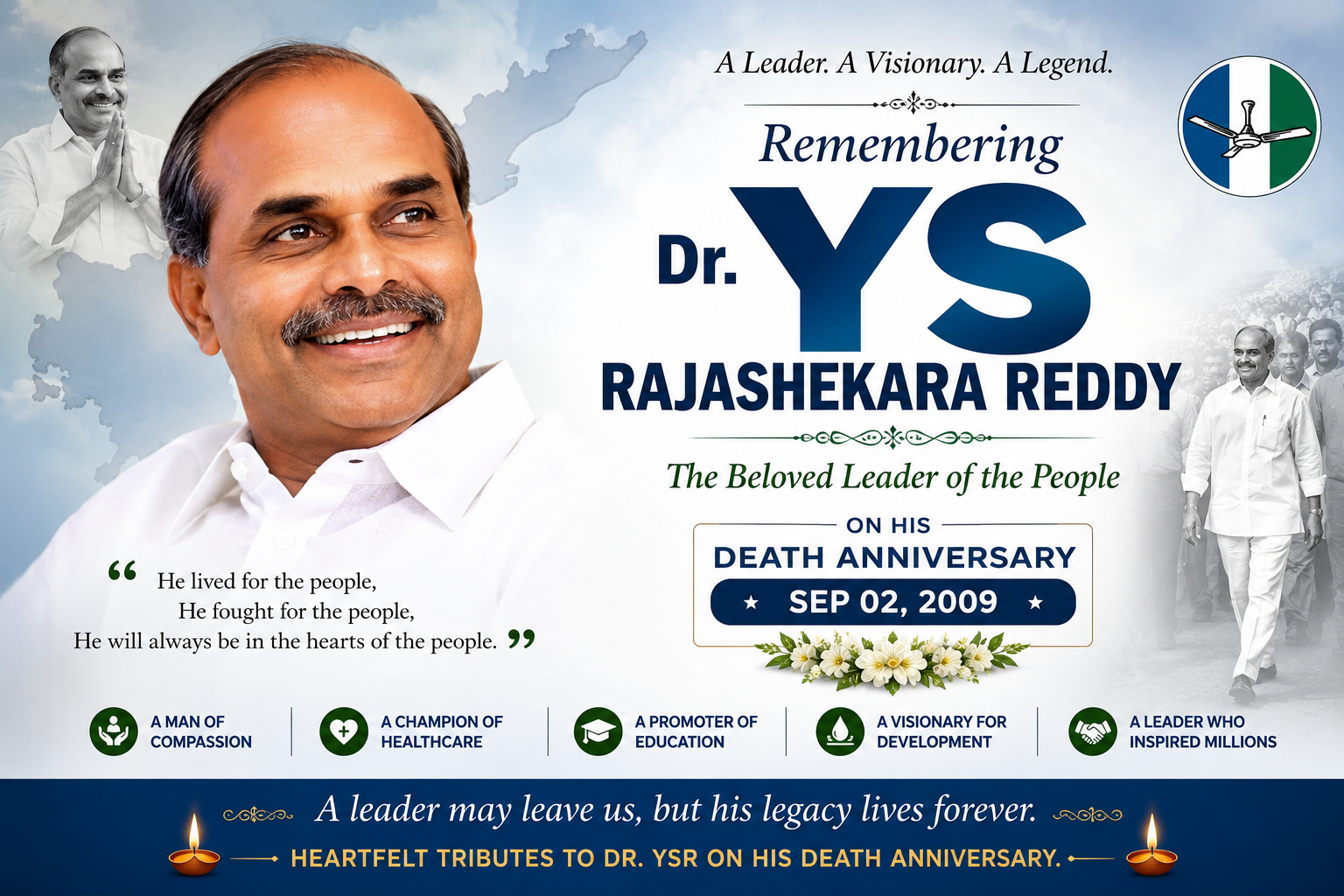
On 2 September 2009, Andhra Pradesh lost a leader who was still in the midst of his journey.
He was on his way to Rachabanda—to meet the people, listen to them and take government closer to them.
That final journey has become one of the most poignant chapters in the history of Andhra Pradesh.
Dr. Y. S. Rajasekhara Reddy may have left this world on 2 September 2009, but the memories of his leadership, his welfare-oriented governance and his connection with the common people continue to live on.
**YSR — A Doctor Who Became a Leader,
A Leader Who Walked With the People,
And A Leader Who Left While Still On His Way To Serve Them.**