FOUGHT LIKE A LION Captain Smit Machchhar: The Courage, Instinct and Decision That Stood Between 182 Lives and Catastrophe
FOUGHT LIKE A LION
Captain Smit Machchhar: The Courage, Instinct and Decision That Stood Between 182 Lives and Catastrophe
DANDA NITI | The Science of Power
There are moments in a pilot's career when training takes over.
And then there are moments when training is no longer enough.
When the cockpit becomes a battlefield.
When the aircraft is falling.
When the person beside you has turned against you.
When you are bleeding, injured and fighting for your own life — yet you still have 182 other lives depending on your next decision.
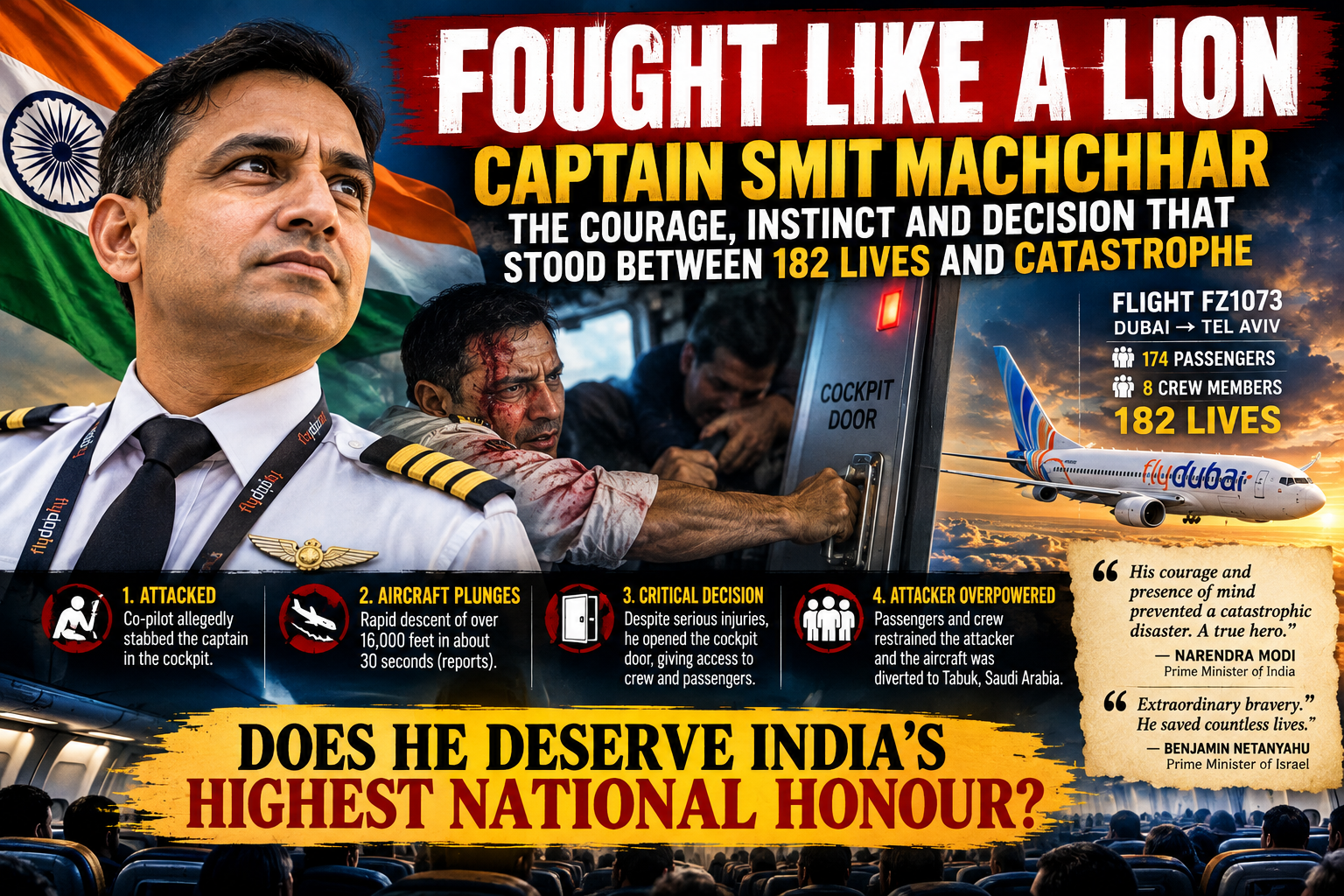
That was the extraordinary situation faced by Captain Smit Machchhar aboard Flydubai Flight FZ1073.
And what makes his story extraordinary is not simply that he fought.
It is what he decided to do while fighting.
HE WAS INJURED. THE AIRCRAFT WAS IN A STEEP DESCENT.
On September 30, Flight FZ1073 was travelling from Dubai to Tel Aviv with 174 passengers and eight crew members.
According to reports, the co-pilot allegedly attacked Captain Machchhar inside the cockpit.
The aircraft then entered a violent and rapid descent. Reuters reported that the aircraft plunged more than 16,000 feet in approximately 30 seconds, while displaying extreme and erratic flight behaviour.
Inside that cockpit, the captain was not merely fighting an attacker.
He was fighting against time, altitude, injury and the possibility of losing control of an aircraft carrying 182 people.
And then came the decision that may have changed everything.
HE OPENED THE COCKPIT DOOR.
Despite being seriously injured, Machchhar managed to activate the cockpit-door mechanism, enabling passengers and crew to enter and overpower the attacker.
That action is easy to describe in one sentence.
It is much harder to comprehend psychologically.
A cockpit door exists precisely to keep people outside from entering.
In that moment, however, the door became the difference between isolation and intervention.
THE DECISION THAT CHANGED THE OUTCOME
Imagine the situation.
You have been attacked.
You are injured.
The aircraft is descending rapidly.
The cockpit is compromised.
And you know that if you lose control, everyone behind you goes down with you.
There is no time for a committee.
No time for consultation.
No second chance.
There is only judgement under extreme pressure.
Captain Machchhar's decision to open the cockpit gave the people outside an opportunity to intervene.
Passengers and crew entered.
The attacker was restrained.
Other pilots travelling aboard the aircraft were able to assist in regaining control.
The aircraft was eventually diverted and landed safely at Tabuk, Saudi Arabia.
The Federation of Indian Pilots has specifically highlighted this combination of courage, situational awareness, leadership, command judgement and devotion to duty in its request that Machchhar be considered for national recognition.
WHAT IF THAT DOOR HAD NOT OPENED?
This is perhaps the most chilling question.
We should not claim that a particular alternative outcome was certain.
But the facts establish something important:
The aircraft was already in a severe emergency.
The captain was seriously injured.
The aircraft was descending rapidly.
And the intervention of passengers and crew after the cockpit door was opened was critical to restoring control.
Had access to the cockpit not been achieved, the available options for intervention would have been dramatically narrower.
That is why this was not simply an act of physical resistance.
It was an act of professional judgement under potentially catastrophic conditions.
The difference between disaster and survival may, in that moment, have been measured in seconds — and in one decision.
VALOUR IS NOT JUST THE ABSENCE OF FEAR
Real courage is often misunderstood.
It is not necessarily the absence of fear.
It is the ability to act while fear, pain and uncertainty are present.
Captain Machchhar was not standing on a parade ground.
He was not protected by a uniformed formation.
He was not carrying a weapon.
He was in a pressurised aircraft thousands of feet above the ground, seriously injured, with the person beside him allegedly attempting to take control of the aircraft.
And yet he continued to act as Pilot-in-Command.
The Federation of Indian Pilots described his conduct as an exceptional demonstration of professional courage and responsibility.
That distinction matters.
Because the first responsibility of a captain is not his own survival.
It is the safety of those who have entrusted their lives to his command.
182 PEOPLE HAD NO IDEA WHAT WAS HAPPENING
For most passengers, a flight is routine.
They board.
They fasten their seat belts.
They sleep.
They watch a movie.
They wait to land.
But on FZ1073, behind the cockpit door, an extraordinary crisis was unfolding.
The people in the cabin could not simply solve it themselves.
They needed the cockpit to become accessible.
They needed someone inside to create that opportunity.
Machchhar did.
And once the door opened, passengers and crew were able to intervene.
The aircraft survived.
The passengers survived.
The crew survived.
And the story that could have become one of aviation's darkest disasters became a story of extraordinary human courage.
THE WORLD SAW THE VALOUR
Indian Prime Minister Narendra Modi praised Machchhar's courage and presence of mind.
Israeli Prime Minister Benjamin Netanyahu described him as a hero and credited the captain's actions, together with those of passengers and crew, with preventing a catastrophic mid-air disaster.
The Israeli ambassador to India also praised Machchhar's resourcefulness, courage and resolve.
And now the Federation of Indian Pilots has formally asked the Prime Minister's Office to consider him for a National Bravery Award, subject to verification by the competent authorities.
The Gujarat government has also announced the Vishishtha Gujarat Garima Award for him.
A PILOT'S BATTLEFIELD IS DIFFERENT
For a soldier, courage may mean holding a position under fire.
For a firefighter, it may mean entering a burning building.
For a police officer, it may mean confronting an armed threat.
For a pilot, sometimes courage means something different:
Remaining capable of making rational decisions while everything around you is collapsing.
That is what makes Captain Smit Machchhar's story so powerful.
He did not merely resist.
He thought.
He did not merely survive.
He acted.
He did not merely save himself.
His actions helped create the conditions in which others could intervene and the aircraft could ultimately be brought safely to the ground.
THE QUESTION OF NATIONAL HONOUR
The Federation of Indian Pilots has asked the Government of India to consider Machchhar for national recognition.
Whether a particular national honour is ultimately appropriate is a matter for the competent authorities and the applicable award criteria, after the investigation and verification of the incident.
But one principle is difficult to miss:
India has witnessed an extraordinary example of professional courage.
A man was attacked in the most critical workplace imaginable.
He was injured.
An aircraft carrying 182 people was in grave danger.
And instead of surrendering to the crisis, he continued to fight, continued to make decisions and opened the door that allowed others to help regain control.
That is not merely a story about aviation.
It is a story about human valour under impossible pressure.
FOUGHT LIKE A LION.
There are battles fought with weapons.
There are battles fought with armies.
And there are battles fought in a cockpit at 34,000 feet — with seconds disappearing, an aircraft falling and hundreds of lives depending on one person's judgement.
Captain Smit Machchhar faced one of those battles.
He fought.
He resisted.
He made a decision.
He opened the door.
And that door gave others the chance to act.
The aircraft came down safely.
182 lives came home.
The investigation into the attack and the motive behind it continues, and those facts must be established through the proper authorities.
But one fact already stands before the world:
WHEN THE SKY TURNED INTO A BATTLEFIELD, CAPTAIN SMIT MACHCHHAR FOUGHT LIKE A LION.
The question now is not whether his courage deserves to be remembered.
It is how a nation chooses to recognise an act of courage that may have stood between 182 people and catastrophe.
#SmitMachchhar #CaptainSmitMachchhar #Flydubai #AviationSafety #Valour #Heroism #NationalBravery #IndianPride #DandaNiti #TheScienceOfPower