Freedom from Vehicle Smoke and the Search for Clean Air: The Importance of ‘World Car-Free Day’ and Urban Reality
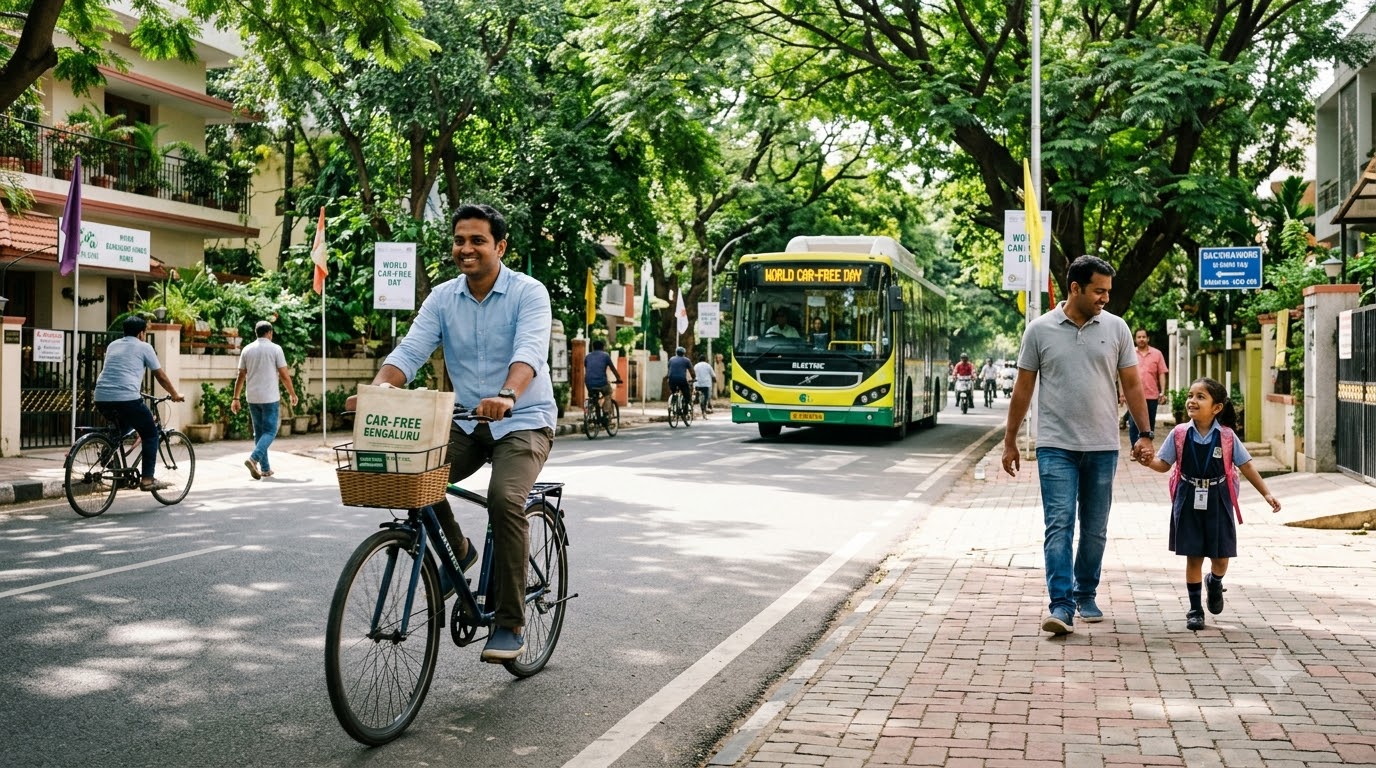
World Car-Free Day: Rethinking Private Vehicle Dependence in Growing Cities
September 22 | Opinion & Analysis
Every year on September 22, World Car-Free Day is observed in many parts of the world. The day encourages people to reduce their dependence on private vehicles and consider alternatives such as public transport, cycling and walking. The modern Car-Free Day movement has roots in European initiatives of the 1990s, with coordinated activities held in several European cities before the campaign expanded internationally.
The central idea is simple: encourage people to leave their private cars at home, where practical, and use public transport, bicycles or walking instead. Beyond a single day, the initiative provides an opportunity to discuss urban air pollution, traffic congestion and the growing dependence on private vehicles.
The Challenge for Cities Like Bengaluru
In rapidly growing metropolitan areas, the relationship between the number of vehicles and available road capacity has become an important urban-planning issue. Cities such as Bengaluru face significant traffic congestion, while vehicle emissions remain one of the factors that can affect urban air quality.
When private vehicles carry only a small number of passengers, the amount of road space and fuel used per traveller can be considerably higher than with mass public transport. During congestion, vehicles may also spend long periods moving slowly or remaining stationary, increasing fuel consumption and emissions.
This makes Car-Free Day more than a symbolic campaign. It can also serve as an opportunity to examine public transport, pedestrian infrastructure and the broader mobility choices available to urban residents.
Air Pollution and Public Health
Vehicle emissions are among the factors that influence air quality in urban areas. The World Health Organization and scientific research have extensively examined the relationship between air pollution and respiratory and cardiovascular health risks. However, attributing a particular increase in a disease or health condition to vehicle emissions alone requires city-specific scientific evidence.
Traffic noise can also affect the quality of urban life. Reducing unnecessary vehicle use can therefore be considered alongside measures aimed at improving public transport, pedestrian safety and quieter urban environments.
Lessons from Other Cities
Cities such as Paris, Amsterdam and Copenhagen have introduced various measures to encourage walking and cycling, improve public transport and manage private vehicle access in selected areas. Their experiences demonstrate the potential value of combining transport planning with pedestrian and cycling infrastructure.
However, policies developed in one city cannot simply be transferred to another. Population density, road networks, public transport capacity, travel patterns and local economic conditions all need to be considered when designing urban mobility policies.
Road Expansion Alone May Not Be Enough
Urban traffic problems cannot necessarily be solved through additional roads and flyovers alone. Expanding reliable city bus services, improving metro connectivity, creating safe footpaths and developing continuous cycling routes can also form part of a broader mobility strategy.
If residents have convenient and dependable alternatives for travelling between homes, workplaces and other destinations, dependence on private vehicles may become easier to reduce. This requires transport planning to be integrated with housing, employment centres and last-mile connectivity.
The Role of Citizens
Sustainable transport is not dependent only on government infrastructure. For short-distance journeys, walking, cycling, public transport and carpooling can provide alternatives to individual vehicle use where conditions permit.
At the same time, people are more likely to adopt these alternatives when cities provide safe roads, reliable public transport, adequate footpaths and convenient last-mile connections. Long-term change therefore requires cooperation between citizens, local authorities and transport agencies.
What World Car-Free Day Represents
World Car-Free Day is not simply about leaving a car at home for one day. It provides an opportunity to reconsider how cities move people and whether public transport, walking and cycling can be made more convenient and accessible.
As urban populations continue to grow, discussions around cleaner air, reduced congestion and better public spaces are becoming increasingly relevant. September 22 offers an opportunity to reflect on these challenges and consider how everyday transportation choices can contribute to more sustainable urban mobility.