GANDHI: FATHER OF THE NATION — OR A TITLE WE NEVER DEBATED? Khilafat. Hindu–Muslim Unity. Ambedkar. Cow Protection. Majority Restraint.
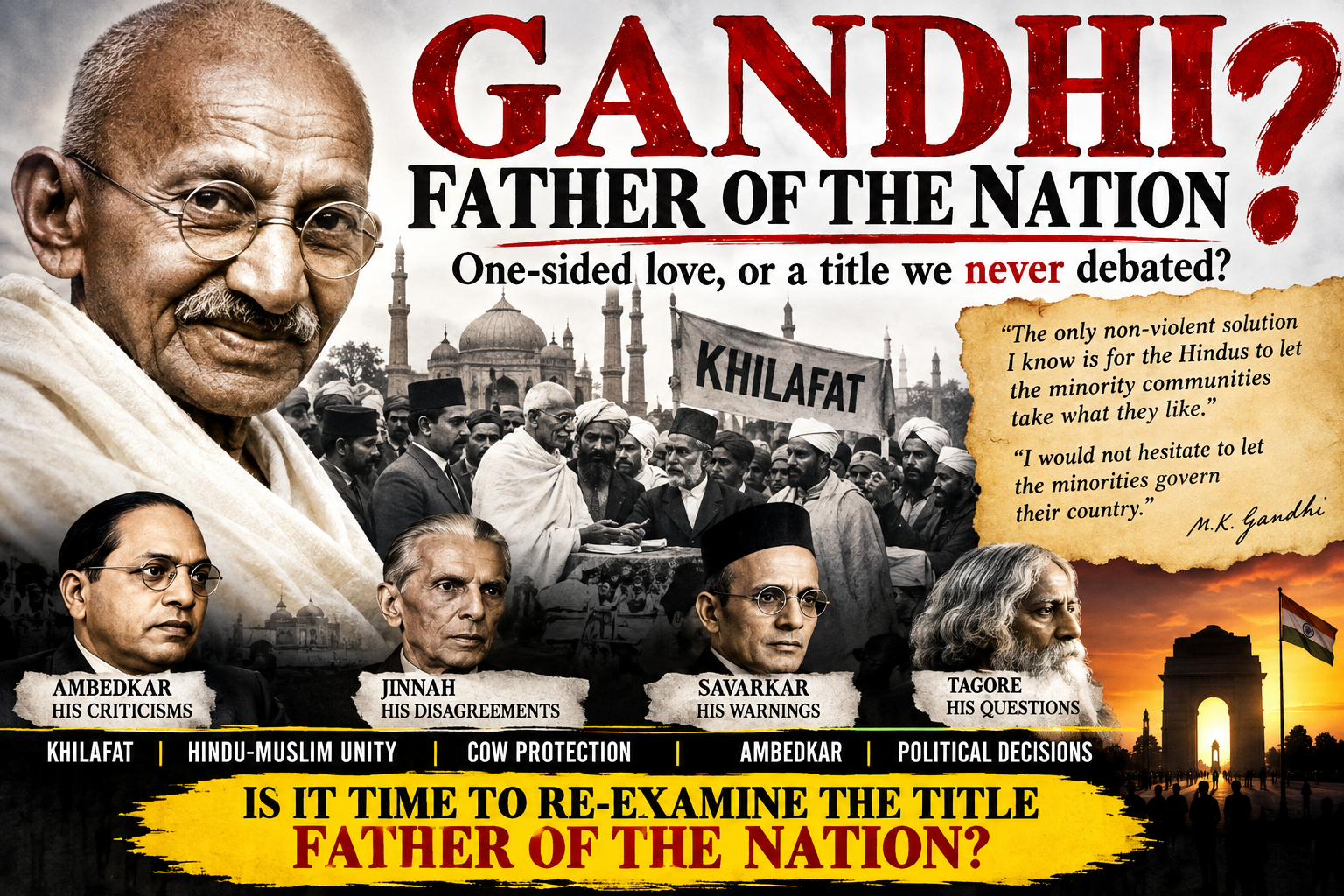
Gandhi: Father of the Nation — A Historical Title Open to Debate?
Khilafat, Hindu–Muslim Unity, Ambedkar and the Question of National Identity
DANDA NITI | The Science of Power
Mahatma Gandhi remains one of the most influential leaders of India's freedom movement. His role in mass mobilisation, Satyagraha and non-violent resistance shaped the struggle against British rule and influenced movements for civil rights across the world.
Yet recognising his contribution does not mean that every political decision he made must remain beyond historical scrutiny.
One question that continues to attract discussion is the title “Father of the Nation”. According to information attributed to the Gandhi Smriti and Darshan Samiti, there is no official government notification conferring this title on Gandhi. The title is widely used as an honorific in India's public memory.
Gandhi and the Khilafat Movement
Following the First World War, Gandhi supported the Khilafat movement, which sought to defend the position of the Ottoman Caliph and address concerns among Indian Muslims about the post-war settlement with Turkey.
Gandhi connected the Khilafat issue with the Non-Cooperation Movement and the broader objective of Swaraj. His strategy was based on the belief that Hindu–Muslim unity was essential for a united national movement.
His support for the movement remains a subject of historical debate. Supporters have viewed it as an effort to build cooperation across communities, while critics have questioned the political consequences of linking a religious issue with the national freedom struggle.
Unity, Cow Protection and Non-Violence
Gandhi regarded cow protection as an important religious sentiment among Hindus. At the same time, he opposed the use of violence or coercion against Muslims in its name.
His position reflected his commitment to Ahimsa and the belief that religious conviction should not justify violence against another person.
However, historians and political thinkers may examine whether his approach placed particular expectations of restraint on the majority community and how such expectations related to political equality and mutual responsibility.
The Moplah Rebellion and Communal Violence
The Moplah rebellion in Malabar involved an uprising against British authority and existing social structures, alongside serious communal violence, including attacks on Hindus and reports of forced conversions.
Gandhi opposed violence and emphasised reconciliation. His approach can be examined both as an expression of non-violent philosophy and in relation to questions about the protection of victims and the responsibilities of political leadership.
The historical circumstances, different participants and consequences of the rebellion should be considered carefully rather than reduced to a single communal interpretation.
Gandhi and Dr. B.R. Ambedkar
Gandhi and Dr. B.R. Ambedkar differed significantly over political representation and safeguards for oppressed communities.
Gandhi placed considerable emphasis on social reform and moral transformation. Ambedkar stressed political representation, institutional protections and constitutional safeguards.
Their disagreement over separate electorates for the Depressed Classes remains an important episode in India's political history.
Their contrasting approaches raise a continuing question: how should a democratic society balance moral responsibility with enforceable rights and institutional protections?
Different Visions of Nation-Building
Gandhi's political approach also differed from the views of leaders such as V.D. Savarkar, Muhammad Ali Jinnah and Rabindranath Tagore.
Savarkar placed emphasis on national consolidation and Hindu national identity. Jinnah's political approach during the Khilafat and Non-Cooperation period differed from Gandhi's strategy. Tagore raised concerns about aspects of mass political mobilisation and the relationship between nationalism and independent thought.
These disagreements demonstrate that India's freedom movement contained multiple political and intellectual traditions.
Was Gandhi Officially Declared the Father of the Nation?
The Gandhi Smriti and Darshan Samiti has stated that no official government notification conferring the title “Father of the Nation” on Gandhi is recorded. The title is commonly associated with Subhas Chandra Bose's address to Gandhi in 1944 through Azad Hind Radio.
As a widely recognised national honorific rather than a constitutional office, the title can be examined through historical discussion and public debate.
Recognising Contribution While Examining History
Gandhi's contribution to India's freedom movement is historically significant. His political decisions, including his support for the Khilafat movement, approach to communal harmony and disagreements with Ambedkar, are also legitimate subjects of scholarly examination.
India's independence was the result of contributions from millions of people, including revolutionaries, soldiers, farmers, workers, reformers, women, political leaders and countless citizens whose names may not appear prominently in historical accounts.
Recognising Gandhi's role does not require overlooking the contributions of others. Equally, examining his decisions does not require dismissing his historical influence.
A Question for Historical Reflection
Perhaps the more useful question is not whether Gandhi should be celebrated or rejected, but how India should understand the distinction between a historical leader and a national symbol.
Citizens can study Gandhi alongside Ambedkar, Jinnah, Savarkar, Tagore and other figures, considering their arguments, disagreements and historical contexts.
The title “Father of the Nation” remains part of India's public memory. Its meaning and significance can be discussed through evidence, historical scholarship and respectful debate.
The purpose of examining history is not to worship or erase its figures, but to understand their contributions, limitations and the diverse forces that shaped the nation.
DANDA NITI | The Science of Power
#Gandhi #FatherOfTheNation #MahatmaGandhi #KhilafatMovement #Ambedkar #HinduMuslimUnity #IndianHistory #FreedomMovement #PoliticalHistory #DandaNiti