Pondicherry at a Crossroads : Tourism a bane or boon
PONDICHERRY AT A CROSSROADS: TOURISM WITHOUT CONTROL IS NO LONGER SUSTAINABLE
A city cannot sacrifice the peace, safety, cleanliness and dignity of its residents in the name of tourism. It is time for Pondicherry to rethink its tourism model before the very charm that attracts visitors is lost.
Pondicherry, fondly known as the French Riviera of the East, has long been admired for its beautiful beaches, heritage streets, French architecture, spiritual atmosphere and relaxed way of life. Its unique character has made it one of South India's favourite tourist destinations. Tourism has undoubtedly contributed to the local economy, creating livelihoods for hotels, restaurants, cafés, homestays, transport operators and small businesses.
But an important question must now be asked: At what cost is this unchecked influx of tourism coming to Pondicherry?
A town with limited road space, fragile coastal ecosystems and established residential neighbourhoods cannot continue to absorb an ever-increasing number of visitors and vehicles without adequate planning, infrastructure and enforcement. What should be a pleasant weekend for tourists is increasingly becoming a stressful experience for residents who have to live with the consequences long after the visitors leave.
1. Traffic congestion: A city brought to a standstill
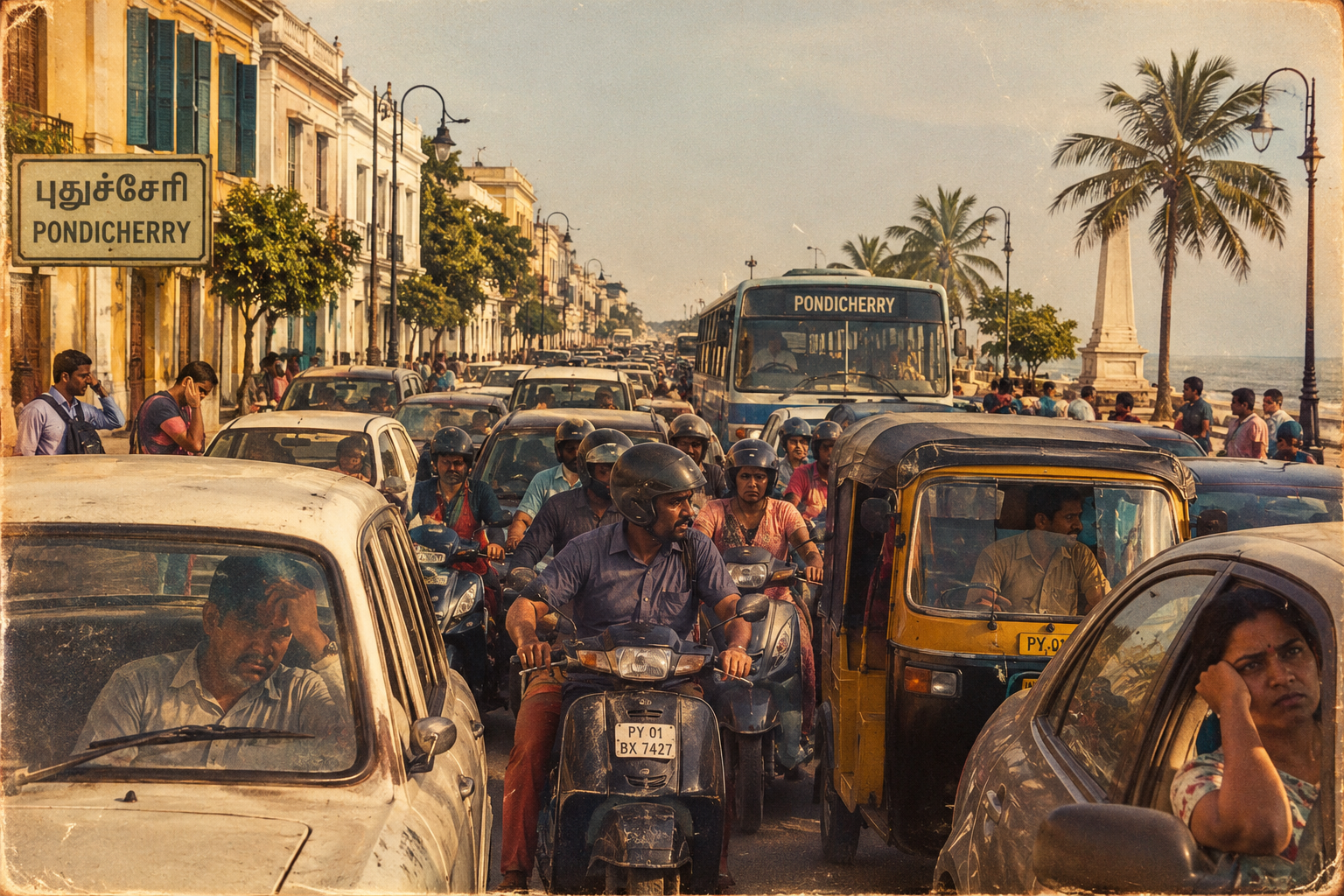
Weekend and long-weekend traffic congestion has become one of Pondicherry's most pressing civic concerns. The roads around White Town, the beach promenade, Mission Street, popular restaurant areas, Rajiv Gandhi square, Indira Gandhi square, stretch ECR from Sivaji statue and major junctions often struggle to accommodate the volume of cars, two-wheelers, tourist taxis and commercial vehicles.
This is not merely a matter of inconvenience. Residents can lose valuable time travelling to work, reaching hospitals, attending to emergencies or carrying out their daily activities. Pondicherry’s streets were never designed to accommodate the present volume of motor traffic.
A Times of India report, “Tourists struggle to park their vehicles in Pondy on weekends,” published in October 2025, highlighted severe parking shortages during holiday periods, with the town's two principal parking areas exceeding capacity. The report also discussed the reluctance of some visitors to use parking facilities farther from the town centre.
In October 2026, Dinamalar again reported extensive congestion during the extended holiday period, including long queues at major junctions and heavy tourist traffic in White Town.
These reports make one thing clear: the problem is neither imaginary nor limited to a few isolated weekends. Tourism is growing faster than the town's ability to manage the resulting traffic.
2. Indiscriminate parking and wrong-side driving
The problem is compounded by motorists who treat public roads as private parking spaces. Cars are left along narrow streets, near intersections, in front of residential gates and wherever a driver finds a convenient gap. Many park their car infront of Liquor marts in a way that ongoing traffic is affected. Even a single badly parked vehicle can obstruct an already narrow road, while emergency vehicles and local residents are forced to negotiate the resulting bottlenecks.
Wrong-side driving is another serious concern. It is seen among both local motorists and visitors, including people riding rented two-wheelers who may be unfamiliar with the town's road layout. Reckless riding, speeding and disregard for traffic signals further endanger pedestrians and other road users. Many local residents including women blatantly flout road rules by jumping signals, driving on the wrong side to such an extent that wrong side driving has become a norm in Pondicherry.
Pondicherry Police acknowledged these very challenges in its Annual Newsletter 2024, published in March 2025. The newsletter identified weekend and holiday tourist inflows, inadequate designated parking and widespread traffic violations, including wrong-side driving, as significant contributors to congestion and road-safety risks.
This is a problem of enforcement as much as infrastructure. Rules cannot remain effective only on paper. There must be consistent penalties, towing of illegally parked vehicles, strict action against wrong-side driving and meaningful accountability for traffic violations.
3. Garbage, plastic pollution and the loss of civic sense
Pondicherry's appeal lies not only in its cafés and heritage buildings but also in its beaches, coastal environment and relatively peaceful surroundings. Yet these assets are increasingly vulnerable to littering and poor waste management. One can see public spaces being used as drinking spaces by tourists and locals alike. Police too go on a checking spree and warn the offenders but to no avail. This shows that such offenders drinking on the beachside, public areas must be penalized as a deterrent to others. The tourists too must learn to respect the place they are visiting.
Discarded food containers, plastic cups, water bottles, beer bottles, cigarette packets and other waste spoil public spaces and burden sanitation workers. Plastic thrown into roadside drains can obstruct water flow, while waste carried through storm-water channels ultimately reaches rivers, backwaters and the sea.
The problem cannot be blamed entirely on tourists. Residents, commercial establishments, vendors and event organisers must also take responsibility. Nevertheless, visitors who enjoy the city's facilities have a clear obligation not to leave behind the waste generated during their stay.
There is documented evidence of the scale of the challenge. An official record of the International Coastal Cleanup held at Pondy Marina Beach on 20 September 2025 reported that 251 volunteers collected approximately 317 kg of marine litter. The recorded waste included glass, plastic and other debris, including liquor bottles and glasses.
This should concern every citizen.
A beach is not a dumping ground. A drain is not a waste bin. A heritage street is not a disposable space to be used and abandoned.
Poor or delayed garbage clearance only compounds to the damage. Municipal authorities must ensure timely collection, regular desilting of drains, sufficient public bins and reliable cleaning schedules, particularly after weekends and long holidays. At the same time, littering must attract enforceable fines rather than empty warnings.
4. The growing entertainment economy and the pressure on residential areas
The expansion of restaurants, resto-bars, liquor outlets, late-night entertainment venues, Hotels, numerous Homestays and spas has changed the character of several parts of Pondicherry. Commercial activity and nightlife are legitimate parts of a tourist economy, but their growth must be balanced against the carrying capacity of the town and the rights of residents.
When entertainment venues cluster in already congested areas, they generate additional traffic, parking demand, noise, late-night movement and pressure on public services. Visitors arriving in private cars often occupy roadside spaces for extended periods, while two-wheelers and taxis add to the congestion.
The concern is not that every restaurant, pub or spa is problematic. Many businesses operate responsibly and contribute positively to the local economy. The concern is the absence of sufficiently effective planning when commercial activity expands into areas whose roads, parking facilities and residential surroundings cannot support it.
Authorities should review the density and location of entertainment establishments, enforce licensing and operating conditions, monitor noise levels and prevent illegal parking and public nuisance.
A town cannot keep adding traffic-generating businesses to its most congested streets and expect the problem to resolve itself.
5. Public safety, alcohol-related disturbances and law enforcement
A destination's reputation depends on more than its nightlife. Visitors and residents alike must feel safe on its streets, beaches and public spaces.
Concerns about drunken driving, public altercations, reckless riding and disturbances associated with alcohol consumption deserve serious attention. The New Indian Express, in its report of 3 June 2026, titled “Drunken brawls, tipsy-driving cases on the rise in Puducherry raise concerns,” reported police action against public nuisance and alcohol-related disturbances, alongside concerns about speeding and road accidents.
Such reporting does not mean that all tourists or nightlife businesses are responsible for crime. Nor does it, by itself, establish that every category of crime is increasing. However, it demonstrates why public safety and law enforcement must remain central to tourism planning.
There must be visible policing in high-footfall areas, effective checks against drunk driving, strict enforcement of licensing rules, strick check on Hotels and Homestays, action against public disturbances and adequate late-night transport arrangements. CCTV coverage, well-lit streets and prompt response to complaints should be treated as essential public-safety measures.
Tourism revenue cannot be allowed to take precedence over the safety and peace of the people who call Pondicherry home.
6. A practical solution: Regulate the influx before the city is overwhelmed
The answer is not to reject tourism. The answer is to make tourism sustainable, organised and accountable. Pondicherry needs a comprehensive mobility and tourism-management policy rather than temporary traffic diversions every time a holiday crowd arrives.
First: Introduce a digital tourist vehicle e-pass system.
During peak weekends, long weekends and major holidays, authorities should consider a pilot e-pass system for non-local private vehicles entering Pondicherry ( like in Kodai , Ooty) The Govt can use a voluntary organisation to study the number and type of non-local vehicles entering Pondicherry every weekend and long weekends, arrive at a fixed number of passes to be issued and try implementing it. Non –local vehicles should be stopped from entering the most congested parts of the town. The system could use advance registration, time slots and a daily vehicle quota determined by road capacity.
Residents, emergency vehicles, essential service providers and other clearly defined categories should receive appropriate exemptions. Visitors who cannot bring their cars into restricted zones should be directed to peripheral parking facilities and convenient shuttle services.
The purpose must be to manage vehicle numbers, not to arbitrarily discourage visitors or create an unnecessary financial burden.
Second: Establish peripheral parking hubs.
Large, secure parking facilities should be developed at suitable entry points outside the congested heritage and beach districts. Visitors can park their vehicles and travel into the town centre using frequent electric buses, shuttle vans, bicycles or designated shared transport.
Parking must be affordable, clearly signposted and convenient. A system that asks tourists to leave their cars outside town without providing reliable alternatives will simply encourage illegal parking elsewhere.
Third: Move high-impact entertainment activity to planned zones outside the historic core.
New large-format entertainment venues, high-capacity nightlife establishments and other traffic-intensive commercial developments should be encouraged in appropriately planned areas outside the most congested residential and heritage districts.
Such zones must have adequate roads, parking, public transport, drainage, waste management, fire safety and policing. Existing businesses should be dealt with through a lawful, phased planning and licensing framework rather than arbitrary displacement.
The historic town centre should prioritise pedestrians, heritage conservation, residents and low-impact commercial activity.
Fourth: Enforce traffic rules without discrimination.
Wrong-side driving, illegal parking, drunk driving, speeding and dangerous riding must attract consistent penalties, whether the offender is a resident or a tourist. Rental two-wheeler operators should verify licences, explain local traffic rules and ensure that vehicles are roadworthy.
Strict enforcement, visible traffic personnel and effective digital monitoring are essential. Civic discipline cannot be optional for either locals or visitors.
Fifth: Make cleanliness a shared and enforceable responsibility.
Municipal authorities must ensure dependable waste collection, public toilets, adequate bins, drain maintenance and additional sanitation teams during peak tourist periods.
Littering and illegal dumping should attract meaningful fines. Restaurants, bars, hotels and event organisers should be held accountable for waste generated by their operations. A deposit-return arrangement for glass bottles and other suitable containers could also be explored.
The existing sanitation complaint mechanisms should be publicised widely so that residents can report overflowing bins, uncollected garbage and blocked drains, with clear timelines for resolution.
Sixth: Adopt a tourism carrying-capacity policy.
Pondicherry should assess its water supply, drainage systems and waste-management infrastructure and ensure it can reasonably support during peak periods.
Based on this assessment, the administration should introduce phased measures such as vehicle caps, timed entry, pedestrian-priority streets and restrictions on private vehicles in selected high-congestion zones.
The objective should be to protect the quality of the visitor experience as well as the quality of residents' lives.
Seventh: Improve policing and regulate high-impact nightlife.
Authorities should strengthen weekend and holiday patrols, enforce liquor licensing and closing-time requirements, prevent drunk driving and respond promptly to complaints of noise, harassment and public nuisance.
Licensing decisions should take account of road capacity, parking, residential proximity and public safety. Responsible businesses should be supported, while repeat violators should face proportionate action under the law.
7. The administration must act before the damage becomes irreversible
The administration, police, municipalities, tourism department, transport authorities and commercial establishments must work together. Short-term traffic management alone cannot solve a structural problem involving vehicle growth, land use, waste disposal and the concentration of entertainment businesses.
Equally important is the responsibility of citizens. Local residents must follow traffic rules, avoid wrong-side driving, dispose of waste properly and respect public spaces. Tourists must recognise that they are visiting a living town, not an amusement park where the convenience of a visitor outweighs the rights of everyone else.
Pondicherry's identity is an asset worth protecting. Its French Quarter, beaches, spiritual centres, local neighbourhoods and distinctive pace of life are precisely what make it special. If congestion, litter, noise and disorder become the defining features of a visit, the city risks undermining the very attraction on which its tourism economy depends.
Conclusion: Tourism must serve the city, not overwhelm it
Pondicherry deserves tourism that creates livelihoods without destroying liveability. It deserves commercial growth without civic disorder, nightlife without public nuisance, and visitors without an unsustainable burden on its roads and environment.
The choice is not between tourism and residents. It is between unplanned tourism and responsible tourism.
A regulated entry system during peak periods, peripheral parking, reliable public transport, planned entertainment zones, rigorous traffic enforcement, efficient sanitation and accountable law enforcement are not unreasonable demands. They are practical steps towards protecting a small town facing pressures that its existing infrastructure was never designed to handle.
Let us welcome visitors who appreciate Pondicherry, support its economy and respect its people. But let us also insist that growth must come with responsibility, regulation and respect for the law.
Pondicherry is our home, our heritage and our shared responsibility. It must not be allowed to choke under the weight of its own popularity.
The time to act is now — before the city loses the peace, cleanliness and character that made it worth visiting in the first place.
News reports and supporting references
These reports can be shared alongside the article to substantiate the concerns raised.
1. Traffic congestion and parking shortages: The Times of India, October 2025 — Tourists struggle to park their vehicles in Pondy on weekends . Reports on parking capacity being exceeded during holiday periods and the resulting traffic-management challenges.
The Times of India
2. Police acknowledgement of traffic problems: Puducherry Police Annual Newsletter 2024, published March 2025 — Official newsletter (PDF) . Identifies tourist inflows, inadequate parking, wrong-side driving and other traffic violations as key concerns.
Pondicherry Police
3. Holiday traffic congestion: Dinamalar, 18 October 2026 — Vehicles queue up at signals during consecutive holidays . Reports congestion associated with increased tourist arrivals during the extended holiday period.
4. Alcohol-related disturbances and road safety: The New Indian Express, 3 June 2026 — Drunken brawls, tipsy-driving cases on the rise in Puducherry raise concerns . Reports police action concerning public nuisance, alcohol-related disturbances and reckless driving.
The New Indian Express
5. Beach litter and marine pollution: Government-backed International Coastal Cleanup record, 20 September 2025 — Pondi Marina Beach cleanup report . Documents approximately 317 kg of litter collected by 251 volunteers, including glass, plastic and liquor bottles.
beachcleanup.ncscm.res.in
6. Recent traffic bottlenecks: India Live, 2 July 2026 — Traffic bottlenecks choke key junctions in Puducherry . Reports congestion at Rajiv Gandhi Square, Indira Gandhi Square and other key junctions.
India Live
Editorial note: The e-pass, vehicle-cap and entertainment-zoning proposals are recommendations, not claims that these policies have already been adopted. The cited evidence supports documented traffic, parking, litter and public-safety concerns; it does not independently establish that every tourist behaves irresponsibly or that all categories of crime are rising.