
Punjab’s Groundwater Crisis: Is the State Draining the Lifeline of Its Farms?
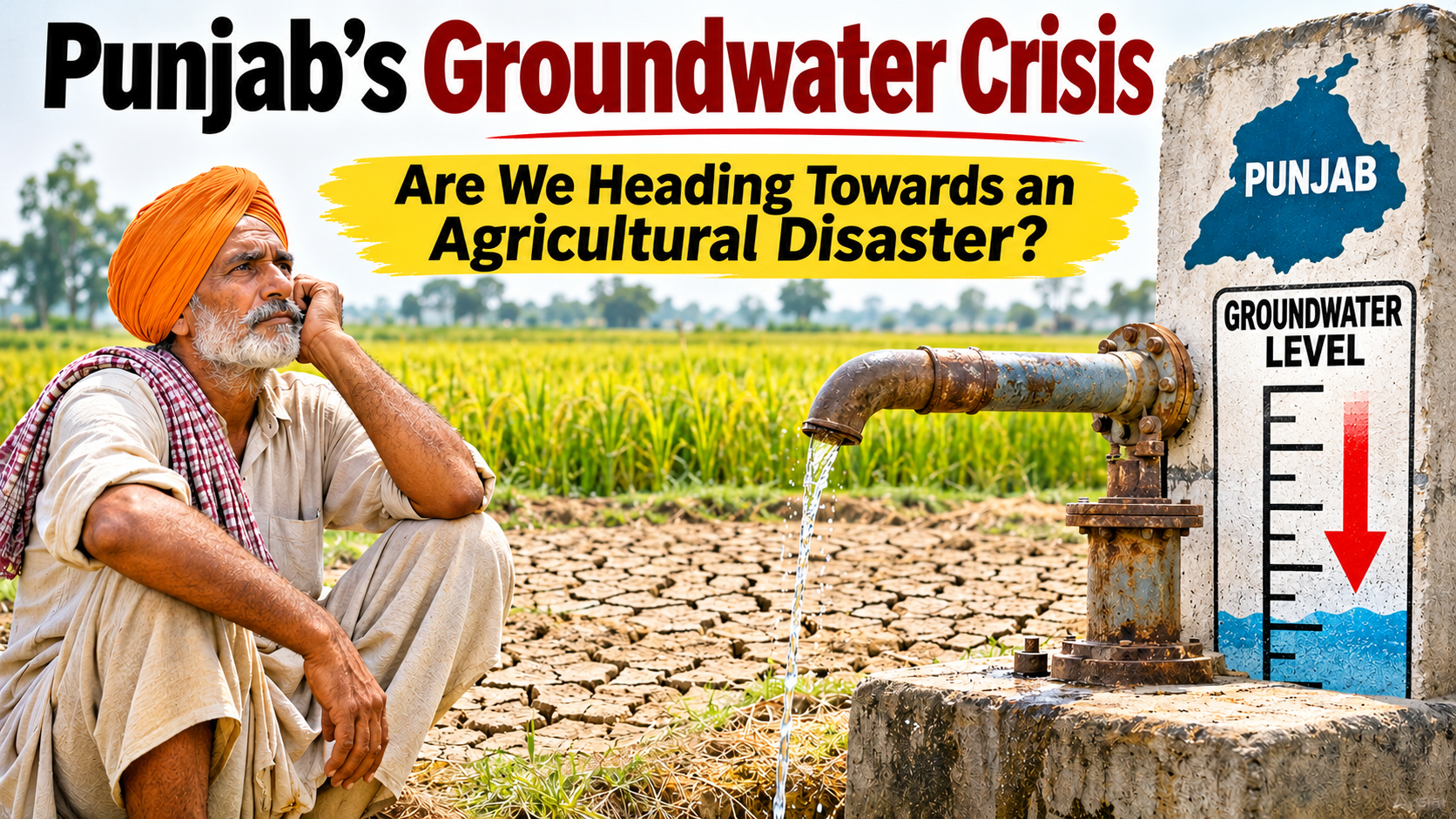
Punjab’s Groundwater Crisis: Is the State Draining the Lifeline of Its Farms?
Punjab feeds the nation, but beneath its agricultural fields, a serious groundwater challenge is developing. Tube wells continue to support farming, while groundwater levels in many parts of the state are declining. The situation has implications for agriculture, drinking-water security and the long-term sustainability of rural livelihoods.
Punjab’s agricultural success was built on high-yielding seeds, procurement systems and irrigation. The Green Revolution strengthened India’s food security, but it also encouraged the expansion of the rice-wheat cropping cycle. Paddy requires substantial amounts of water, and where canal supplies were insufficient or poorly timed, farmers increasingly depended on groundwater through tube wells.
This dependence is influenced by more than individual farming decisions. Procurement arrangements, crop prices, electricity support and the risks associated with alternative crops all affect farmers’ choices. Any transition to less water-intensive crops therefore requires dependable markets and adequate financial support.
Government Data Shows the Scale of the Challenge
The Central Ground Water Board’s 2025 assessment, cited by the Ministry of Jal Shakti in a Lok Sabha reply dated 12 February 2026, estimates Punjab’s annual groundwater recharge at 18.60 billion cubic metres (BCM). The annual extractable groundwater resource was assessed at 16.80 BCM, while extraction was estimated at 26.27 BCM. The stage of groundwater extraction was therefore assessed at 156.36 per cent.
The assessment classified 111 of Punjab’s 153 blocks, or 72.55 per cent, as over-exploited. Ten blocks were classified as critical, 15 as semi-critical and 17 as safe. Although the figures indicate some change compared with earlier assessments, the state continues to face significant groundwater stress.
The Impact Is Reaching Farms, Homes and Public Health
A Central Ground Water Board bulletin based on May 2025 monitoring found that groundwater levels had declined between May 2024 and May 2025 in 71.11 per cent of monitored wells, covering 73.75 per cent of the state’s area. In some locations, groundwater levels were recorded at more than 40 metres below ground level.
As groundwater levels decline, farmers may have to depend on deeper borewells and more powerful pumps, increasing electricity and cultivation costs. Small farmers can be particularly vulnerable when these expenses rise while returns from farming remain uncertain.
Groundwater also supports household drinking-water supplies and rural livelihoods. Continued depletion may make reliable access more difficult for communities with limited alternatives. According to government information, groundwater in Punjab is largely potable, although certain pockets have recorded arsenic, fluoride or uranium levels above drinking-water limits. Regular monitoring and testing are therefore important.
Government Measures Are in Place, but Implementation Matters
Punjab established the Water Regulation and Development Authority under the Punjab Water Resources (Management and Regulation) Act, 2020. Its groundwater extraction and conservation directions came into effect in February 2023. These provisions include permissions and charges for certain non-exempt users, along with water-conservation credits. Agricultural groundwater use is among the exempt categories, making changes in farming practices an important part of the broader conservation effort.
The Union government has also cited measures such as aquifer mapping, rainwater harvesting and restoration of traditional water bodies. The Per Drop More Crop programme promotes micro-irrigation, while Punjab has been encouraging farmers to consider less water-intensive crops in place of paddy.
For such measures to achieve lasting results, farmers need reliable canal supplies, affordable water-saving technologies and dependable markets for alternative crops.
What Happens If Punjab Does Not Act Now?
Continued groundwater depletion could lead to deeper and more expensive pumping, putting additional pressure on farm incomes, electricity consumption and drinking-water security. It could also affect the natural resource base that supports Punjab’s agricultural economy.
Addressing the issue does not mean placing the burden solely on farmers or reducing food production. Crop diversification, efficient irrigation, improved canal management, rainwater harvesting and wastewater reuse can contribute to groundwater conservation. At the same time, farmers need appropriate incentives, stable markets and practical alternatives to water-intensive crops.
Conclusion
Punjab’s agricultural fields remain productive, but groundwater data highlights the need for long-term conservation. The assessed groundwater extraction rate of 156.36 per cent indicates significant pressure on the state’s groundwater resources. Protecting this resource will be important for farmers, rural communities and future generations.
Punjab played a major role in strengthening India’s food security. Ensuring the sustainability of its groundwater resources will be equally important for the future of its agriculture.