
"PUNJAB: THE FALLEN KINGDOM, THE DIVIDED LAND AND THE UNFINISHED DREAM"
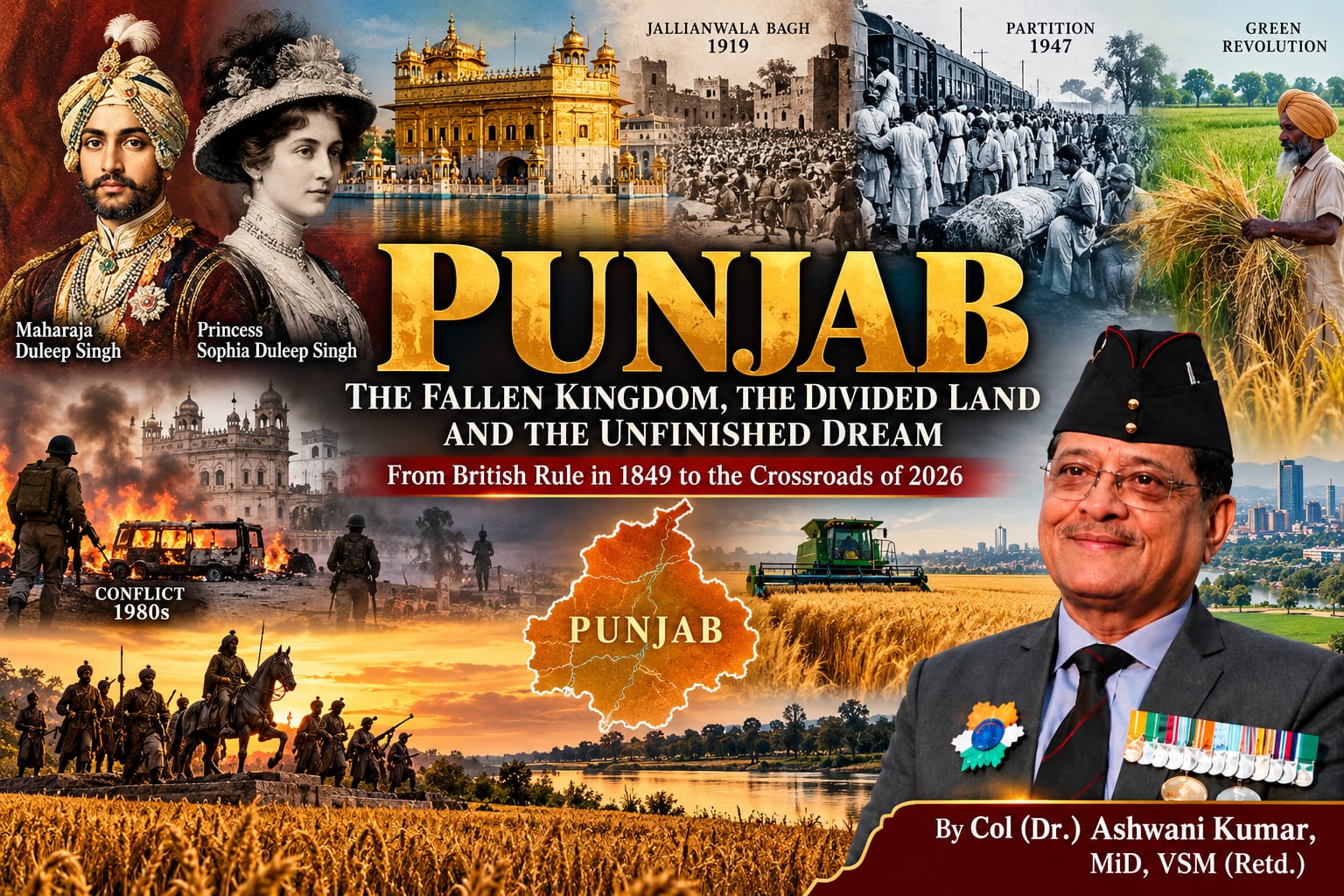
By
Col (Dr.) Ashwani Kumar, MiD, VSM (Retd).
From British Rule in 1849 to the Crossroads of 2026'
'A land of courage, sacrifice and contradictions'
Punjab is not merely a geographical region bounded by rivers and political borders. It is a civilisation shaped by agriculture, spiritual traditions, military courage, enterprise and the resilience of its people. Its soil has sustained generations, its soldiers have defended India's frontiers, and its revolutionaries have contributed significantly to the struggle for independence.
Yet Punjab's history is also a story of lost sovereignty, colonial exploitation, Partition, political turmoil and difficult economic transitions. How did the land of Maharaja Ranjit Singh, Bhagat Singh and countless freedom fighters travel from the heights of historical influence to the challenges confronting it today? To understand present-day Punjab, we must begin in 1849, when the British annexed the Sikh kingdom, and follow the journey through nearly two centuries of transformation.
The fall of the Sikh kingdom: 1849.
Maharaja Ranjit Singh had established a powerful kingdom in the north-western subcontinent, with Lahore as its capital. His death in 1839 was followed by political instability, succession struggles and weakening central authority. Two Anglo-Sikh wars eventually brought the kingdom under British control.
On 29 March 1849, the British annexation was formalised, ending the sovereignty of the Sikh kingdom. The young Maharaja Duleep Singh, son of Ranjit Singh, was compelled to relinquish his claim to the throne. He was subsequently taken away from his homeland and spent much of his life in Britain and France. His mother, Maharani Jind Kaur, was separated from him for years. The Koh-i-Noor diamond also passed into British possession and was presented to Queen Victoria.
The fate of Duleep Singh represents the human dimension of conquest, a child born to rule a kingdom became dependent upon the government that had taken it away. The annexation was not simply a change of administration. It marked the end of an independent political order and the beginning of a new relationship between Punjab and an expanding empire.
The Maharaja's daughter who challenged an empire.
The story of Punjab's royal family did not end with Duleep Singh's exile. His daughter, Princess Sophia Duleep Singh, born in Britain in 1876, became an important campaigner for women's voting rights. Sophia used her public position to support the British suffrage movement. She participated in campaigns that challenged established political authority and questioned the exclusion of women from democratic representation. Her activism included resistance to the census and opposition to taxation without political representation.
There is a striking historical irony here. The British Empire had deprived her family of a kingdom, yet she grew up within British society and used her position to challenge an entrenched political system.
Her life connects Punjab's history with a wider struggle for dignity, equality and the right to participate in public affairs. She reminds us that resistance does not always take place on a battlefield. Sometimes it takes the form of a determined individual confronting powerful institutions through political action.
Colonial Punjab: Development and exploitation.
British rule transformed Punjab's administration, economy and social structure. Railways, irrigation canals, canal colonies and new agricultural systems expanded production and connected the province more closely to imperial markets.
Punjab also became an important source of military recruitment. British administrators encouraged the recruitment of particular rural and martial communities, while land policies and official classifications influenced social and economic relationships. These developments brought opportunities to some cultivators and landowners, but they also served imperial interests. Agricultural production, revenue collection and military recruitment strengthened British control.
The colonial system cannot be understood solely through the construction of canals and railways. Nor should every development of the period be dismissed as having no lasting benefit. The important question is who controlled the system, whose interests it served, and how much political freedom Punjabis possessed within it. The province's growing agricultural importance coexisted with the denial of self-government. That contradiction helped shape the political consciousness of generations of Punjabis.
The awakening of resistance.
Punjab became a significant centre of India's freedom struggle. The Ghadar movement mobilised Indians abroad against colonial rule, while agrarian protests and revolutionary organisations challenged British authority.
The Pagri Sambhal Jatta agitation became associated with resistance to colonial agricultural policies and the defence of cultivators' rights.
The Jallianwala Bagh massacre of 13 April 1919 marked one of the darkest episodes of British rule. British troops under Brigadier General Reginald Dyer fired upon a gathering in Amritsar, killing and injuring many people. The massacre deepened public anger and strengthened the demand for freedom.
Punjab also produced extraordinary revolutionaries. Bhagat Singh became a symbol of youthful courage and revolutionary commitment. Udham Singh, who later assassinated Michael O'Dwyer in London in 1940, linked his act to the memory of Jallianwala Bagh. Lala Lajpat Rai contributed to nationalist politics and died in 1928 after injuries sustained during a protest against the Simon Commission. These individuals represented different approaches to resistance, but their lives reflected a common rejection of colonial subordination. Their sacrifices deserve remembrance not merely through statues and anniversaries, but through a serious understanding of the freedoms for which they struggled.
Independence and the tragedy of Partition.
In August 1947, India became independent, but Punjab paid an immense human price. The province was divided between India and Pakistan. Lahore, a historic centre of Punjabi culture and politics, became part of Pakistan. Communities that had lived alongside one another for generations were separated by a new international boundary.
Partition triggered mass displacement and horrific communal violence. Hindus, Sikhs and Muslims were killed, abducted, dispossessed or forced to abandon ancestral homes. Refugee trains and convoys carried families towards uncertain futures. Women suffered particularly brutal forms of violence, while countless children lost parents and homes. The tragedy cannot be reduced to a single community's suffering or a single community's responsibility. Innocent people across religious boundaries experienced loss, fear and displacement.
For Indian Punjab, Independence therefore brought both freedom and the immense task of rebuilding. Refugees had to begin their lives again, often with little more than the possessions they could carry. The division also disrupted markets, agricultural networks, transport links and cultural connections. The Punjab that emerged after 1947 was smaller in territory but continued to carry a vast historical inheritance.
Rebuilding a new Punjab.
The people of Indian Punjab demonstrated remarkable resilience. Refugees established farms, shops, factories and new communities. Through hard work and adaptation, many rebuilt livelihoods that had been destroyed by Partition.
Agriculture remained central to the state's economy, but the post-Independence period also brought institutional change, irrigation development and efforts to modernise production.
The reorganisation of Punjab in 1966 was another turning point. Haryana became a separate state, Chandigarh became a Union Territory and the shared capital of Punjab and Haryana, and the remaining Punjab became predominantly Punjabi speaking.
Questions concerning Chandigarh, river-water sharing and territorial arrangements continued to influence political debate. They reflected the difficulty of reconciling linguistic identity, administrative convenience and competing regional interests. Nevertheless, Punjab continued to contribute substantially to India's economic and national development.
The Green Revolution: Punjab feeds India.
The Green Revolution transformed Punjab's agriculture. Improved seeds, fertilisers, irrigation, machinery and agricultural research increased wheat and rice production. Punjab became one of India's major contributors to national food security. Farmers who had experienced displacement and hardship became central to the country's effort to reduce dependence on imported food grains. The transformation demonstrated the power of scientific innovation when combined with farmer's skill, infrastructure and public policy.
But agricultural success also created new challenges. The expansion of water-intensive paddy cultivation placed increasing pressure on groundwater. Intensive farming affected soil health, while dependence on a limited number of crops made agricultural incomes vulnerable to changing costs and environmental conditions.
The system that helped secure India's food supply now requires reform to remain sustainable. Crop diversification, water conservation, better agricultural technology and viable markets for alternative crops are essential. Punjab's farmers should not be expected to carry the burden of national food security without adequate economic support. The transition must be planned with them, not imposed upon them.
The painful decade: Conflict and suffering in the 1980s.
The 1980s brought one of the most traumatic periods in modern Punjab's history. Political disputes, religious tensions, competing demands over autonomy and representation, and the growth of armed militancy created an increasingly dangerous situation. Operation Blue Star in June 1984 involved the Indian Army entering the Golden Temple complex to remove armed militants. The operation caused deaths and damage at one of Sikhism's holiest sites, leaving deep religious and emotional wounds.
Prime Minister Indira Gandhi was assassinated by two of her Sikh bodyguards on 31 October 1984. The assassination was followed by organised anti-Sikh violence, particularly in Delhi and other parts of India. Thousands of Sikhs were killed, and many families suffered the destruction of homes and businesses. The failures to prevent the violence and secure timely justice became enduring questions for India's institutions.
Punjab subsequently endured years of militancy, targeted killings, bombings, disappearances and counterinsurgency operations. Civilians were caught between armed groups and security forces. Families across communities experienced grief, insecurity and the loss of loved ones.
A responsible account must acknowledge both the violence committed by militants and allegations of unlawful conduct by state personnel, while recognising the distinct historical and legal circumstances of each incident.
No historical narrative can repair every wound. But honest documentation, accountability and respect for victims are necessary if history is to become a source of understanding rather than renewed division.
A Personal Reflection: The Fear Behind the Uniform and the Forgotten Families of Punjab.
For me, the dark years of Punjab are not merely a chapter in history. They are memories that remain deeply etched in my mind. I had completed college in the late 1978 and was preparing for competitive examinations when militancy began casting its shadow over Punjab. In 1981, I joined the Indian Army. My father, meanwhile, was a police officer entrusted with responsibilities in sensitive areas such as Patti, Sri Muktsar Sahib and Amritsar during the period. He was repeatedly exposed to danger and faced ambushes on several occasions while carrying out his duties. Yet, beyond the uniform and official responsibilities, there was a family living with a different kind of battle the battle of fear, uncertainty and helpless waiting.
Imagine the psychological burden on a police officer who is posted away from the family knowing that he may encounter armed militants, an ambush or a sudden attack, while his own children are serving in the defence forces in militancy prone areas. My father had to discharge his duties knowing that his children, too, were exposed to danger in the service of the nation. At home, his wife and two young daughters were left alone at a distant place, carrying their own anxieties while worrying about the safety of the husband and brothers who might not return when expected.
The middle years of the 1980s were among the most difficult. For a family such as ours, the threat was not confined to the place of duty. It followed us into our homes, our conversations and our silences. A telephone call, an unexpected delay or news of an ambush could bring a fresh wave of apprehension. The officer on duty had to remain composed and fulfil his responsibilities, the family at home had to find the courage to live with the uncertainty. This was the unseen price paid by many families of police personnel and members of the armed forces during those troubled years and while serving or residing in Punjab.
As a young Army officer, I also witnessed the difficult circumstances in which Punjab was living. I saw the fear among ordinary people, the disruption of family life and the insecurity that affected communities in towns, villages and remote areas. Many Hindu families left their ancestral homes because they feared for their lives. Some families who remained faced threats, demands for money and intimidation. There were also reports and accounts of killings, sexual violence and other grave atrocities against civilians. Every such incident deserved investigation, accountability and justice.
These experiences left me with a question that I believe deserves a place in Punjab's history. In our public discussions, the suffering of Sikhs during the anti-Sikh violence following the assassination of Prime Minister Indira Gandhi in October 1984 is rightly remembered. The killings were a grave injustice, and the victims and their families deserve our unequivocal sympathy, support and pursuit of justice. No political consideration or passage of time can diminish that responsibility.
But should our compassion end there?
What about the Hindu families who were threatened, displaced or forced to abandon their homes during the years of militancy in Punjab? What about those who lost family members, suffered extortion or lived under the constant fear of violence? What about the women, children and elderly people whose sense of security was shattered? Have their experiences been documented and acknowledged with equal seriousness? Have the families who left their villages and rebuilt their lives elsewhere received the attention their suffering deserves?
These are not questions intended to diminish the pain of Sikh victims or to create a competition between communities. They arise from a simple conviction, every innocent life has equal value, and every victim deserves dignity, remembrance and justice. Acknowledging the suffering of Hindu families does not take anything away from Sikh victims. Equally, recognising the suffering of Sikhs does not require Hindu victims to remain silent about their own experiences.
I also find myself asking where the organisations and political parties that claim to represent Hindu interests were during those years. Did they do enough to document the suffering of Hindu families, support those who were displaced and raise the concerns of people living under the shadow of militancy? Have these experiences received the sustained public attention they deserve? These questions should be examined fairly, on the basis of records and testimony, rather than answered through sweeping accusations against any political party or community.
Political organisations have every right and indeed a responsibility to speak for victims of injustice. But that responsibility must be consistent. If we demand justice for Sikhs who were killed in 1984, we must also demand justice for Hindu families who suffered atrocities during the years of militancy. If we remember one set of victims, we must not overlook another simply because their suffering receives less public attention or does not fit comfortably into a political narrative of any party.
As a Hindu, a soldier and the son of a police officer who repeatedly faced the dangers of militancy, I believe that this is a matter of serious introspection within our own society. Have we preserved the testimony of affected families? Have we documented the experiences of those who were forced to leave their homes? Have community organisations done enough to provide support and ensure that these painful memories are not lost? These questions must be asked honestly, without hatred, bitterness or prejudice against any community.
The suffering of Punjab must be remembered in its entirety. The Sikhs who lost their lives in the violence of 1984 deserve justice. The Hindu families who suffered at the hands of militants deserve recognition and justice. Police personnel, soldiers and civilians who endured violence and insecurity must also find their rightful place in the historical record. Accountability should be based on evidence and individual responsibility, never on collective religious identity.
Punjab's wounds cannot be healed by silence, selective remembrance or competing claims of victimhood. They can begin to heal when every community feels that its pain has been heard, its dead have been remembered and its grievances have been examined fairly.
My appeal is therefore not against any community. It is an appeal for equal compassion, honest history and impartial justice. We owe this to the victims of Punjab's dark years, to the families who lived through those terrible times, and to the generations that deserve to inherit a history based on truth rather than division.
9. Peace returns, but new challenges emerge.
By the 1990s, militancy had substantially declined and Punjab returned towards normal democratic life. The restoration of peace was a major achievement, although the memories and consequences of the conflict continued to affect families and communities. Yet peace did not automatically resolve Punjab's economic and social challenges. Agricultural dependence remained high, industrial growth did not eliminate the search for employment, and many young people began looking beyond the state for education and better opportunities.
Drug trafficking and addiction emerged as serious concerns, demanding a response that combines enforcement against criminal networks with prevention, medical treatment, rehabilitation and community support. Migration, rural indebtedness and changing employment expectations also influenced the aspirations of younger generations.
These problems should not be interpreted as evidence that Punjab has lost its character. They are challenges requiring effective institutions, credible policies and sustained public attention.
Punjab in 2026: A crossroads of destiny.
Today, Punjab possesses substantial strengths, productive farmers, an internationally connected diaspora, a strong cultural identity, educational institutions, entrepreneurial talent and a long tradition of public service. Yet it must confront several structural challenges.
Groundwater depletion demands a more sustainable agricultural model. Industrial investment and employment generation need sustained attention. Young people require opportunities that allow them to build secure and dignified lives at home. Public services, government finances and institutional accountability remain important to the state's long-term prospects. Drug addiction must be addressed through a combination of strong action against traffickers, accessible treatment, rehabilitation and support for affected families. Farmers need alternatives that protect incomes while conserving natural resources.
Punjab must also preserve its language, literature, music, historical sites and religious heritage. Its traditions of Sikh, Hindu, Muslim and other cultural interactions form part of a wider history that cannot be understood through division alone. The task before Punjab is not to choose between tradition and modernity. It is to build a modern economy while retaining the courage, community spirit and cultural confidence that have sustained its people through successive upheavals.
The unfinished dream.
Punjab's history offers no simple explanation for every contemporary problem. Colonial rule, Partition, political decisions, economic policies, social changes and environmental pressures have all shaped its journey. Their relative effects must be examined through evidence rather than political slogans.
The way forward requires agricultural diversification, water conservation, food processing, industrial investment, technical education, stronger public institutions and meaningful employment. It also requires a political culture that places long-term public welfare above short-term considerations.
Above all, Punjab must restore confidence among its young people that success is possible within their own state. The courage that once carried revolutionaries into the freedom struggle and enabled refugees to rebuild their lives can also support a new period of renewal. But courage must be accompanied by sound policy, responsible leadership, social cooperation and measurable results.
The land must rise again.
From the loss of sovereignty in 1849 to the tragedy of Partition in 1947, from the sacrifices of freedom fighters to the achievements of the Green Revolution, Punjab has repeatedly faced challenges that could have broken a less resilient society. Its people rebuilt homes after Partition, helped feed a nation after Independence and endured years of violence before peace returned. These achievements are part of Punjab's enduring legacy. But history does not guarantee future success. A glorious past can inspire a people, yet only the choices made in the present can secure the future.
The next chapter of Punjab's history must be written through sustainable agriculture, productive industry, honest governance, social recovery and opportunities for its youth.
The question is no longer merely what Punjab once was. The more important question is what Punjab now chooses to become.
A land that gave India revolutionaries, soldiers, farmers and reformers must not allow its future to be defined solely by its wounds or its difficulties.
Punjab's unfinished dream is to transform its historical courage into renewed prosperity, its sacrifices into opportunity, and its rich inheritance into a future worthy of the generations yet to come.
Disclaimer: This article is a historical and analytical account based on available sources, personal recollections, and the author's interpretation of events. It seeks to acknowledge the suffering and sacrifices of all communities without prejudice or collective blame. Any errors or omissions are unintentional, and the views expressed are solely those of the author.