Shein shares fall in long-awaited stock market debut
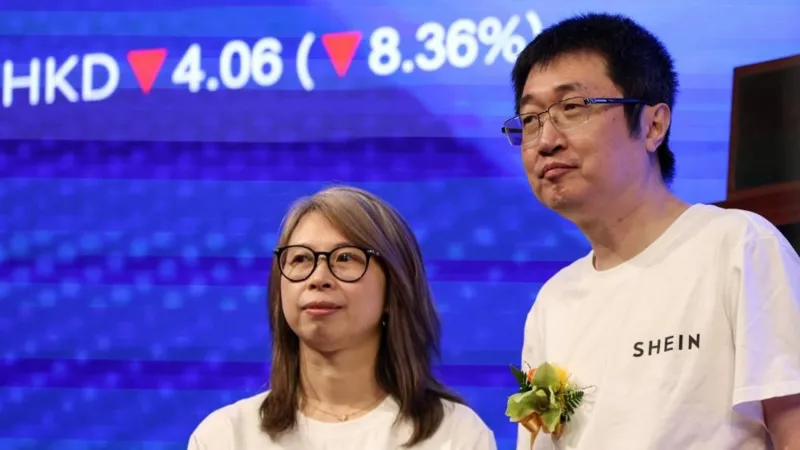
Shares in fast-fashion giant Shein fell in their highly anticipated stock market debut on Tuesday as the firm listed in Hong Kong after a long quest to go public.
It comes after failed attempts to list in the US and UK, as concerns were raised over issues including Shein's labour practices and its environmental impact.
Once estimated to be worth nearly $100bn (£74bn), Shein is now valued at around a quarter of that figure, as the firm faces other challenges like heated competition and trade tensions.
Shein became hugely popular, especially among younger people, due to its ability to source the very latest fashions at ultra-low prices through a vast network of factories in China.
At a ceremony to celebrate the listing, chief financial officer Leigh Gui said the company's model of selling large numbers of small orders with rapid payment options now reaches about 160 markets worldwide.
"Let global consumers enjoy the sound of fashion," he said after a gong was struck to mark the start of trading.
On Monday, Shein priced its shares at HK$48.56 each, raising 13.6 billion Hong Kong dollars ($1.7bn; £1.3bn) from the listing.
That gave the company a stock market valuation of $26.3bn.
Shein's shares fell by as much as 10% in early trading before the losses eased. At lunchtime, they were around 3.5% lower at just under 47 Hong Kong dollars each.
The disappointing debut suggests the market is not convinced that Shein's growth can make a "comeback", said Charu Chanana, chief investment strategist at investment bank Saxo.
Shein has more than 273 million active customers who placed a total of more than a billion orders in the year to the end of March 2026, the firm said in a filing ahead of the listing.
But Shein now faces higher costs, regulatory scrutiny and more competition, while investors are increasingly drawn towards technology companies, Chanana said.
For customers, the slump in Shein's shares is a sign that the firm's cheap prices are "becoming harder to sustain", which may lead to higher prices, she added.
A benchmark for fast fashion
The listing marks the largest new share sale in Hong Kong so far this year, which is being seen as a test of investor appetite for the fast fashion industry.
It is a rare "standalone" e-commerce firm that can be assessed on its own merits, fashion industry analyst Louise Deglise-Favre from research firm GlobalData.
Shares in rivals Asos and Boohoo have been battered in recent years as they face regulatory scrutiny and fierce competition.
"Investors have learned to be sceptical," while concerns over sustainability and ethical issues add to the complexity of Shein's share sale, Deglise-Favre said.
The rise and rise of fashion giant Shein
The truth behind your $12 dress: Inside the Chinese factories fuelling Shein's success
Shein was founded in China in 2008 and is now headquartered in Singapore.
The firm's long road to the stock market highlights the geopolitical pressures and regulatory scrutiny faced by Chinese companies with global ambitions.
The company once looked set for one of the largest stock market debuts ever by a Chinese firm, with Wall Street in its sights.
Its business had surged during the Covid-19 pandemic as people, stuck at home, turned to online retailers.
Shoppers shared clips of themselves trying on large numbers of its garments, a trend called Shein Hauls, boosting the company's online presence.
An initial public offering (IPO) in the US - by far Shein's largest market - would have offered it a chance to further increase its global profile and tap into Western financing.
But the firm faced resistance from US lawmakers, who objected to the planned listing over concerns of forced labour in Shein's factories. In response to such allegations, the company has said it takes a "zero-tolerance policy for forced labour".
It has also been accused of copying other designers' ideas. Shein has said "it takes all claims of infringement seriously" and that it respects the rights of all designers.
Shein also explored the possibility of making its stock market debut in London but faced similar opposition.
The BBC has contacted Shein for further comment.
'Only realistic path'
In 2025, Shein shifted its attention to Hong Kong, with Chinese authorities approving the move in July this year.
"Shein ran out of venues that could take it," said Ashley Dudarenok, founder of Chinese market research firm ChoZan.
The company attempted to "look less Chinese" by shifting its headquarters to Singapore ahead of its IPO bid, but it never won political backing abroad nor assurances from Beijing, she added.
"For Chinese companies increasingly shut out of Western exchanges, Hong Kong is fast becoming the only realistic path to market," Deglise-Favre said.
The move also coincided with Shein's publicity-shy founder Xu Yangtian making a rare public appearance during a major business conference in February.
Xu took to a stage in Guangdong, home to many of China's garment factories, to re-affirm his company's ties to Beijing.
He pledged investments in China's clothing industry, adding that the "nourishment" from the country has been "inseparable" from Shein's success.
Headwinds ahead
Trade tensions and regulatory concerns mean Shein is navigating a very different landscape to when it first started exploring a potential IPO.
In July, it reported a $99m quarterly loss as its sales slowed after the US struck down an import duty exemption on small packages.
The exemption, known as the de minimis rule, had helped Shein and rival Temu grow rapidly as it allowed packages worth less than $800 to enter the US without incurring import duties.
Similarly, the European Union has imposed a €3 (£2.57; $3.50) tax on low-value imports.
The Iran war has also hit demand, raised costs and caused delays to deliveries in some markets, Shein has said.
Its rivals are feeling the pressure too. In August, Temu-owner PDD reported lower-than-expected quarterly revenue.
Shein is also being investigated by US and European regulators over its business practices.
The company also needs to find ways to stand out from its rivals, that are now also using predictive technology to make their websites more appealing to shoppers, said Jason Hsu from Rayliant Global Advisors.
"Shein is not longer a unique player," Hsu said.
Despite these challenges some analysts still see strong potential for Shein.
Investors will be scrutinising whether the company can navigate these issues, such as shifting logistics out of China to avoid the US and EU's import fees, Deglise-Favre said.
The slump in the firm's valuation shows "genuine deterioration", but it is still backed by a "formidable supply chain" and a global reach, she added.
People are still buying the company's goods, but costs have weighed on its business and have shown that its business model does not generate profits in the way it once did, said Dudarenok.
As a listed company, Shein will need to "prove its margins still work in a world of tighter regulation, tariffs and more expensive customer acquisition," she added.