Sonam Wangchuk’s Forced Hospitalisation Sparks National Outrage: Supporters Call It “Legal Kidnapping” as Questions Mount Over Delhi Police’s Actions
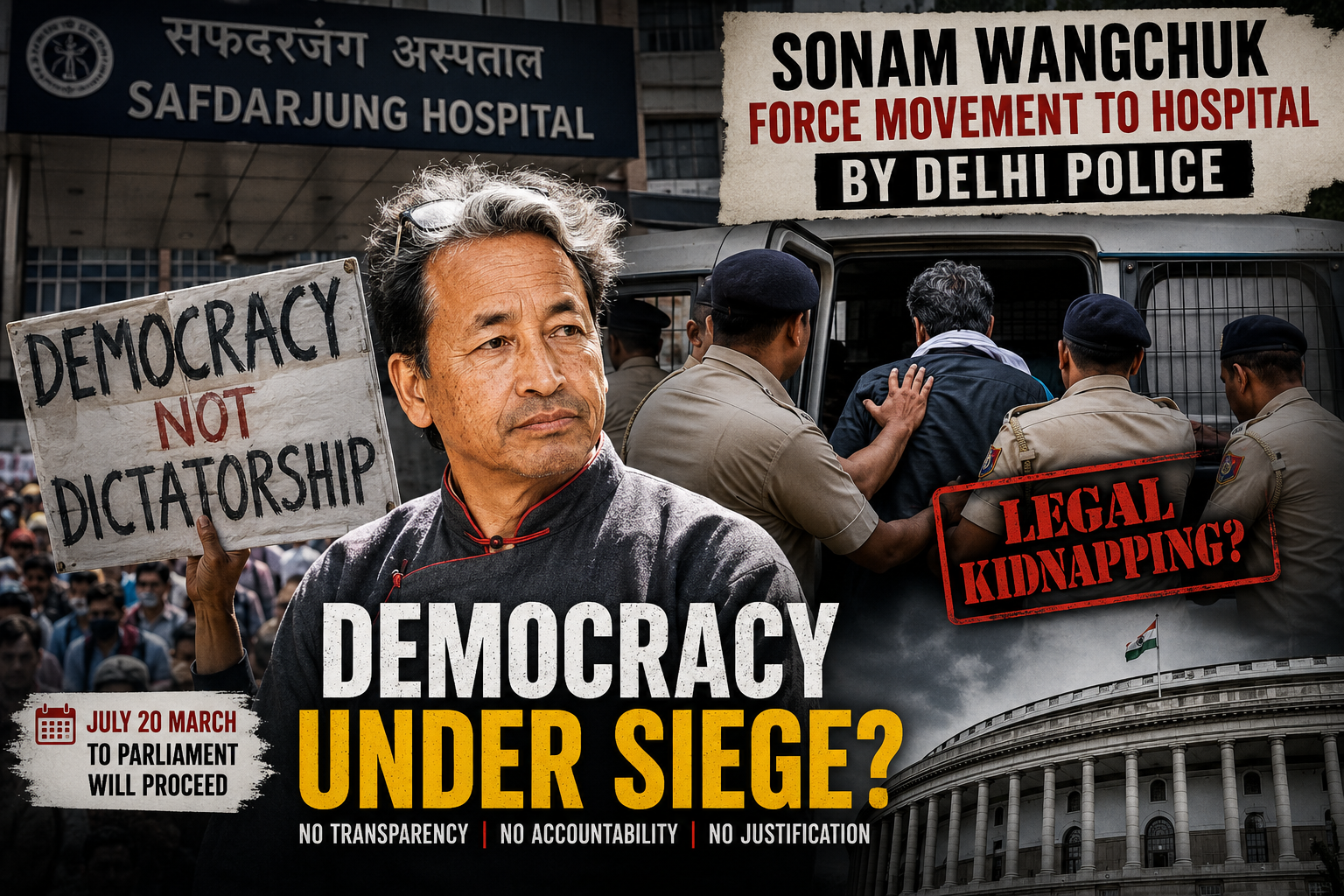
The Sonam Wangchuk hospitalised controversy has intensified political and public debate after the environmentalist and education reform activist was forcibly shifted to Safdarjung Hospital by Delhi Police. The incident has triggered widespread criticism from supporters, who have described the action as “legal kidnapping” and accused authorities of attempting to suppress a peaceful democratic movement. The development comes just days before the planned July 20 march to Parliament, a protest aimed at demanding sweeping reforms in India’s education system.
According to Wangchuk’s wife, Gitanjali J. Angmo, the activist is “absolutely fine” despite being admitted to the hospital. However, she alleged that Safdarjung Hospital has repeatedly declined to provide copies of his medical reports despite her requests. Angmo further stated that she has formally informed hospital authorities that no medical treatment should be administered to Wangchuk without her consent.
Questions Raised Over Delhi Police’s Decision
The manner in which Sonam Wangchuk was taken to the hospital has become the central issue of the controversy. Supporters argue that if an individual is conscious, stable, and capable of making informed decisions, forcibly moving them under police supervision raises serious concerns about personal liberty and constitutional rights.
The phrase “legal kidnapping” has rapidly gained traction among those backing Wangchuk’s movement. While authorities have yet to publicly explain the detailed circumstances behind the decision, critics argue that the lack of transparency has only deepened public suspicion. They contend that such actions create an impression that peaceful dissent is increasingly being treated as a law-and-order problem rather than as a democratic right.
Movement Expands Beyond the NEET Controversy
Speaking after the incident, Gitanjali J. Angmo made it clear that the movement has evolved beyond the alleged NEET examination paper leak. According to her, the campaign now seeks comprehensive reforms in India’s education system.
She said that changing the education system is the responsibility of the executive and policymakers and argued that the present system has failed students across the country. In her view, the movement is intended to awaken the nation’s conscience rather than focus solely on one examination controversy.
Angmo also confirmed that the July 20 Parliament march will proceed as planned and asserted that Sonam Wangchuk himself intends to participate.
Political Questions Grow Louder
The incident has also generated political criticism directed at both the Delhi Police leadership and the BJP-led governments at the Centre and in Delhi. Opposition voices and several civil society groups are questioning why a peaceful activist was subjected to such treatment instead of being allowed to continue his democratic protest.
Some critics have linked the controversy to the recent change in Delhi’s Police Commissioner, arguing that the incident will inevitably invite scrutiny over policing priorities and institutional independence. However, no official evidence has been presented to establish a connection between the leadership change and the handling of Wangchuk’s case.
The BJP has not accepted allegations that the incident reflects political interference. Government representatives have generally maintained that law enforcement agencies act according to established legal procedures. Nevertheless, critics argue that the ruling party should address growing public concerns instead of remaining silent on an issue that has attracted national attention.
A Debate Over Democracy and Dissent
The Sonam Wangchuk episode has reignited a broader conversation about the state of democratic protest in India. Supporters believe that when peaceful activists are detained or moved against their wishes without clear public justification, it sends a worrying message about the shrinking space for dissent.
Several commentators have described the incident as reflecting authoritarian tendencies, while others caution against drawing conclusions before all official facts are made public. Regardless of political affiliation, the controversy has once again highlighted the delicate balance between maintaining public order and protecting citizens’ constitutional freedoms.
As images and reports related to Wangchuk’s hospitalisation continue to circulate widely, the issue has moved beyond one individual and become a symbol of the larger debate surrounding civil liberties, accountability, and transparency.
What Happens Next?
With the July 20 Parliament march expected to proceed, attention is now focused on whether authorities will allow the demonstration to take place peacefully. Equally important will be the response from Delhi Police and the Union Government regarding the questions surrounding Wangchuk’s hospitalisation and the allegations made by his family.
The coming days are likely to determine whether this controversy remains an isolated incident or becomes a defining moment in the ongoing national conversation about democratic rights, peaceful protest, and public accountability.
Conclusion
The Sonam Wangchuk hospitalisation controversy has evolved into more than a dispute over one activist’s treatment. It has become a test of transparency, constitutional freedoms, and the relationship between citizens and the state. As the nation watches the events unfold, many will be looking for clear answers, accountability, and reassurance that democratic dissent continues to have a protected place in India.