India-China Reset: After Modi-Xi Meeting, Is the Border Dispute Really Settled?
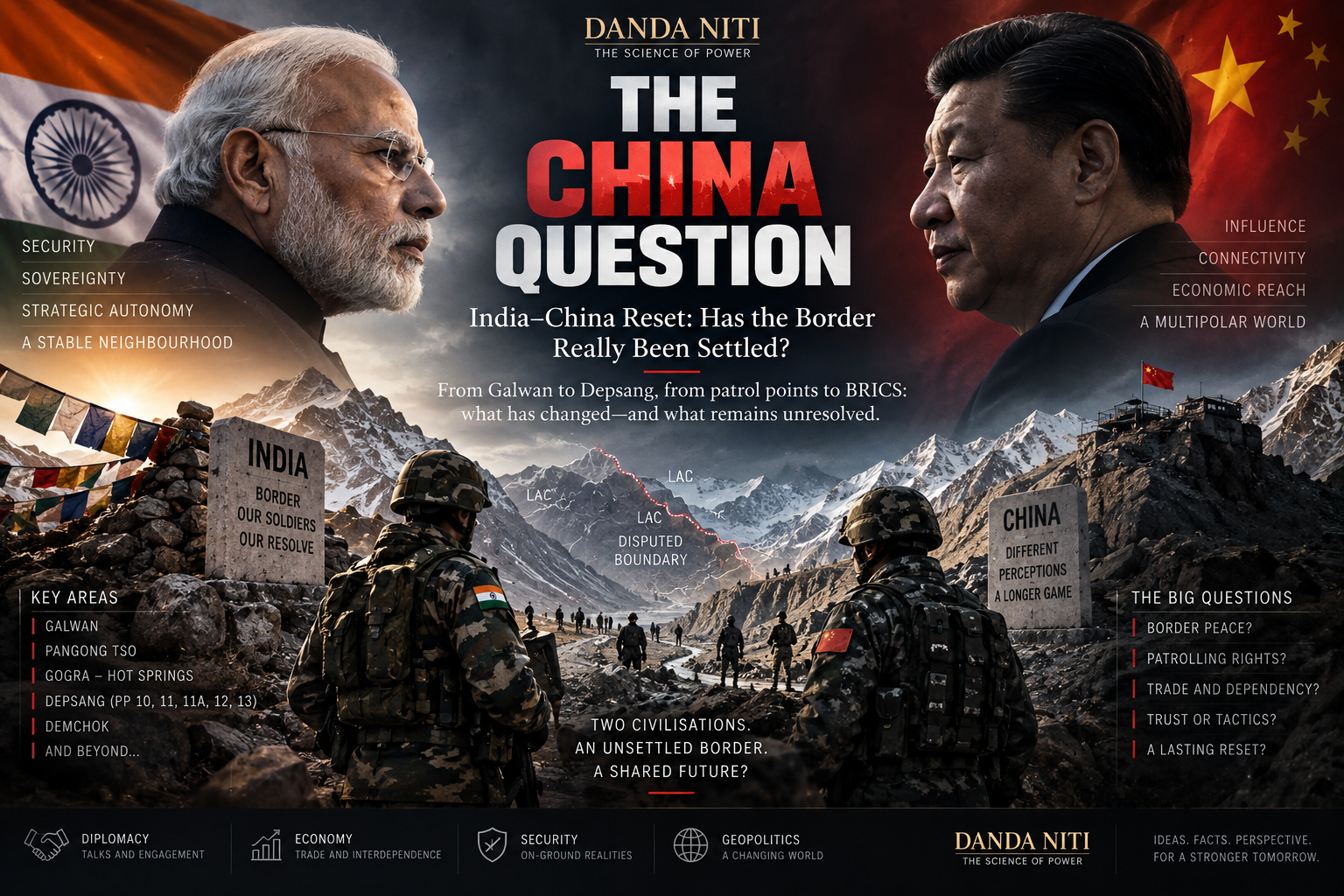
India-China Reset: After Modi-Xi Meeting, Is the Border Dispute Really Settled?
From Galwan to Depsang and Demchok, India-China ties have entered a new phase of dialogue, but the larger boundary question remains unresolved.
By DANDA NITI | The Science of Power
India-China relations are once again seeing renewed high-level engagement. On September 12, 2026, Prime Minister Narendra Modi and Chinese President Xi Jinping met in New Delhi on the sidelines of the BRICS Summit. The meeting marked Xi Jinping's first visit to India in seven years.
The meeting highlighted a renewed emphasis on dialogue, stability, economic engagement and long-term relations. But one important question remains: has the India-China border dispute actually moved towards a settlement, or are the two countries entering a new phase of managing their differences?
Why 2020 Changed India-China Relations
The situation along the India-China border changed significantly in 2020, particularly in eastern Ladakh. India stated that Chinese forces had attempted to alter the status quo along the Line of Actual Control, while China disputed India's characterization of the developments.
The situation eventually resulted in several military confrontations. On June 15, 2020, Indian and Chinese troops clashed in the Galwan Valley. Twenty Indian soldiers were killed, while China later acknowledged four PLA deaths.
The confrontation became a major turning point in bilateral relations. India subsequently strengthened military deployments and infrastructure along the frontier, while diplomatic and military negotiations continued.
What Happened in Depsang and Demchok?
Depsang and Demchok became important areas during the post-2020 border negotiations because of restrictions on patrolling and the military positions maintained by the two sides.
On October 21, 2024, India and China reached an agreement concerning patrolling arrangements in Depsang and Demchok. According to India's Ministry of External Affairs, the agreement facilitated disengagement from the 2020 friction points and provided for patrolling, and where applicable grazing, according to longstanding practice. The Indian government subsequently stated that the agreement had been implemented. ([mea.gov.in](https://www.mea.gov.in/lok-sabha.htm?dtl%2F39008%2FQUESTION_NO_843_INDOCHINA_AGREEMENT_ON_BORDERRELATED_ISSUES%2523%3A~%3Atext=India%252525252520and%252525252520China%252525252520reached%252525252520agreement%2Cthe%252525252520friction%252525252520points%252525252520of%2525252525202020.&utm_source=chatgpt.com))
However, the agreement did not amount to a final settlement of the India-China boundary. The broader boundary question continues to be addressed through established bilateral mechanisms.
Disengagement Is Not the Same as a Boundary Settlement
Three terms are important when assessing the developments along the Line of Actual Control.
Disengagement means troops move away from a confrontation.
De-escalation involves reducing military tensions and the possibility of confrontation.
Demarcation means formally identifying and marking the boundary.
Progress on disengagement in particular areas does not mean that the entire India-China boundary has been formally settled. This distinction remains central to understanding the current situation.
What Did Modi and Xi Discuss?
During their September 12, 2026 meeting, Prime Minister Modi emphasized that peace and tranquillity in the border areas remain an essential basis for the continued development of bilateral relations.
Both leaders expressed commitment to a fair, reasonable and mutually acceptable resolution of the boundary question. The discussion also covered economic and trade relations, supply chains, market access, business links and people-to-people ties. ([pib.gov.in](https://www.pib.gov.in/PressReleasePage.aspx?PRID=2309538&lang=1®=48&utm_source=chatgpt.com))
The combination of border discussions and broader economic engagement shows that the two countries are attempting to manage multiple areas of the relationship simultaneously.
Is an India-China Reset Underway?
There are several developments pointing towards increased engagement. The 2024 Depsang-Demchok agreement addressed important patrolling issues, high-level diplomatic contact continued, and Xi Jinping visited India in September 2026.
Economic and people-to-people engagement is also being discussed alongside border-related issues.
At the same time, the fundamental boundary dispute remains unresolved. The security concerns that emerged after the 2020 confrontation also continue to influence the relationship.
For that reason, describing the current situation as a complete return to the pre-2020 relationship would be premature. It can instead be viewed as a new phase involving dialogue, border management, economic engagement and continued strategic differences.
BRICS and the Wider Relationship
The Modi-Xi meeting took place during India's BRICS presidency. BRICS provides a platform where India and China can cooperate on selected economic and global issues even while differences remain between them.
For India, the challenge is to maintain security along the northern frontier while continuing economic and multilateral engagement. For China, managing relations with India involves balancing bilateral engagement with continuing differences over the boundary and other strategic issues.
The result is a relationship in which cooperation and competition can exist at the same time.
What Will Determine the Next Phase?
The future direction of India-China relations will depend not only on summit meetings but also on developments on the ground.
Key questions include whether military commanders can operate under predictable arrangements along the LAC, whether existing agreements continue to be implemented, whether patrols can take place without confrontation and whether further measures can reduce the risk of future incidents.
Another important question is whether economic engagement can expand while both countries continue to manage their strategic and security concerns.
The Bigger Question: Reset or Managed Competition?
The available evidence supports both renewed engagement and continued differences.
On one side, there has been diplomatic contact, the 2024 patrolling agreement and renewed high-level engagement in 2026.
On the other, the boundary has not been finally settled, and the security environment along the LAC remains an important part of the bilateral relationship.
The current phase can therefore be understood as an attempt to stabilize and manage India-China relations while negotiations over unresolved issues continue.
Conclusion
The September 2026 Modi-Xi meeting has brought India-China relations back into focus. The 2024 Depsang-Demchok agreement was an important step in managing the border situation, but it did not resolve the larger boundary dispute.
India and China are now simultaneously pursuing dialogue, economic engagement and strategic interests. Whether this develops into a more stable long-term relationship will depend on how existing agreements are implemented and how the two sides address their remaining differences.
The handshake represents diplomacy. The patrol represents border management. The boundary remains the unresolved question.
And that unfinished question will remain central to the future of India-China relations.
DANDA NITI – The Science of Power