"The Courage to Think: When Presence of Mind Saves Lives"
By Col (Dr.) Ashwani Kumar, MiD, VSM (Retd)
From the Cockpit to the Battlefield - A Soldier's Reflection on Bravery, Instinct and Leadership Under Fire.
When Seconds Become a Lifetime.
There are moments in life when the difference between survival and tragedy is not measured in minutes or hours, but in a few decisive seconds. At such moments, courage alone may not be enough. What matters is the ability to think clearly, assess the situation, control one's emotions and act with determination.
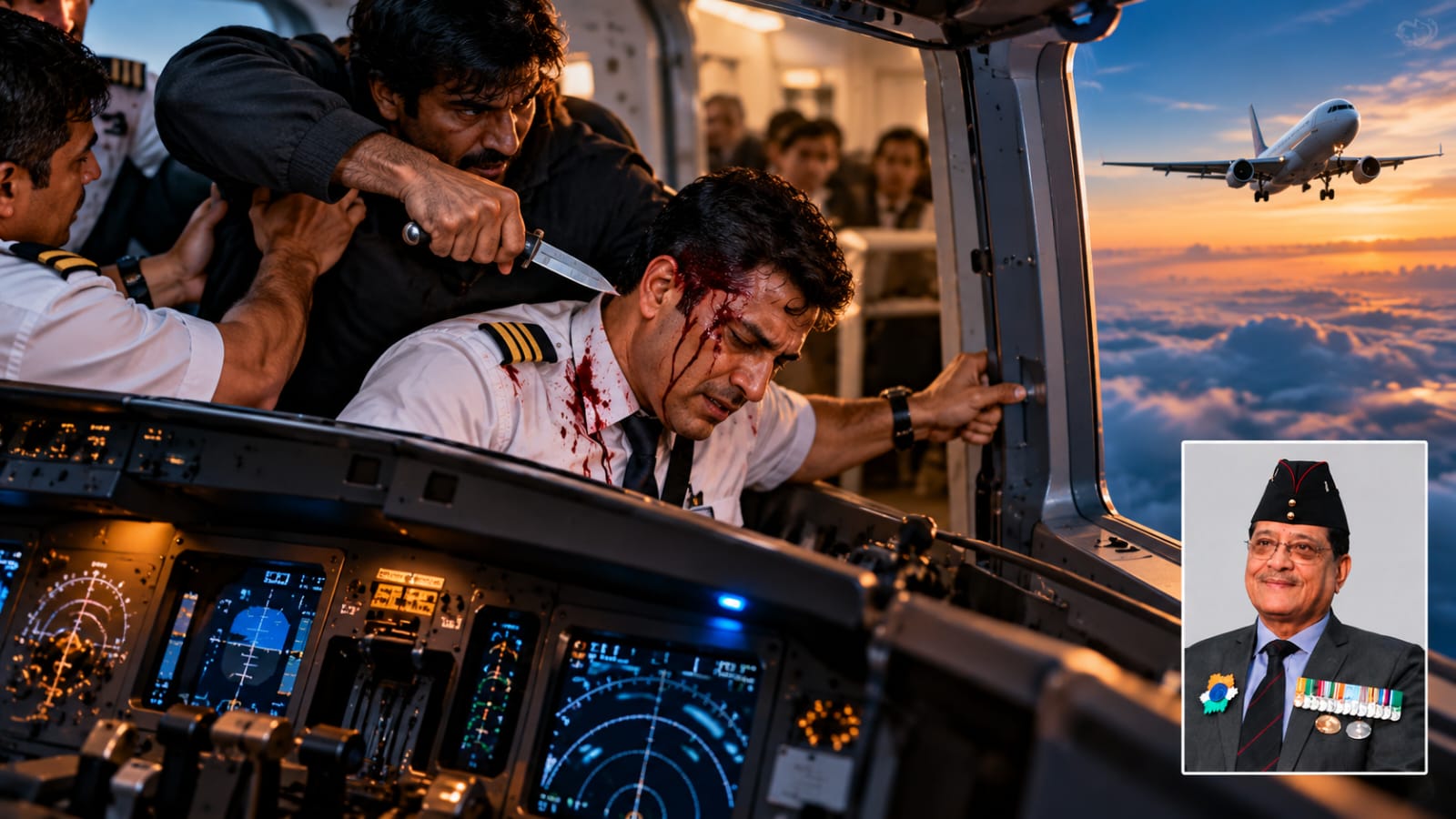
The incident involving a wounded pilot who continued to respond to an emergency aboard a passenger aircraft is a compelling reminder of this extraordinary human capacity. When the safety of passengers was at stake, his actions reportedly helped create an opportunity for others to intervene and bring the aircraft to safety.
Such incidents compel us to reflect upon a fundamental truth, professional training prepares us for emergencies, but presence of mind determines how effectively we respond when the unexpected happens.
As a soldier who has experienced hostile fire during operations with the Indian Peace Keeping Force (IPKF) in Sri Lanka, I have personally understood the meaning of those critical seconds. I have witnessed how a moment of confusion can endanger lives and how a determined, calculated response can alter the course of an unfolding crisis.
The cockpit and the battlefield may be separated by geography, technology and operational environment, but the human challenge is remarkably similar. When danger takes control of the circumstances, the first responsibility of a leader is to regain control through the mind.
A Pilot's Courage: Beyond the Cockpit.
A pilot is entrusted with more than an aircraft. The cockpit represents responsibility for hundreds of lives, many of whom have no understanding of the technical complexities unfolding around them. In normal circumstances, aviation depends upon procedures, instruments, communication and teamwork. But emergencies can develop in ways that challenge even the most experienced professionals.
An engine failure, fire, sudden loss of control, medical emergency or an act of violence may demand immediate decisions. A pilot cannot afford to surrender to panic. He must assess what remains functional, identify available options and act within the limits of time.
The reported incident involving Captain Smit Machchhar illustrates the importance of this human element. Despite suffering injuries during an onboard confrontation, he reportedly managed to open the cockpit door, allowing intervention by others. Additional pilots subsequently assumed control, and the aircraft landed safely.
The significance of such an episode extends beyond the immediate act of bravery. It demonstrates the value of retaining purposeful action even when personal safety is under threat. Bravery is not necessarily the ability to perform a spectacular act. Sometimes, it is the ability to perform one essential action that gives others a chance to survive.
The pilot's response also highlights an important aspect of professional responsibility, knowing when to act independently and when to enable others to take over. Leadership does not always mean personally completing every task. Sometimes, it means creating the conditions in which a team can succeed.
The Human Mind: The Most Important Instrument in a Crisis.
Modern aircraft are technological marvels. They possess sophisticated navigation systems, flight computers, warning mechanisms and multiple safety arrangements. Yet technology cannot eliminate every emergency. When an unexpected situation develops, the human operator must interpret information, distinguish between immediate and secondary threats, and decide what action is appropriate.
This is where situational awareness becomes critical.
A person under pressure may experience narrowed attention, confusion and an overwhelming desire to react instantly. Effective training helps counter these responses by creating familiarity with emergency procedures and developing the ability to prioritise. In aviation, this philosophy is reflected in crew resource management, which emphasises communication, teamwork, leadership and sound decision-making. A pilot must not merely fly the aircraft; he must manage the situation. The same principle applies to every person occupying a position of responsibility.
My Experience as a Soldier: Six Ambushes in One Night in Srilanka.
My understanding of courage, presence of mind and crisis leadership was not acquired from books alone. It was forged in the operational environment of Sri Lanka during my service with 4 JAT Regiment as part of the Indian Peace Keeping Force. On the night of 5-6 October 1988, I was leading a military convoy moving from Trincomalee towards Vavuniya. I was serving as the co-driver and was responsible for helping manage the movement under difficult operational conditions in leading the convoy on a broken, damaged road from Trincomalee to Vavuniya in the darkness and no light was supposed to be on except the parking lights
That night became one of the most unforgettable experiences of my military life. Our convoy was ambushed at six different locations during the journey.
The enemy's (LTTE) apparent intention was to disrupt our movement, break the convoy's cohesion and create panic among the soldiers and cause maximum damage to lower the morale as one of their tactics to the newly inducted troops. Each fresh encounter presented another challenge. Hostile fire, uncertainty, the vulnerability of moving vehicles and the safety of the men travelling with us demanded continuous alertness, once fire starts no one knew what to do with 60 plus trucks (Shaktiman 3xTon truck) fill of troops. In such circumstances, the first casualty can sometimes be a person's ability to think rationally. And everyone is depending on the leading vehicle for action from the vehicle, carry on moving or park the vehicle and fight back.
I knew that if panic overtook the convoy, the situation could rapidly deteriorate. As the officer leading the movement, I had to control my senses before attempting to control the situation.
There was no room for emotional reactions or confusion. Every response had to be deliberate, appropriate to the circumstances and directed towards protecting the men and completing the mission.
Returning fire when required, maintaining control of the movement and preventing the enemy from dictating our actions were essential elements of overcoming the successive ambushes.
The responsibility was not merely to survive the immediate exchange of fire. It was to ensure that the convoy remained capable of moving, that the soldiers retained their confidence, and that we reached our destination. Despite six ambushes at six different locations, we eventually reached Vavuniya. That night left me with a lesson that has remained with me throughout my military career:
The person responsible for others must first master his own fear, confusion and instincts before he can effectively manage a crisis.
A leader's calmness is not a display of indifference to danger. It is a conscious effort to prevent fear from controlling the decisions that determine the fate of others.
Two Different Battlefields, One Common Human Response.
When I reflect upon the reported incident involving the wounded pilot, my mind returns to that night in Sri Lanka. The circumstances were entirely different.
I was leading a military convoy through hostile territory. The pilot was confronting an emergency aboard a commercial aircraft. My environment involved hostile fire, military vehicles and the immediate threat of an ambush. His involved an aircraft, an injured crew member, passengers and the complex responsibilities of aviation safety. I was leading few injured and others to a safe place by returning fire and keeping in touch with my senior who was controlling from the end. The technologies were different. The operational environments were different. The nature of the threats was different. Yet the fundamental human response was remarkably similar.
Both situations demanded that the person entrusted with responsibility should not surrender to panic. Both required rapid assessment, control of emotions, decisive action and an unwavering concern for the lives of others.
In my case, the convoy had to be brought safely through successive hostile encounters to its destination. In the pilot's case, the emergency had to be managed so that the aircraft and its passengers could be brought to safety. Neither situation allowed the luxury of waiting for perfect circumstances. Now sometime I think, has stopped moving all vehicles behind me would have been a sitting duck target, damage would have been much more. This is where the true meaning of presence of mind becomes evident.
A soldier controlling a convoy under repeated ambushes and a pilot managing an emergency while wounded may occupy different worlds, but both demonstrate the same essential quality:, the ability to convert fear into purposeful action.
Lessons from Aviation History: When Human Judgment Saved Lives.
Aviation history provides remarkable examples of professionals who confronted extraordinary emergencies and demonstrated the value of calm thinking, technical knowledge and decisive action.
The Miracle on the Hudson - US Airways Flight 1549, 2009.
AsyncImage, US Airways flight 1549 Airbus A320 Hudson River January 2009 rescue boats" aspect Ratio="16:9" width="100%",
On 15 January 2009, Captain Chesley Sullenberger and First Officer Jeffrey Skiles faced a catastrophic situation shortly after take-off from New York's LaGuardia Airport.
Following bird strikes, both engines lost thrust. The aircraft was too low for a conventional return to the airport, and the crew had to assess the available options almost immediately.
Captain Sullenberger chose a controlled water landing on the Hudson River.
All 155 people aboard survived.
The successful outcome reflected professional preparation, rapid assessment, coordination and the ability to choose a viable course of action under extreme pressure. The incident is a reminder that an emergency is not managed by wishing it away. It is managed by recognising reality and acting within the available possibilities.
The Gimli Glider: Air Canada Flight 143, 1983.
AsyncImage query "Air Canada Boeing 767 Gimli Glider aircraft landing Gimli Manitoba 1983.
aspect Ratio="16:9" width="100%", On 23 July 1983, an Air Canada Boeing 767 ran out of fuel at cruising altitude following a fuel-quantity calculation error.
Captain Robert Pearson and First Officer Maurice Quintal suddenly found themselves operating a large passenger aircraft without engine power. Pearson used his gliding experience to manage the aircraft, while Quintal contributed knowledge of the former Gimli airbase, where the aircraft eventually landed.
There were no fatalities. The lesson is profound, when technology and normal operating conditions fail, experience and the ability to improvise within one's professional knowledge can become decisive.
It also reminds us that courage and sound judgment do not guarantee a perfect outcome. Their purpose is to give people the best available chance of survival.
The Difference Between Reacting and Taking Control.
There is a fundamental difference between merely reacting to danger and taking control of a dangerous situation. Reaction is often instinctive. It may be driven by fear, anger or the immediate impulse to escape. Control, however, requires awareness, judgment and the ability to select an appropriate course of action.
On that 5-6 October 1988 night, the enemy sought to disrupt our movement through repeated ambushes. Our responsibility was to prevent those attacks from destroying the cohesion and purpose of the convoy. The situation could not be controlled by courage alone. It required courage supported by judgment, training and disciplined action.
The same principle applies to aviation emergencies.
A pilot cannot allow an unexpected event to dictate every subsequent decision. He must identify what remains possible, use the available resources and act to preserve life. This is not recklessness. It is disciplined courage. The finest professionals are not those who never encounter fear, but those who remain capable of making responsible decisions despite fear.
Beyond the Cockpit and the Battlefield: A Universal Lesson.
The significance of these incidents extends far beyond aviation and military service.
Consider a doctor confronted with a patient in cardiac arrest. A railway driver facing an obstruction on the track. A firefighter trapped between advancing flames and endangered civilians. A ship's captain navigating a vessel through a violent storm. Each faces a moment when others depend upon the quality of his or her decisions.
The lesson is universal, the individual occupying the responsible position must not become a victim of panic. This does not mean that human beings should be expected to display superhuman qualities. It means that training, preparation, teamwork and emotional discipline should be cultivated long before a crisis occurs. A person who has rehearsed decisions under pressure is better prepared to recognise what must be done when the real emergency arrives. Leadership is not merely about giving instructions when everything is normal. It is about remaining effective when circumstances become abnormal. This is what the difference in a soldier and others.
Courage Is Intelligence in Action.
Looking back upon my military service, particularly the difficult days in Sri Lanka, I have come to regard courage as something deeper than physical fearlessness. A soldier may possess a weapon, a pilot may have sophisticated instruments, and a commander may have authority. Yet none of these is sufficient if the mind loses its ability to assess and decide on the spot. The human mind remains the central instrument of crisis management.
The pilot who perseveres despite injury, the aircrew who manages an aircraft with failed systems, and the soldier who responds to an ambush with discipline demonstrate different expressions of the same human quality. They do not eliminate danger. They confront it with awareness, resolve and purposeful action.
When I recall the night of 5-6 October 1988, when our convoy was ambushed six times between Trincomalee and Vavuniya, I recognise the same fundamental responsibility that confronts a pilot in an emergency: to control one's senses, make sound decisions and protect those whose lives depend upon one's actions.
The geography may change. The technology may advance. The uniform may be replaced by a flight suit. But the fundamental test remains unchanged. When lives depend upon us, we must not allow panic to make our decisions.
Courage is the strength to face danger. The presence of mind is the ability to control it. Leadership is ensuring that others survive it. That, to me, is the true meaning of bravery.
Author's Note.
The reflections on the IPKF experience are drawn from my military service with JAT Regiment in Sri Lanka, including the night movement from Trincomalee towards Vavuniya on 5 -6 October 1988. The article also draws upon documented aviation emergencies to examine the relationship between courage, professional training and decision-making under pressure.
Disclaimer:
This article draws upon the author's personal military experience and publicly available accounts of aviation emergencies for educational and illustrative purposes. The military narrative reflects the author's recollection, while external information and references remain the property of their respective owners and are duly acknowledged. The article is intended to highlight courage, presence of mind and leadership under pressure, without making technical or operational judgments.