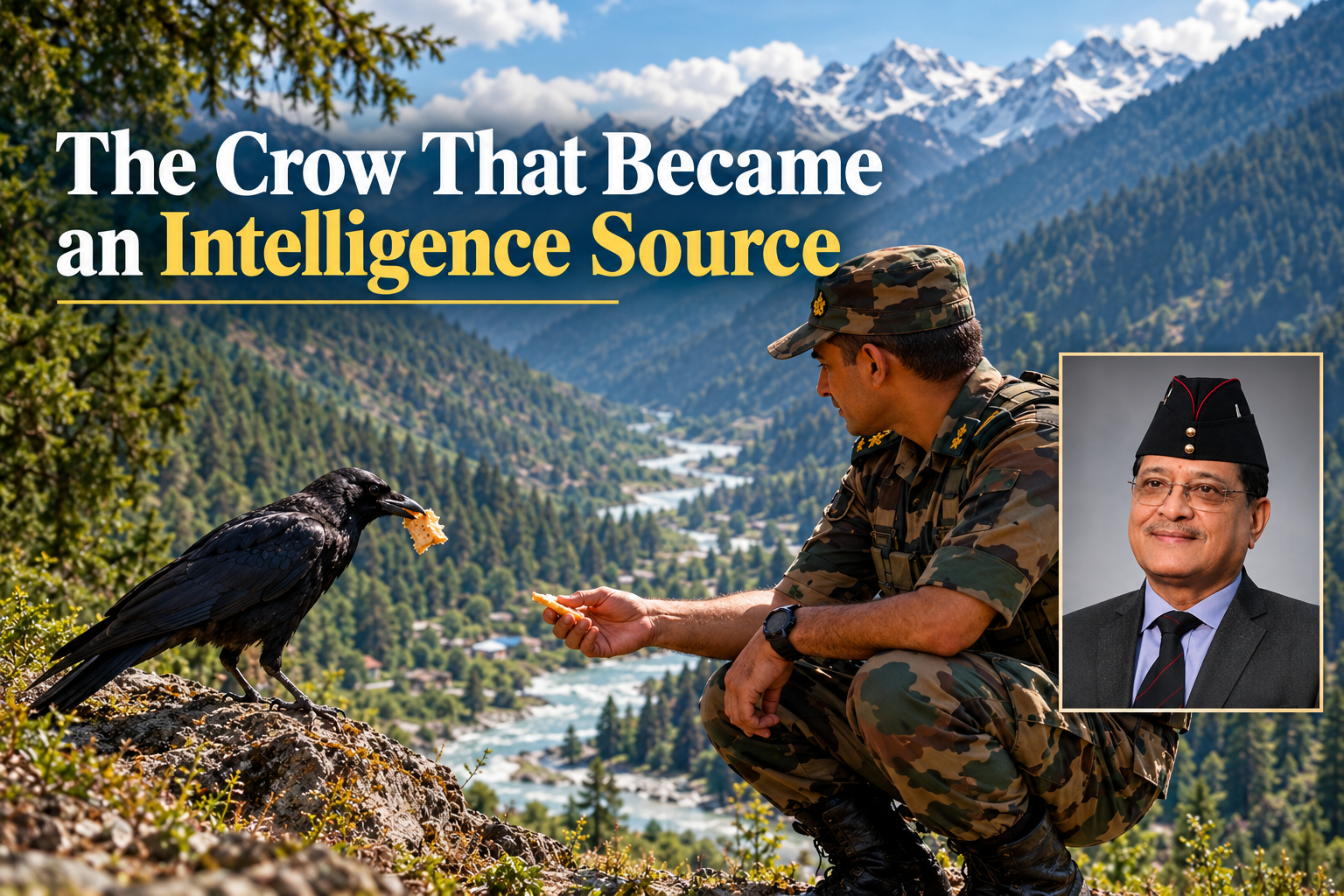
"The Crow That Became an Intelligence Source".
By
Col (Dr.) Ashwani Kumar, MiD, VSM (Retd.)
@Ashk Machhanvi.
How an unusual bird, a few pieces of chapati and an intelligence officer’s habit of observing small indicators contributed to a successful operation in the mountains of Jammu and Kashmir.
Gurez Valley has a silence of its own.
Nestled deep in the Himalayas and surrounded by towering mountains the valley is a place of extraordinary beauty. The Kishanganga River flows through it while dense forests steep slopes narrow tracks and scattered settlements create a landscape that can be both majestic and unforgiving. For a soldier operating there the same terrain that creates beauty can also provide perfect concealment.
I was serving in Gurez Sector during middle 90s, one such period when the area was a difficult operational environment. There were reports of militant movement in and around the forests but little concrete intelligence about their exact location. In those days intelligence gathering in such remote areas was a demanding task.
My years in the field had taught me that intelligence rarely arrives as a complete report. It often comes in fragments through a human source an unusual movement a change in routine or an apparently insignificant incident. I had learnt this lesson much earlier during my posting in the Poonch sector where I had an unusual companion a parrot. And as an Instructor in the training institutes where i had explored and carried out study on new avenues of gathering Intelligence.
It may sound strange to speak of a parrot in the context of military operations but that bird became an unexpected part of my field experience. As Captain Kumar I gradually became familiar with its habits movements calls and reactions. I learnt to recognise changes in its normal behaviour and on several occasions those observations provided useful indications that helped us locate and act against militant hideouts and camps, way back in late 80s.The success of those operations left a lasting impression on me. It also deepened my interest in ornithology and more broadly in ethology.
Ornithology is the scientific study of birds including their behaviour communication movements habits and reactions to their surroundings. Ethology is the broader scientific study of animal behaviour. For an intelligence officer there is an important lesson in this.
One must first understand what is normal. Only then one can recognise what is abnormal. A sudden silence an unusual call a change in flight path an unusual reaction to a stranger or repeated movement towards a particular location may not by itself constitute intelligence. But it can become an indicator that deserves observation and analysis. That lesson from Poonch remained with me.
Years later in Gurez a crow reminded me of it.
The Crow of Gurez and Maj Kumar.
One day we noticed a crow moving between the inhabited area and a thickly wooded portion of the jungle. At first nobody paid much attention. It was just a crow. Then one of our men threw a small piece of chapati towards it. The crow picked it up and flew away.
The next day another piece was thrown. Again the crow picked it up.
This time however we noticed that it repeatedly flew towards the same portion of the thick jungle. We thought he must have had his best over there but after some it used fly to another direction with his group.
Kumar began watching it.
The crow would come towards us take the food and fly back in the same direction. After some time it would return.
Again and again.
Then we noticed something else.
Its voice was different.
The crow did not always make the same sound. At certain moments particularly when it moved towards the jungle it gave a different call.
I could not immediately explain what the sound meant. But experience had taught me not to dismiss unusual behaviour simply because bird could not explain it at once.
So we watched.
The crow came again.
A piece of chapati was thrown.
It picked it up and moved towards the same area.
The pattern raised a question. Was there something in the jungle attracting the bird or had it become accustomed to something there? Or crow wanted to convey something!!! A big question mark?
We did not assume someone present there. But there was something unusual.
An assumption is not intelligence.
It was only an indicator. I decided to have a closer look. Initially I considered moving towards the suspected area with my buddy. I couldn't established what was there and wanted to see the ground for myself.
As I prepared to move something unexpected happened. The crow began flying around me. It gave a series of unusual calls. It moved ahead and then came back. Again it flew towards the jungle and again returned towards me sometime around me. Its behaviour appeared almost as though it was trying to stop me from moving forward.
I paused and started thinking?. Was I reading too much into the behaviour of an ordinary bird? I thought
Perhaps.
But as an intelligence officer must learn to respect an unusual indicator without immediately accepting its interpretation. I decided not to proceed immediately. I turned back. The crow changed its behaviour again and became little cool and calm.
It flew towards the food picked up another piece of chapati and once again moved towards the same area but with a rounded manner, it was again a question for me to think.
That sequence strengthened my suspicion. The crow was not giving us a military report. It was not saying that someone/militants were hiding there. But its behaviour was telling us that something was different in that area. That was enough to make us look again.
An Additional Source of Intelligence.
For an Intelligence Officer, the most important habit is to remain observant and to look for information where others see only ordinary routine. Even in an age of satellites, drones, electronic surveillance, artificial intelligence and sophisticated technical intelligence systems, human observation and unconventional sources of information retain their value. A bird, an animal, a routine movement, an unusual sound, a change in local behaviour or even a seemingly insignificant incident can sometimes provide the first indication of something important. An Intelligence Officer should therefore develop the habit of observing, recording, correlating and questioning such small indicators. The objective is not to treat every unusual occurrence as intelligence, but to recognise that anything unusual may become an additional source of intelligence when placed in the right operational context. Technology can provide enormous amounts of information, it is still the trained human mind that often recognises its significance.
From Indicator to Intelligence.
We began observing the area carefully. The jungle was thick and deceptive. At first glance there was nothing remarkable. But once you begin looking for deviations from the normal pattern small irregularities start acquiring significance. The indications gradually became stronger and there was reason to believe that the area had been used by militants.
The operation was planned and executed carefully.
After the ground recce and other inputs it was confirmed there is something. Later the militants were located in the area and the operation was successfully executed and completed. Weapons equipment and other material connected with their activities were recovered. We found log books, maps and other documents. Only after the operation was over we could fully appreciate the larger significance.
The militant presence represented a serious threat to the camp and the intelligence lead had helped us uncover it. In the circumstances it became clear that a major militant attack on the camp had been averted. For me the incident demonstrated the value of intelligence gathering in an area where conventional information was scarce.
Those were days when there were no drones and no UAVs providing the persistent surveillance that is possible today. An intelligence officer had to find his own ways and means.
He had to develop sources.
He had to understand the local environment.
He had to observe people animals terrain and routines.
He had to look for the smallest indicators and analyse them.
Most importantly he had to remain open to information from unexpected sources.
Where there is hardly any intelligence even a small indicator can become valuable if it is observed carefully analysed properly and corroborated before action is taken. That was the lesson Gurez gave me.
Crow as Nature's Living Computer.
The crow had not been an intelligence operative. It had not understood our mission.
It had not deliberately decided to help the Army. Yet it had noticed something. It had responded to its surroundings. Its calls had changed. Its movements had changed. And its behaviour changed again when I attempted to move towards the suspected area.
The important thing was not that the crow had somehow found militants. The important thing was that someone had noticed the crow. That is where intelligence begins. The experience also took me back to the parrot in Poonch. That bird had been my early teacher in observing animal behaviour. The crow in Gurez became a later reminder that nature is constantly providing information. We only have to learn how to read it. That is why I sometimes describe the crow as Nature’s Living Computer. A computer receives information stores it and processes patterns. The crow through instinct memory and observation does something remarkably similar.
It remembers.
It recognises.
It reacts.
And it communicates through behaviour and sound. May the crow differentiate between a soldier and civilian with a weapon. For an intelligence professional the larger lesson is clear.
Intelligence is not merely about collecting information. It is about gathering knowledge, studying indicators, recognising patterns, analysing apparently insignificant details, corroborating observations and converting fragments of information into meaningful intelligence.
A single piece of information may mean nothing.
A second observation may create a doubt.
A repeated pattern may create an indicator.
Analysis of several indicators may lead to an intelligence assessment.
And sound intelligence can ultimately lead to operational success.
A Friend in Gurez.
The work was appreciated by my seniors. But the crow became something more personal during my stay in Gurez. It became my companion. It would often follow me when I moved in the area. I began recognising its presence its calls and its movements. What had started as an insignificant observation had gradually become a familiar part of my daily environment and an unexpected source of intelligence indicators. Of course the bird did not understand the significance of what it was doing. It was simply behaving according to its nature. But I had learnt to observe its nature. My predecessor later told me something that I have never forgotten.
After I was posted out of the area the crow too disappeared.
Perhaps it was coincidence.
Perhaps it changed its routine.
Or perhaps it had become accustomed to my presence.
I cannot say.
But I remember that information with a smile.
The parrot in Poonch had been my early teacher.
The crow in Gurez became my later companion.
Both reinforced the same fundamental lesson:
Observe the normal. Recognise the deviation. Study the indicator. Analyse it. Corroborate it. Then act.
In the mountains of Gurez a few pieces of chapati an unusual call and the repeated flight of an ordinary crow became the beginning of a chain of observations that contributed to a successful operation. Weapons and other material were recovered. A serious threat to the camp was detected. And a major militant attack was averted.
Somewhere in that chain of events was a small black feathered completely unwitting observer.
The Crow of Gurez my love my companion.
I still remember it with appreciation. “Well done my little intelligence officer. Your signs were understood.”
Perhaps that is the most enduring lesson I carried from Gurez. Intelligence is not always about knowing more. Sometimes it is simply about noticing more and knowing what to do with what you notice.
Author's Note
This is a personal recollection from my years of service in difficult operational environments in a far flung area in Jammu and Kashmir. The incident stayed with me because it demonstrated how observation and the study of behaviour can sometimes provide valuable intelligence when conventional sources are limited. For an intelligence officer every unusual indicator deserves attention but not every indicator is intelligence. It must be studied analysed and corroborated before it can contribute to an operational decision.
Disclaimer:
This article is a personal recollection written for literary and historical purposes. Certain operational details have been generalised to protect operational sensitivities and the privacy of individuals. Nothing in the article is intended to disclose classified information or current operational methods.