"THE EASTERN FRONTIER: INDIA’S NEXT STRATEGIC IMPERATIVE"
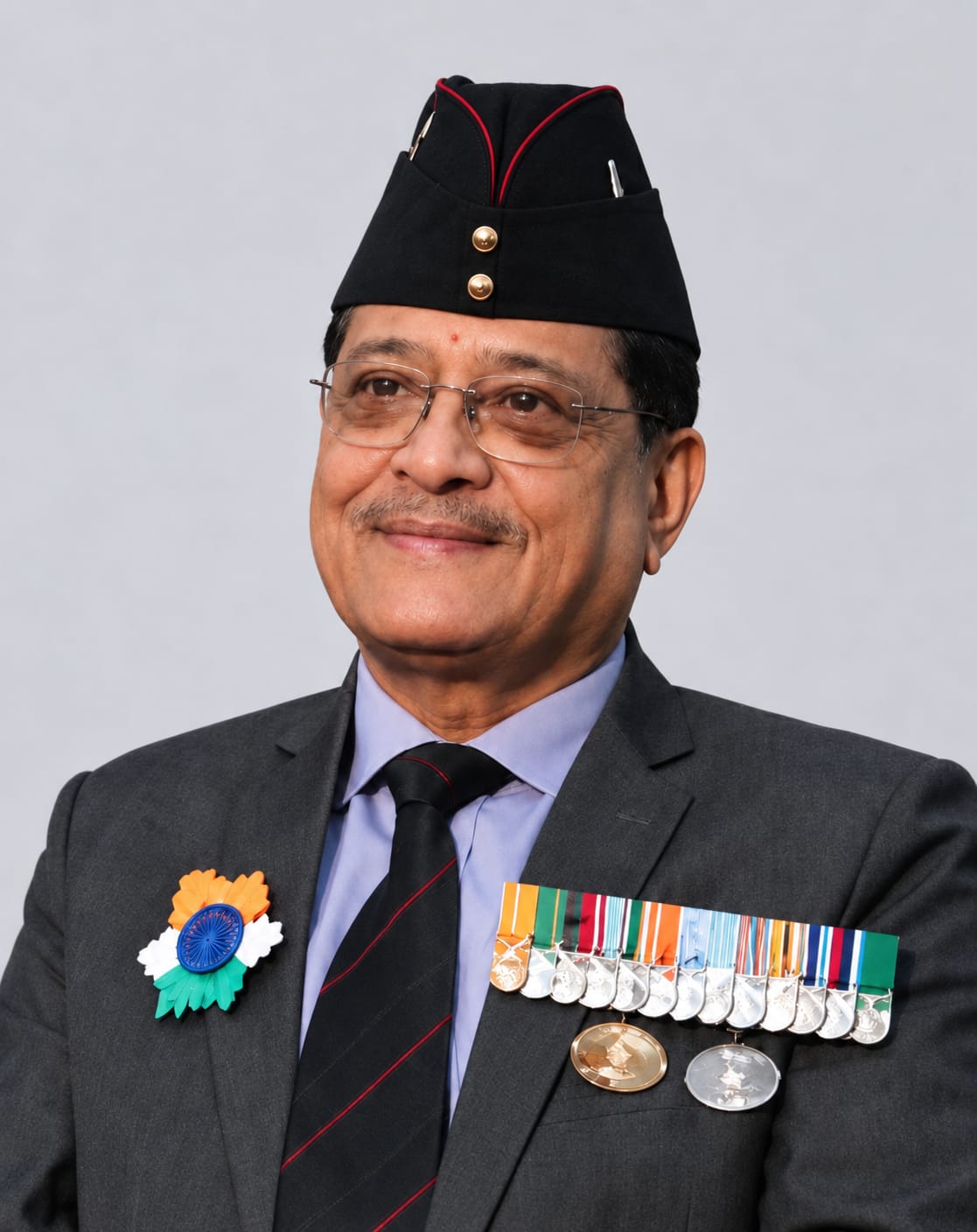
By
Col (Dr.) Ashwani Kumar, MiD, VSM (Retd.)
Why India Must Secure the West, Prepare for the East and Think Beyond the Pakistan Centric Mindset.
For decades, India's national security discourse has been dominated by Pakistan. The reasons are understandable. Pakistan has been responsible for wars, proxy conflict, terrorism and persistent military confrontation. India cannot afford to become complacent on that front.
But the strategic environment around India has changed.
The question today is not whether Pakistan remains a security challenge. It does. The more fundamental question is whether Pakistan should continue to occupy such a disproportionate place in India's long-term strategic imagination when China has emerged as a much larger military, economic and technological power with direct implications for India's northern and eastern frontiers.
India's own official documents recognise the scale of the China challenge. The Ministry of External Affairs has stated that China claims approximately 90,000 sq km of Indian territory in Arunachal Pradesh, while the Government has also dealt with the continuing sensitivities along the Line of Actual Control.
It is therefore time to ask a difficult but necessary question:-
Are we preparing for tomorrow's strategic challenges, or are we allowing yesterday's conflicts to dominate our thinking?
THE NORTHEAST IS NOT THE PERIPHERY
The Northeast has too often been viewed as India's distant geographical extremity. The region sits at the intersection of China, Tibet, Myanmar, Bangladesh, Bhutan and Southeast Asia. It connects India's landmass with one of the world's most strategically important economic and security regions. The Government itself has long recognised the importance of India's eastern connectivity and the Northeast's potential role as a gateway towards Southeast Asia.
From a defence perspective, however, geography gives the Northeast an even greater significance.
Arunachal Pradesh faces China's Tibet Autonomous Region. Sikkim provides another critical Himalayan axis. Manipur, Nagaland, Mizoram and other northeastern states connect India to a volatile and strategically important Myanmar frontier. Assam is the logistical and geographical heart of much of the region. The Siliguri Corridor remains the vital link between mainland India and the Northeast. This is not a peripheral theatre. It is a strategic frontier.
A SOLDIER'S VIEW FROM THE GROUND.
My own view is shaped not merely by reading maps or studying strategic assessments. I have served in the Northeast and have travelled through the region regularly, observing its terrain, operational conditions, people, infrastructure and security environment at close quarters. Service in difficult operational areas teaches a simple lesson, a map never tells the complete story. Mountains, jungles, rivers, weather, roads, bridges, communications, airfields, local populations and logistics can determine the outcome of an operation as much as weapons and manpower.
The Northeast therefore requires a security architecture designed around its actual geography and operational realities, rather than one imposed merely from a conventional mainland perspective. My experience has convinced me that India needs to take the Eastern Frontier much more seriously not after a crisis begins, but during peacetime.
PAKISTAN CANNOT REMAIN THE PERMANENT CENTRE OF STRATEGIC THINKING
This is not an argument for neglecting Pakistan. Pakistan remains a significant military and security challenge. The western front must remain adequately defended, monitored and prepared.
But there is a distinction between maintaining deterrence against Pakistan and allowing Pakistan to dominate India's entire strategic imagination.
China presents a different scale of challenge.
It is a major military and economic power, possesses substantial technological capabilities, has a long Himalayan frontier with India, and maintains strategic relationships across India's neighbourhood. The logical response should therefore be a gradual shift towards a more China-centric long-term strategic planning framework, particularly in force development, infrastructure, intelligence, technology, air power and the preparation of the Eastern and Northern theatres. In simple terms,
Pakistan must be contained, China must be strategically prepared for.
A NEW CONCEPT: A POWERFUL AND JOINT WESTERN COMMAND
One way of achieving this strategic balance would be to examine a fundamentally stronger unified command structure for the western theatre.
Rather than treating the Pakistan facing challenge primarily as an Army responsibility, India could consider a genuinely joint operational structure incorporating the relevant capabilities of the Army, Air Force and Navy, together with intelligence, surveillance and reconnaissance, air defence, cyber, logistics and other supporting elements. Relevant strategic capabilities could also be integrated into operational planning under their appropriate national command arrangements. Such a command would not mean weakening any individual Service.
Quite the opposite. It would mean ensuring that land, air, maritime, intelligence, cyber and strategic capabilities work together as one operational system.
India has already been moving towards such jointness. The Ministry of Defence declared 2025 the “Year of Reforms”, specifically identifying strengthening jointness and facilitating Integrated Theatre Commands as priorities. The CDS has also described jointness and integration as prerequisites for functional Integrated Theatre Commands and argued that theatre commands should ultimately enable multi domain operations involving cyber and space alongside traditional domains. The proposed western structure would therefore build upon an existing reform direction rather than represent a departure from it.
THE IDEA IS NOT TO ABANDON THE WEST, BUT TO FREE STRATEGIC SPACE FOR THE EAST.
A stronger integrated western command could provide India with a more coherent mechanism for dealing with the Pakistan centric threat. This would potentially allow greater national attention to be directed towards the Eastern Frontier. The objective should be:
Secure the West.
Strengthen the East.
Prepare for China.
That should become a central principle of India's future defence planning.
THE EASTERN THEATRE NEEDS A TRUE JOINT COMMAND.
The Eastern Frontier itself should receive a much stronger integrated command architecture. Such an arrangement should bring together, according to operational requirements:
Army + Air Force + relevant Navy assets + intelligence + ISR + air defence + cyber + logistics + strategic capabilities + border forces and other supporting agencies. The command must be capable of looking beyond the immediate border. Its strategic horizon should extend from the Himalayas to the Bay of Bengal and from Myanmar towards Southeast Asia.
Modern warfare does not respect Service boundaries.
A land battle may depend upon air superiority. Air operations may depend upon intelligence and logistics. Maritime forces may influence the wider strategic environment. Cyber and space capabilities may determine what a commander can see and how quickly he can act.
Therefore, the future commander must have access to a joint operational instrument, not a collection of separate Service capabilities.
THE SILIGURI CORRIDOR: A NATIONAL STRATEGIC ASSET.
Any discussion about the Northeast must address the Siliguri Corridor. The narrow land connection between mainland India and the Northeast is more than a geographical curiosity. It is a strategic vulnerability. Its protection should involve not merely troops on the ground but an integrated architecture involving:
Surveillance,
Air defence,
Rapid mobility,
Protected communications,
Alternative logistics routes,
Rail and road redundancy,
Air infrastructure,
Intelligence,
Cyber protection,
Civil-military contingency planning.
The objective should be to ensure that no sudden crisis can isolate the Northeast from the rest of India.
INFRASTRUCTURE IS DEFENCE.
In the Northeast, a road is not merely a road.
A bridge is not merely a bridge.
An airfield is not merely an airfield.
A communication network is not merely a communication network.
Every major piece of infrastructure in strategically sensitive border areas has a potential dual civilian and military value. India therefore needs to accelerate roads, tunnels, bridges, advanced landing grounds, logistics nodes, fuel storage, communications and alternative routes. Border infrastructure should be planned with the same seriousness as military infrastructure.
BORDER POPULATIONS ARE PART OF NATIONAL SECURITY.
The people living in India's border areas are India's first permanent presence on the frontier.They cannot be treated merely as recipients of development schemes.
They are also an important component of India's national security architecture. Better roads, communications, healthcare, education, employment and connectivity can strengthen their connection with the national mainstream while simultaneously ensuring a stronger governmental presence in remote areas.
A populated and prosperous frontier is inherently more resilient than an empty one.
GROOMING COMMANDERS WHO UNDERSTAND THE THEATRE.
There is another reform that deserves serious consideration: how India grooms officers for its most important operational appointments. For critical theatre and strategic commands, deep operational experience should receive appropriate weight. An officer who has commanded soldiers at the unit level, subsequently commanded larger formations and acquired experience at higher operational and strategic levels develops an understanding that cannot be acquired solely through staff appointments.
This does not mean that career progression should become automatic or based simply on the number of commands held. Merit, professional competence, integrity, performance, suitability, strategic outlook and institutional requirements must remain fundamental. But where a theatre is exceptionally complex, sustained operational exposure to that theatre should be a significant consideration. The principle should extend to other important operational and strategic appointments wherever appropriate. India should deliberately groom commanders who understand the battlefield from the soldier's level to the national-strategic level.
Recent official appointments themselves illustrate the value placed on varied operational experience. For example, the Army's April 2026 announcement regarding the Eastern Army Commander highlighted experience ranging from battalion and brigade command in high-altitude terrain to division and corps command.
CHINA-CENTRIC DOES NOT MEAN CHINA-OBSESSED.
A China-centric strategy must not become China-obsession. It means that India's defence planning should realistically account for the relative scale and nature of the Chinese challenge. It means strengthening:
Technology, Tntelligence, Infrastructure, Air power, Missiles, Drones, Electronic Warfare, Cyber, Space, Logistics and maritime capabilities. It also means understanding China's relationships with India's neighbours and the strategic geography extending from Tibet through Myanmar and the Bay of Bengal. India must think in terms of systems and theatres, not isolated borders.
FROM NORTHEAST TO SOUTHEAST ASIA.
The strategic importance of the Northeast does not end at India's international boundary. India's Act East policy gives the region an opportunity to become an economic and strategic bridge towards Myanmar, Thailand and the wider ASEAN region. Connectivity projects, trade corridors and multimodal transport networks can therefore have both economic and strategic consequences. A secure Northeast can become a gateway. A neglected Northeast can become a vulnerability. The choice lies in our planning today.
THE TIME FOR A STRATEGIC RESET IS NOW.
India is already moving towards jointness, theatre commands and multi domain warfare. The Ministry of Defence has explicitly identified Integrated Theatre Commands as part of its reform agenda, while the Inter-Services Organisations framework has created a legal foundation for greater joint command arrangements. The question is therefore not whether India should move towards jointness. The question is how intelligently and strategically we design it.
My proposition is that the next stage should give much greater weight to the Eastern Frontier and the China challenge, while ensuring that the Pakistan facing western theatre is placed under a sufficiently powerful and genuinely integrated command architecture.
The West must not be weakened.
The East must not be neglected.
CONCLUSION: LOOK EAST BEFORE THE CRISIS COMES
India has spent decades learning to look west whenever a security crisis emerges.
It is time to develop the strategic habit of looking east before the crisis arrives.
Pakistan remains a serious security responsibility. But India must increasingly organise its long-term defence thinking around the larger strategic environment in which China occupies a central position.
A powerful, joint western command could ensure that the western challenge remains firmly contained.
A stronger and genuinely integrated Eastern Theatre could then receive the attention, manpower, infrastructure, technology and strategic leadership that its importance demands.
And above everything else, India must change its mental map.
The Northeast is not India's backyard.
It is not merely a collection of remote states.
It is not a peripheral theatre to be remembered when trouble starts.
It is India's eastern strategic frontier, its gateway to Southeast Asia and one of the most consequential theatres for India's future security.
> The West must be secured. The East must be prepared. China must be factored into our long-term strategic calculus. And the Northeast must finally occupy the place it deserves in India's national-security architecture.
Author's Note
The views expressed in this article are those of the author, based on his professional experience, field exposure and personal assessment of India's security environment. The proposed command structures and reforms are suggestions for wider strategic debate and are not representations of existing Government policy.
Col (Dr.) Ashwani Kumar, MiD, VSM (Retd.)