"The Last Journey: When Four Lives Met at the Threshold of Eternity"
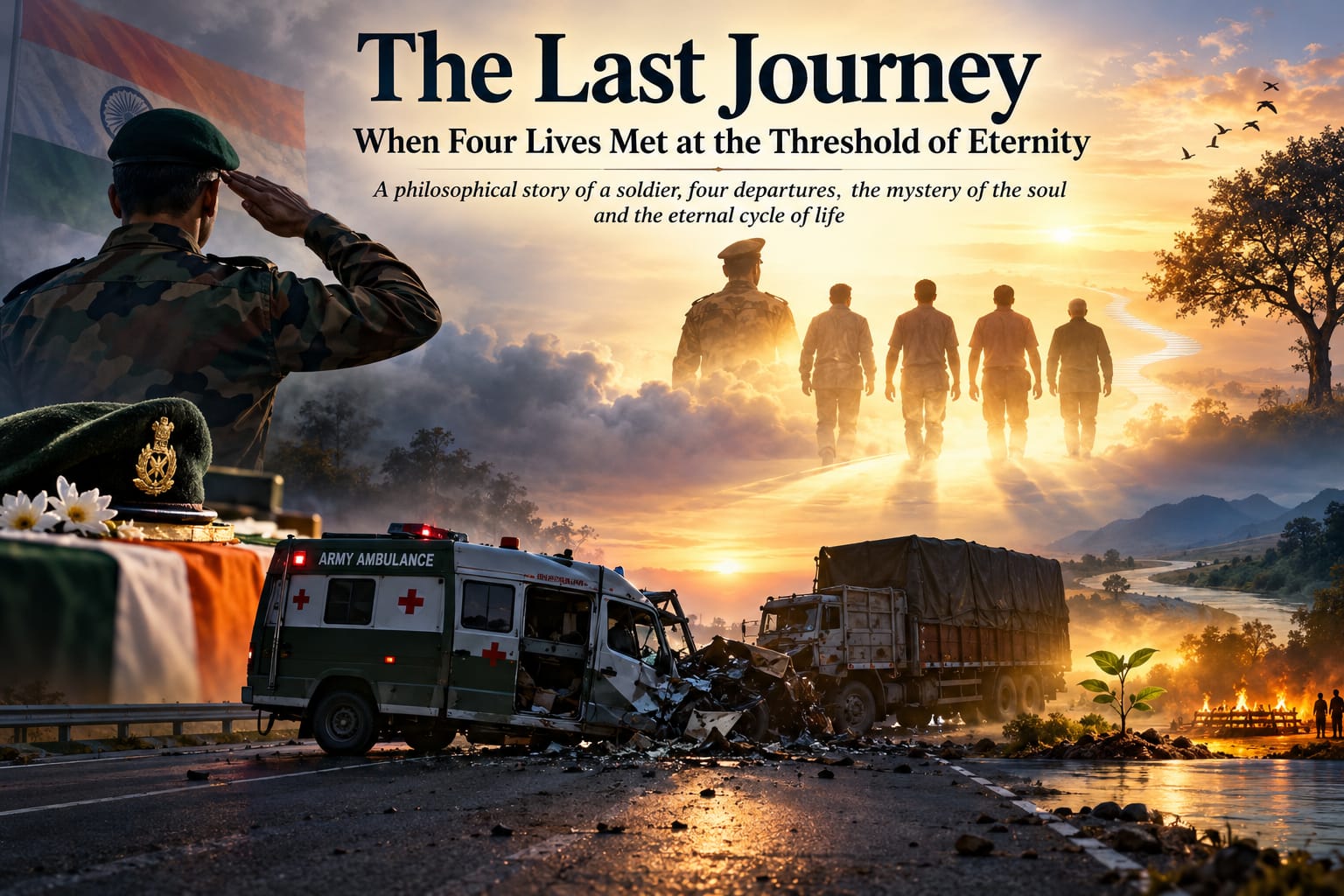
By Col (Dr.) Ashwani Kumar, MiD, VSM (Retd.)
A philosophical story of a soldier, four departures, the mystery of the soul and the eternal cycle of life.
The journey that was meant to end at home.
The highway was beginning to awaken when an Army ambulance moved along the Purvanchal Expressway in Sultanpur, Uttar Pradesh. Inside it lay the mortal remains of Subedar Major Satyawan Singh, whose earthly journey had ended in Chandigarh. His family was accompanying him to his native village in Deoria for the final rites. His son Gaurav, brother Rajan, nephew Ram Samujh and the ambulance driver, Jaspal, were part of this final journey. It was supposed to be a journey of farewell. A soldier was returning home, not in uniform to meet his family, but in a coffin to be received with tears, prayers and the dignity accorded to one who had served the nation. But near Haliyapur, the ambulance collided with a stationary truck. Four more lives were lost.
A family that had set out to perform the last rites of one departed soul suddenly found itself confronting four additional deaths. A father's journey had ended before the ambulance began its journey. Now, his son, brother, nephew and the driver who was carrying him home had also departed. The destination remained unchanged, but the meaning of the journey had been transformed forever.
When I read this news, I did not see merely a road accident. I saw a profound question about life, death, time and the mysterious relationship between human existence and eternity. Why do some lives end together, and what happens to the soul when the body ceases to exist?
A memory from the road to Abohar.
The Sultanpur tragedy brought back another incident I had encountered in reports years earlier. An Army ambulance travelling from Abohar towards Bathinda met with a fatal accident in the Malout region of Punjab. Three Army personnel lost their lives when the ambulance collided with a truck following an attempt to avoid a stray animal. The circumstances were different, but the image was hauntingly familiar: an Army ambulance, a highway, men travelling under the responsibility of military duty, and death arriving unexpectedly. Two incidents, separated by years and geography, had brought me to the same reflection.
A soldier spends his career preparing for danger. He learns to recognise the possibility of death in operational areas, on battlefields and during military assignments. Yet, the final moment may arrive on an ordinary highway, far from the enemy and sometimes within sight of home. There is no uniform that makes the human body immortal, nor any medal that exempts its wearer from mortality.
As a retired Army officer, I have witnessed the realities of military life, the grief of families and the solemnity of military funerals. These experiences have often compelled me to contemplate a question that neither rank nor experience can answer, is human existence confined to the physical body, or is the body merely a temporary instrument of a much longer journey?
The soldier and the mystery of the departed.
My thoughts travelled back to an account shared by my General, who had witnessed the cremation of 87 soldiers near Beriwala Bridge in the Fazilka sector during the 1971 war.
Eighty-seven soldiers.
Eighty-seven lives that had once carried childhood memories, family relationships, ambitions and unfinished conversations.
Their mortal remains were consigned to the flames, but what happened to their souls?
Did their existence end with the destruction of their physical bodies? Did they enter another state of being? Did their journey continue through rebirth, as Indian spiritual traditions suggest?
I could salute them, honour their sacrifice and remember their courage. But I could not answer the ultimate question. Military service teaches a man to confront death, but it does not necessarily teach him to understand it. Perhaps this is why the death of Subedar Major Satyawan Singh and the four lives lost in the subsequent accident affected me so deeply. The tragedy brought together the final journey of a soldier and the sudden departure of those accompanying him.
The body and the Atman.
Indian philosophical thought makes a fundamental distinction between the physical body and the Atman. The body is born, grows, ages and eventually returns to the elements. The Bhagavad Gita, particularly its second chapter, presents the soul as unborn, eternal and indestructible. The analogy of changing worn out garments for new ones offers a profound understanding of death as transition rather than absolute annihilation.
But where does the soul go?
Does it retain the memories of the life it has left? Does it recognise those with whom it shared affection? Does it enter another body, another family and another age?
The doctrine of Samsara describes the cycle of birth, death and rebirth. Karma is understood in many Indian traditions as connecting actions with the continuing journey of existence, while Moksha represents liberation from this cycle. These are spiritual and philosophical teachings, not scientifically established explanations of any particular death. Nevertheless, they offer a framework through which humanity has attempted to understand the continuity of existence. Perhaps the body is a temporary residence, and life is a passage through a mystery much larger than our visible world.
Kaal: The unseen traveller.
Our ancestors contemplated time through the concept of Kaal. Time is not merely the movement of a clock's hands. It is the force through which childhood becomes youth, youth becomes old age and every physical form undergoes transformation.
A river continues to bear the same name even though its waters are constantly changing. Human existence may also be understood through this relationship between change and continuity.
Our bodies change, memories evolve and relationships deepen. Yet the experience of being oneself remains central to human consciousness.
What is that continuity?
Is it consciousness? Is it the Atman described in the Upanishads? Or is consciousness entirely dependent upon the functioning of the brain?
Science investigates the biological foundations of consciousness, while philosophy and spirituality explore questions that remain unresolved. The clock can record the moment of birth and the moment of death. It cannot explain the ultimate meaning of existence. Perhaps Kaal measures the duration of our physical passage, while eternity belongs to a dimension of spiritual understanding that human beings have yet to comprehend.
Four lives, one moment.
I imagine Gaurav accompanying his father's mortal remains. Perhaps he was recalling a childhood memory, a conversation or a promise made to his father. Perhaps he was thinking about the relatives waiting in the village and the responsibilities that would follow the final rites. Rajan and Ram Samujh would have carried their own memories and expectations. Jaspal, entrusted with the journey, would have been concentrating on the road and his responsibility.
Four individuals, each with a separate history, identity and future. Then, in an instant, their earthly journeys were interrupted. We cannot know what each was thinking in those final moments, nor can we claim that their deaths were predetermined by destiny or Karma. The physical circumstances must be established through investigation, and responsibility for the accident must be examined on evidence. Yet the human mind naturally searches for meaning when several lives are lost together. Perhaps it is because we find it difficult to accept that so much affection, experience and expectation can be extinguished in a single moment. A journey undertaken for one farewell became the occasion for several more.
The unfinished conversations.
Behind every death lies a world that the departed leave behind. A chair remains empty. A telephone no longer rings with the expected voice. A mother waits for her son, a child for a father, and a family struggles to understand a loss that arrived without warning.
There is no philosophy capable of removing such grief. We postpone affection, apologies and conversations, assuming that another day will always be available.
But death does not consult our calendar. The tragedy reminds us that time is not our possession. It is an opportunity entrusted to us, moment by moment. If contemplation of death has any practical purpose, it must be to make us more compassionate, more responsible and more conscious of the lives connected with our own.
The cycle of life.
In the traditional Indian understanding, the physical body returns to the five elements: earth, water, fire, air and space. The funeral pyre marks the end of the body's physical journey, while the spiritual understanding of rebirth offers the possibility of continuity beyond it. Nature itself reveals cycles of transformation. Seeds fall into the earth and give rise to new growth. Rivers flow towards the sea, while rain returns to the mountains. Generations depart, and new generations inherit their memories, values and responsibilities.
The doctrine of rebirth extends this cyclical vision to the soul.
Whether one accepts it literally or approaches it as a spiritual metaphor, the idea invites us to recognise that existence may be larger than the individual lifetime we experience. There is also another continuity that we can observe directly: the continuation of a person's influence through those who survive. A father lives in the values he gives his children. A soldier lives in the courage he inspires in his regiment. A brother lives in the affection remembered by his family.
In this sense, death does not erase everything that a person has contributed to the world.
The last salute.
As an Army veteran, I have saluted men whose faces remain in my memory. Some returned from operations; others did not. Some lived to see their children grow, while others left behind dreams that remained unfinished.
The uniform may be laid aside, and the mortal body may return to the elements, but the honour of service survives through memory and the lives influenced by that service.
Subedar Major Satyawan Singh's final journey was meant to bring him home. Instead, it became a tragedy that confronted several families with an irreparable loss. May the departed rest in peace, and may their families find the strength to endure their grief.
Beyond the horizon.
I return my thoughts to that highway. The ambulance is no longer moving. The journey has ended. Traffic resumes, the sun rises and the world continues with its familiar rhythm. But beyond the visible road lies a question that no accident investigation can answer.
Where does the soul go?
Does it return to another life? Does it continue in a state beyond physical existence? Or is consciousness a mystery that humanity is destined to contemplate without ever completely possessing?
I do not claim to know.
After a lifetime spent studying military affairs, intelligence, human behaviour and the realities of conflict, I find myself no different from any other human being when confronted with death.
A seeker. A questioner. A traveller through time.
Perhaps the last journey is not merely the movement of a body from one place to another. It is the moment when the visible world reaches the limits of what it can reveal about existence.
And perhaps the purpose of contemplating death is not to become obsessed with the end, but to understand the responsibility of the life we still possess.
For the body, the journey ends.
For the soul, the mystery continues.
For those who remain, love and remembrance become the bridges between absence and continuity.
Epilogue: The journey beyond time.
We arrive without knowing the road ahead. We live believing that time belongs to us. We depart without carrying the possessions we spent a lifetime collecting.
If the soul is eternal, as our ancient wisdom teaches, death is a passage. If its ultimate nature remains unknown, humility is our most honest companion.
Whatever lies beyond the final breath, one truth remains within our reach: the measure of a life is not merely the time it occupies, but the humanity it leaves behind.
The last journey may end at the threshold of the visible world, but the mystery of existence has no known horizon.
Col (Dr.) Ashwani Kumar, MiD, VSM (Retd.)
@Ashk Machhanvi.