United Punjab: A Dream of History, Heritage, Peace and Prosperity"
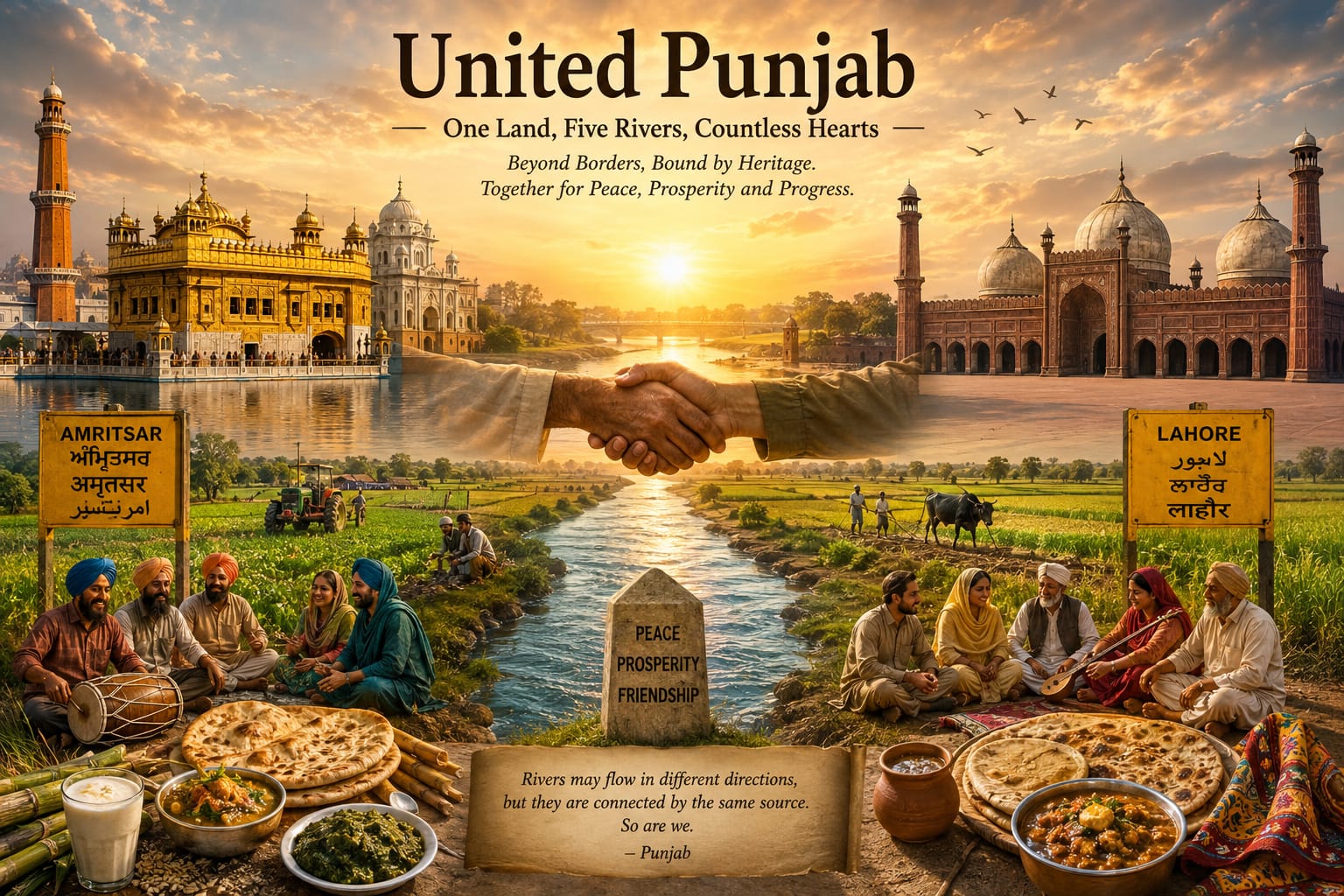
United Punjab: Preserving a Shared Heritage Through Culture, Cooperation and Understanding
By Col (Dr.) Ashwani Kumar, MiD, VSM (Retd.)
CEO, Sharda Sarvagya Peeth, Jammu & Kashmir
Introduction
Punjab is not merely a geographical expression. It is an emotion, a civilization and a living memory. The very name Punjab—Land of Five Rivers—evokes images of fertile fields, brave soldiers, revered saints, vibrant culture and people known for their resilience and generosity.
For centuries, Punjab stood as a gateway to the Indian subcontinent. It absorbed invasions, nurtured civilizations and produced warriors, scholars, saints and revolutionaries who shaped the destiny of the region.
Yet, in 1947, Punjab suffered one of the greatest tragedies in its history. A land that had remained culturally connected for centuries was divided. Families were separated, communities were uprooted and millions were forced to leave behind their homes, memories and ancestral lands.
Nearly eight decades later, the idea of a “United Punjab” continues to resonate with many Punjabis across the world. The question is not necessarily whether political boundaries can or should be redrawn, but whether the spirit of Punjab can find renewed unity through culture, heritage, economic cooperation and human understanding.
The Punjab That Once Was
Before Partition, Punjab covered a vast region extending across areas that are today part of India and Pakistan. Lahore was an important cultural centre, Amritsar a spiritual centre, Rawalpindi a major military centre and Multan an ancient seat of commerce and civilization.
People spoke Punjabi, shared common customs, celebrated harvest festivals and participated in each other’s joys and sorrows. While religion distinguished communities, Punjabi identity created important cultural bonds.
The villages and towns of Lahore, Sheikhupura, Gujranwala, Sialkot, Jalandhar, Ludhiana, Ambala and Amritsar formed interconnected social and economic networks. Punjab was not merely a province; it represented a broader cultural civilization. The region's diverse heritage continues to be reflected in its language, literature, music, food and traditions. :contentReference[oaicite:1]{index=1}
The Demographic Reality Before Partition
The Punjab of 1947 was a diverse land. Muslims constituted a majority in western districts, while Sikhs and Hindus were concentrated more heavily in eastern regions. However, many districts contained mixed populations.
The cultural strength of Punjab was closely connected to this diversity. Its cities and villages reflected traditions associated with different faiths and communities, while Punjabi language and customs provided a shared cultural identity.
The Tragedy of Partition
Then came 1947.
The Radcliffe Line divided Punjab between India and Pakistan. What followed was one of the most traumatic chapters in the region’s history. Millions crossed the newly created border. Families were separated, properties were abandoned and communities were uprooted from places where they had lived for generations. The Partition of Punjab represented a profound social and civilizational rupture. :contentReference[oaicite:2]{index=2}
As a child, I often listened to stories narrated by my father and grandfather about those turbulent days. Their voices carried the pain of separation, the fear of uncertainty and the grief of losing ancestral roots. My 89-year-old uncle even today talks about those days, and many of those stories still raise goosebumps and leave a lasting impression on my mind.
Yet, amidst the sorrow, they also remembered friendships that transcended religion and instances of humanity displayed by ordinary people who helped their neighbours. These memories convinced me that while borders may divide territories, they cannot permanently erase centuries of shared heritage.
Punjab After Partition
The Punjab that emerged after 1947 was dramatically transformed. Pakistan inherited the western portion of Punjab, while India retained the eastern part. India subsequently reorganised the region, and in 1966 Haryana was created as a separate state while several hill areas became part of Himachal Pradesh. Chandigarh became a Union Territory.
Administrative boundaries changed, but they could not erase historical and cultural connections. Today, Punjabis live in Indian Punjab, Haryana, Himachal Pradesh, Pakistan Punjab and across the global diaspora. They remain connected through language, food, music, traditions and memories. :contentReference[oaicite:3]{index=3}
A Soldier’s Perspective
My understanding of Punjab is not limited to books or family memories. As a soldier, I had the privilege of serving in several border regions of Jammu & Kashmir and Punjab, including Poonch, Naushera, Jammu and the Pir Panjal region. Over the decades, I interacted with villagers, farmers, ex-servicemen, traders, religious leaders and ordinary citizens living close to the international border and the Line of Control.
I observed a common reality. Many ordinary people desired peace and stability. Farmers worried about their crops, families worried about their children and traders hoped for better opportunities. Most ordinary citizens sought stability, prosperity and a dignified life.
In border villages, the cost of prolonged tensions is felt directly. Security concerns can disrupt daily life and development, while resources that could otherwise support education, healthcare and infrastructure must also be devoted to managing security challenges.
During my interactions in Punjab and Jammu & Kashmir, I often encountered elderly individuals who still remembered pre-Partition Punjab. Many spoke nostalgically about Lahore, Sialkot, Gujranwala and Rawalpindi. Some had left ancestral homes there, while others had relatives whom they never met again.
Their memories reflected pain, but also hope—hope that future generations may inherit friendship rather than hostility.
Can Punjab Unite Again?
The answer depends upon how one defines unity. If unity means political reunification under a single administration, such a possibility remains unrealistic in the foreseeable future. Sovereignty, national interests, security concerns and geopolitical realities cannot be ignored.
However, if unity means cultural, economic, educational and civilizational cooperation, then the idea can be approached through peaceful and practical initiatives. Countries that once experienced conflict have demonstrated that cooperation can develop while national sovereignty remains intact.
Similarly, Punjabis on both sides of the border can strengthen cultural and people-to-people ties without challenging existing national boundaries.
The Economic Dividend of Peace
One of the strongest arguments for greater cooperation lies in economic development. National security will always remain essential, and no responsible nation can compromise on it. At the same time, a stable environment can create greater opportunities for trade, investment and regional development.
A future marked by greater trust, cooperation and economic engagement could create opportunities in:
- Education
- Healthcare
- Scientific research
- Infrastructure
- Rural development
- Employment generation
Punjab could potentially strengthen its role as a gateway connecting South Asia with wider regional markets. Lahore and Amritsar, separated by a relatively short distance, could become complementary economic and cultural centres rather than symbols of division. Agriculture, food processing, textiles, logistics, tourism and information technology could benefit from greater connectivity, subject to prevailing national policies and security considerations.
Cultural Reunification Without Political Reunification
The real strength of Punjab lies in its culture.
The poetry of Bulleh Shah, the teachings associated with Guru Nanak Dev Ji, the legacy of Maharaja Ranjit Singh and the folk traditions of Punjab form an important part of the region’s shared cultural heritage.
The language, food, humour, music and traditions retain remarkable similarities across the border. Cultural festivals, literary exchanges, academic cooperation, heritage conservation projects and pilgrimage routes can help strengthen these connections.
The Kartarpur Corridor is one example of how religious and people-to-people connections can be facilitated across an international border when the necessary arrangements and political understanding are in place.
The Sharda Peeth Perspective
As CEO of Sharda Sarvagya Peeth, I view this subject through the lens of civilizational continuity. Sharda Peeth symbolises an important part of the shared intellectual and spiritual heritage of the Indian subcontinent.
The idea of a Sharda Corridor, in this context, should be understood as an effort to reconnect people with their cultural and spiritual roots rather than as an attempt to alter political boundaries.
Civilizations are not confined by political boundaries. They survive through memories, traditions, knowledge, faith and cultural exchange.
A culturally connected Punjab would honour the sacrifices of those who suffered during Partition while ensuring that future generations inherit understanding rather than bitterness. The objective should not be to recreate historical maps, but to preserve and revive meaningful connections.
Conclusion
Punjab has endured immense suffering, yet it remains one of the most vibrant regions of the world.
Its rivers continue to flow. Its language continues to thrive. Its songs continue to be sung. Its spirit remains resilient.
The idea of a United Punjab should not necessarily be interpreted as a political project. Rather, it can be viewed as a vision of reconciliation, cultural revival, economic cooperation and human understanding.
As someone who grew up listening to Partition stories from my father and grandfather and later served as a soldier on India’s borders, I have witnessed both the pain of division and the desire for peace.
The people of Punjab deserve a future where history is remembered but not allowed to imprison the future.
Perhaps the greatest tribute to those who suffered in 1947 would be to ensure that future generations inherit friendship instead of fear, cooperation instead of confrontation and hope instead of hatred.
Maps may remain divided, but hearts need not be. If the spirit of Punjab can once again connect people across borders through culture, heritage and mutual respect, then the deepest wounds of history may gradually begin to heal. And that, perhaps, would be the truest meaning of a United Punjab.
Author’s Note
The idea of Punjab has always been deeply personal to me. Born in Punjab and having grown up listening to the stories of Partition narrated by my father and grandfather, I vividly remember the emotions that accompanied those memories.
Their accounts of abandoned homes, separated families, forced migrations and immense human suffering often sent shivers down my spine. Those were not merely stories; they were lived experiences etched into the collective memory of an entire generation.
Yet, despite the pain, they also spoke of a Punjab where people of different faiths lived together, shared festivals, celebrated harvests and stood by one another in times of hardship. Their memories carried not only the wounds of separation but also the warmth of a shared civilization.
Having served for decades as a soldier in border areas of Punjab and Jammu & Kashmir, I have personally witnessed the aspirations of ordinary people who desire peace, progress and prosperity. Their hopes reinforce my belief that while borders may define nations, human relationships and cultural bonds can transcend them.
If this article contributes in any way towards reducing the inherited pain of Partition and encouraging a spirit of understanding among future generations, it will have served its purpose.
Disclaimer
This article is a historical and cultural reflection on the shared heritage of Punjab. It does not advocate any alteration of internationally recognised borders or national sovereignty. The concept of “United Punjab” is discussed solely in the context of cultural, civilizational, economic and people-to-people connections aimed at promoting mutual understanding and preserving a common heritage.