
US Startup Claims It Can Make Gold from Mercury — Could Lab-Grown Gold Crash Prices?
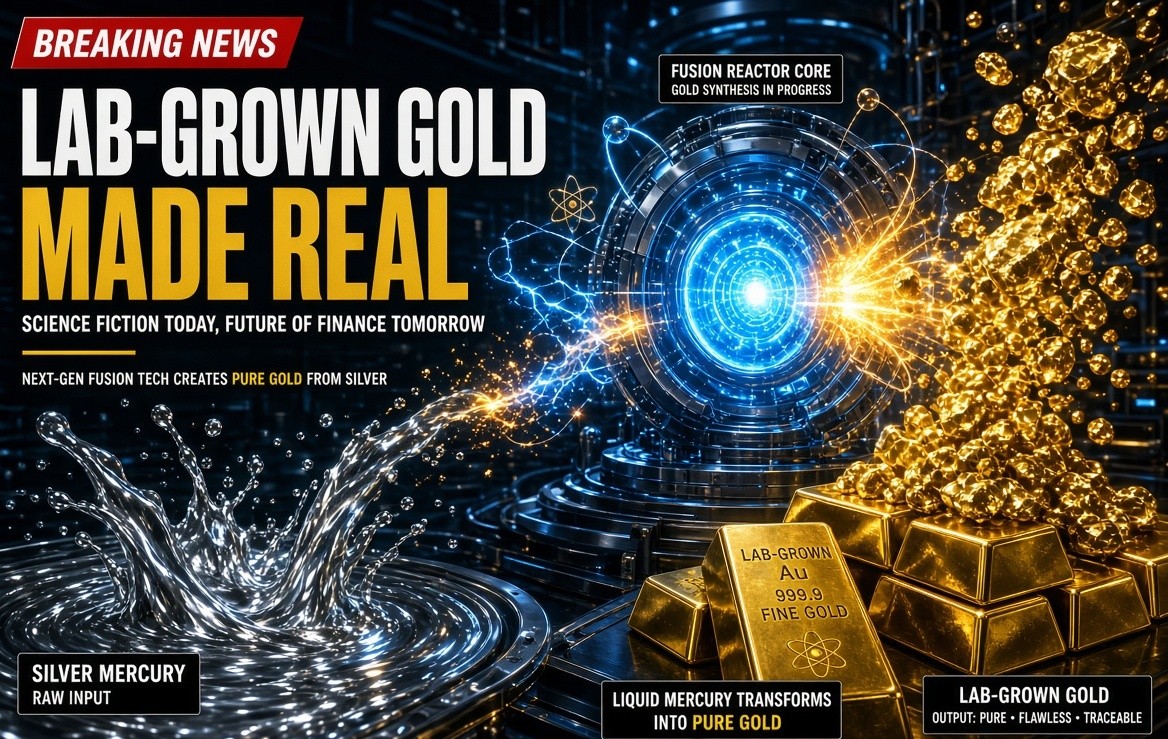
Marathon Fusion Claims It Turned Mercury Into Gold: Could It Affect Gold Prices?
A San Francisco-based fusion startup, Marathon Fusion, has made a remarkable claim that has attracted attention in scientific and financial circles. The company says it has converted mercury into stable gold using neutrons generated through nuclear fusion. Although the underlying nuclear physics is established, the company's experimental claim has not yet been independently verified.
On October 21, 2026, Marathon Fusion announced on social media platform X that it had achieved what it called "high-rate alchemy" the previous month. The company claimed its gold-production rate was ten times a benchmark associated with CERN's earlier experiments. However, it has not publicly disclosed the quantity of gold produced or provided sufficient experimental data to independently establish the scale of the achievement.
The company is also exploring the production of medical isotopes used in cancer diagnosis and treatment. It says it is building a fusion reactor in San Francisco as part of its broader technology development efforts.
How Does the Process Work?
The proposed process relies on nuclear transmutation, in which a change in an atom's nucleus transforms one element or isotope into another.
According to Marathon Fusion's proposed method, high-energy neutrons from a deuterium-tritium fusion reaction strike mercury-198 atoms. This reaction can produce radioactive mercury-197, which subsequently decays into gold-197, the only stable isotope of naturally occurring gold.
The underlying nuclear reactions are physically plausible. However, confirming the company's specific experimental result requires detailed measurements, independent analysis and information about the amount and purity of the gold produced.
What Could a Future Fusion Plant Produce?
In a 2025 research paper, Marathon Fusion modelled a process that could potentially produce around two tonnes of gold annually per gigawatt of thermal fusion power. This figure is a theoretical projection for a future facility, not a demonstrated production result from the company's recent experiment.
For comparison, global gold mine production was estimated at approximately 3,672 tonnes in 2025. Even if the proposed process eventually becomes commercially viable, its impact on the market would depend on the number of operating facilities, their actual output and the economics of production.
The Major Challenges
Several important questions remain unanswered. Marathon Fusion has not disclosed the quantity of gold obtained in its reported experiment, its purity, the recovery efficiency or the cost of producing it. The company's claim that its production rate exceeded CERN's benchmark also requires clarification because the two approaches use different processes and the comparison has not been fully explained.
CERN's ALICE experiment estimated that the Large Hadron Collider produced approximately 29 picograms of gold during its 2015–2018 operations. The gold nuclei generated in those collisions existed only briefly before being destroyed in subsequent interactions. Marathon Fusion's proposed approach is different and aims to use fusion-generated neutrons to produce gold on a larger scale.
Radioactive byproducts and material-processing requirements present additional challenges. Depending on the isotopes present, the resulting material may require separation, testing and storage before it can meet applicable safety requirements. Commercial fusion power plants capable of operating at the scale envisioned in these projections are also not yet widely available.
Could This Affect Global Gold Prices?
If fusion-based gold production eventually becomes economically viable and expands significantly, it could add a new source of supply to the global market. Some observers have compared this possibility with the growth of lab-grown diamonds, although the economics and market dynamics of gold production are substantially different.
In the short term, Marathon Fusion's announcement alone is unlikely to transform the gold market. The company has not disclosed its experimental yield, and its projected future production depends on technology that has not yet been demonstrated at commercial scale.
Over the longer term, market sentiment could change if researchers independently verify the results and companies demonstrate that the process can produce meaningful quantities of gold at competitive costs. Until then, the prospect of fusion-produced gold remains speculative.
Potential Implications for India
India is one of the world's major gold-consuming countries, with jewellery demand closely linked to weddings, festivals and cultural traditions. If a commercially viable technology eventually increased global gold supply and contributed to lower prices, Indian consumers could benefit from more affordable gold.
However, the effect would depend on several factors, including production costs, international bullion prices, import duties, taxes and the rupee's exchange rate. Lower international prices could also affect gold investors and businesses holding substantial inventories, while the impact on domestic miners would depend on their exposure to market prices.
For now, there is no established evidence that Marathon Fusion's reported experiment will lead to a near-term change in gold prices or India's gold import bill.
What Happens Next?
Marathon Fusion's claim represents an intriguing development in the potential use of fusion-generated neutrons for nuclear transmutation. However, independent verification, transparent experimental results, larger-scale demonstrations and evidence of commercial viability will be essential before its significance can be assessed confidently.
For the moment, the announcement is a scientific claim worth investigating rather than proof that fusion technology is ready to disrupt the traditional gold market.
```