Whining in Quotes: The Crybaby Western Media's Coverage of Flight FZ1073
THE "HERO" DEBATE: HOW WESTERN MEDIA REFRAMED CAPTAIN MACHCHHAR'S MID-AIR MIRACLE
By Dr.Dheeraj Rangarajan
October 5, 2026
When Flydubai Flight FZ1073 touched down safely in Saudi Arabia on September 30, the story of its survival seemed clear-cut. Captain Smit Machchhar, bleeding heavily from multiple stab wounds inflicted by his own co-pilot, managed to fight off the attacker and unlock the cockpit door, allowing passengers to intervene and avert a catastrophic crash.
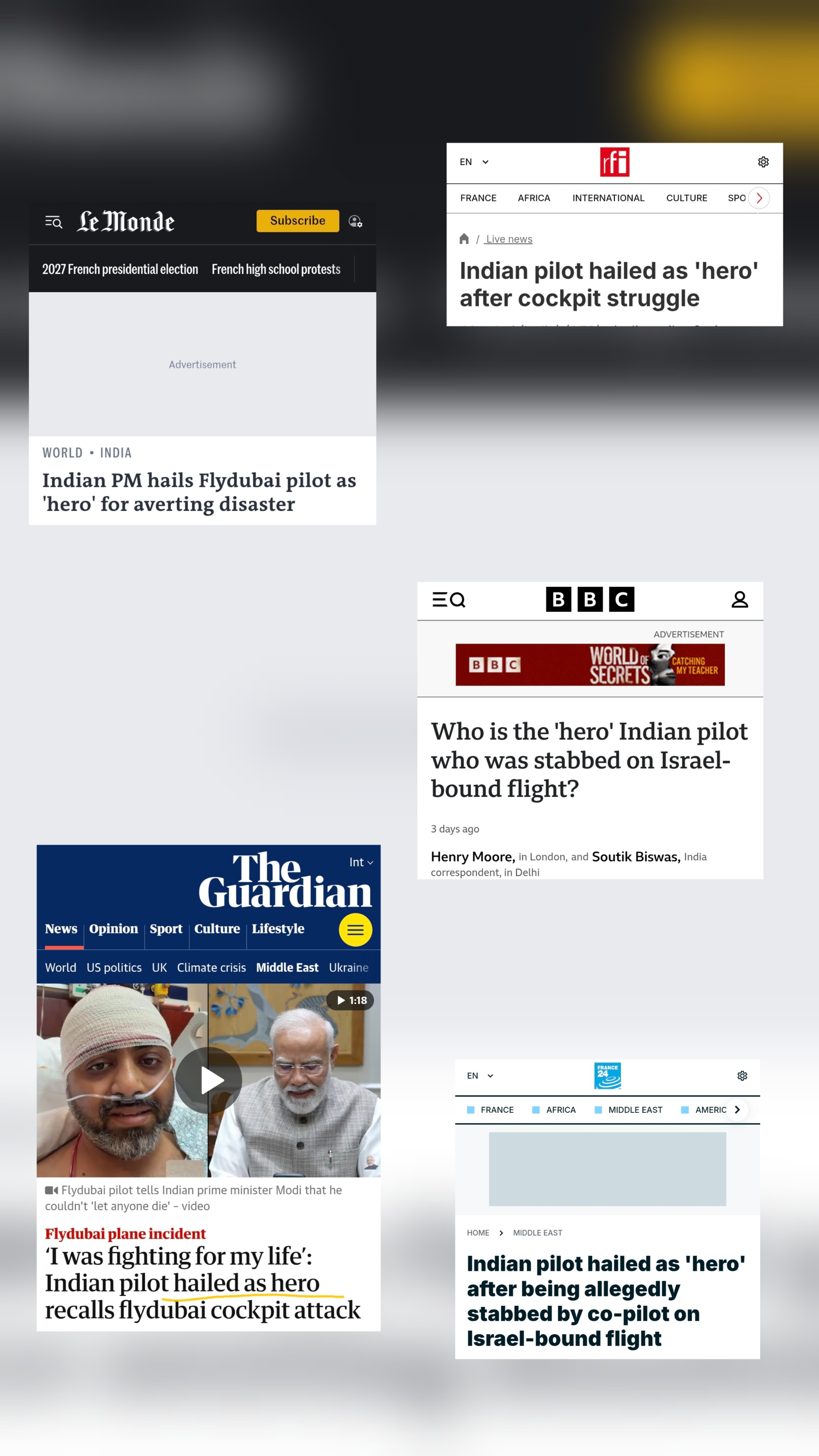
World leaders from New Delhi to Jerusalem immediately lauded the Indian captain's actions as extraordinary. Yet, as the story filtered through major Western newsrooms, readers began noticing a subtle but recurring typographical choice: the word hero was consistently placed in quotation marks.
Now, what began as a miraculous tale of aviation survival has morphed into a fierce debate over international media bias, narrative control, and how Western outlets report on the triumphs of individuals from the Global South.
The Quotation Mark Controversy
In the hours following the incident, headlines across European and North American outlets prominently featured phrases like Flydubai Pilot Hailed as "Hero" or Netanyahu Praises "Hero" Captain in Cockpit Attack.
From a strict journalistic standpoint, placing descriptive, subjective nouns in quotation marks is standard practice. It allows a publication to attribute the label to a specific source—in this case, Israeli Prime Minister Benjamin Netanyahu or Indian Prime Minister Narendra Modi—without the editorial board adopting it as an objective fact.
However, to thousands of vocal readers and media critics across Asia and the Middle East, this editorial detachment felt deeply inappropriate given the undeniable stakes of the event.
Critics argue that placing "hero" in quotes subtly undermines the absolute certainty of Machchhar’s bravery, framing a life-saving act of self-sacrifice as merely an alleged claim.
"When a pilot takes a knife to the body to keep an aircraft from being driven into the ground, heroism ceases to be subjective," noted one prominent media analyst on social media. "To hide behind the style guide in this instance feels evasive at best, and dismissive at worst."
A Shift in Focus
The typographical debate is compounded by what critics describe as a deliberate narrative pivot in Western broadcasts.
Initial reports detailed the visceral, desperate struggle of Captain Machchhar fighting for his life and the lives of the roughly 180 people on board. But as the news cycle progressed, several Western outlets heavily shifted their focus to the cabin. Extensive coverage was dedicated to the passengers and off-duty Israeli pilots who rushed the cockpit, subdued the attacker, and safely landed the diverted Boeing 737 in Saudi Arabia.
While the courage of the passengers and off-duty crew is undisputed, observers point out that their intervention was entirely dependent on Machchhar’s foundational act:
absorbing the initial attack, securing the flight controls, and physically unlocking the reinforced cockpit door while critically wounded. By minimizing this sequence of events, some critics argue, Western media effectively diluted the Indian captain's central role in the rescue.
Representation and the Global South
The discourse surrounding Flight FZ1073 has tapped into a long-standing friction regarding representation in legacy media. Audiences in the Global South have frequently expressed frustration over a perceived reluctance by Western outlets to grant unequivocal, standalone credit to non-Western professionals during global crises.
The framing of the Flydubai incident—characterized by the cautious use of "hero" and a diffused focus on the broader, predominantly Western passenger response—has reinforced these grievances. It leaves an impression that the media establishment is uncomfortable with a single Indian national holding the undivided spotlight in an international rescue.
Regardless of the typographical choices made in editorial boardrooms in London or New York, the consensus on the ground remains unbothered by style guides. For the 174 passengers who walked away from the tarmac in Saudi Arabia, Captain Smit Machchhar’s actions require no attribution, and his heroism requires no quotation marks.